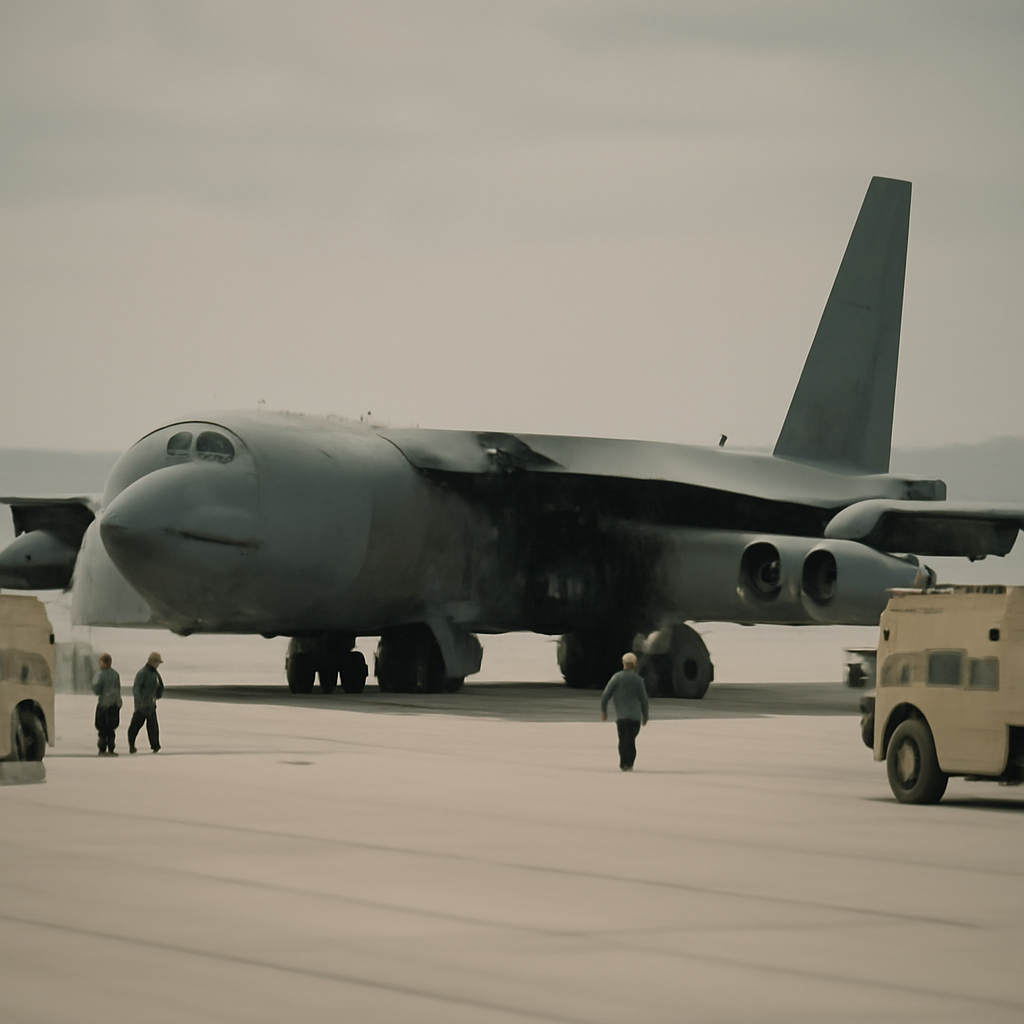
"A United States Air Force B-52 Stratofortress crashed shortly after takeoff on the Edwards airfield at 11:20 a.m. Emergency crews immediately responded to the scene and the situation is ongoing. More information will be provided as it becomes available." — Edwards Air Force Base, official Facebook and X pages.
Edwards’ immediate response and airfield status
Edwards Air Force Base confirmed the B-52 crash in a social-media statement and dispatched emergency crews to the scene. The airfield was closed and all inbound aircraft were diverted; the base suspended all non‑commercial visitor passes “until further notice to allow the installation to focus entirely on emergency response operations.” The 412th Test Wing later said the base would terminate operations the following day “mainly because of the runway itself,” and would stand down operations while emergency and investigative work proceeded.
Aircraft, mission, and crew composition
The 412th Test Wing’s press release identified the aircraft as an Air Force B-52 Stratofortress engaged in a routine test mission and said it was carrying eight people. The wing noted the mission had included personnel described as a “mixed crew of military, government civilians, and government contractors.” The number aboard—eight—is the maximum the aircraft can carry, including two jump seats; the release noted the usual crew size is five. Earlier reporting indicated the aircraft had been part of the Radar Modernization Program, and that this specific B-52 had been the first to receive an AN/APQ-188 active electronically-scanned array (AESA) radar, though a tail-number claim (061) was reported on a social feed and remained unconfirmed in the official releases.

This site is the portfolio.
OSINTSights runs on Cloudflare Workers, D1, R2, and Vectorize, with an AI pipeline on Hetzner ARM. Nubivance designed, built, and operates it. We do the same for clients.
See what we buildSurvivability, eyewitness video, and wreckage
Initial indications from the 412th Test Wing said the crash was not survivable. At a post-crash press conference, Air Force Col. James Hayes, Deputy Commander at the 412th Test Wing, said review of footage led investigators to deem the accident “an unrecoverable crash and unsurvivable,” and that officials proceeded with casualty notification when that assessment was made. Still images and video shared on social platforms showed a large fire and a column of black smoke visible from miles away; Fox News later shared a video showing a very large scorched area alongside one of Edwards’ runways with no readily discernible wreckage, which the reporting said pointed to a total loss of the aircraft.
Investigations and expected timeline
The crash is the subject of ongoing investigations. Col. Hayes told reporters that investigators had “no indication as to what the cause was of this” and cautioned that answers might not be known for “upwards of six months” after multiple investigations are completed. The 412th Test Wing’s public affairs office described the event as under investigation and said officials were working to account for all personnel.
Recent related incidents and historical context at Edwards
Although unrelated, reporting noted this B-52 crash occurred two days after a separate U.S. military aircraft accident: a U.S. Marine Corps F/A-18D Hornet assigned to Marine Fighter Attack Squadron 323 went down near Mount Rainier on June 13; both crew members in that jet ejected safely, and the jet sparked a wildfire after impact. The 412th Test Wing also observed that this B-52 mishap may represent the biggest loss from Edwards since a fatal crash of a B-50D bomber in 1951 that also carried eight people.
What this means for the Radar Modernization Program, Edwards operations, and investigators
- Radar Modernization Program managers and test program staff: The crash involved an aircraft participating in the Radar Modernization Program and reportedly equipped with an AN/APQ-188 AESA radar. Program officials will face immediate scrutiny and a likely pause or reallocation of test flights while multiple investigations proceed and safety reviews are undertaken.
- Edwards Air Force Base operations and airfield managers: The base has closed the airfield, diverted inbound traffic, suspended non‑commercial visits, and announced a temporary stand-down of operations the following day “mainly because of the runway itself,” indicating a near‑term operational impact on test schedules and logistics.
- Investigators and safety officials: Multiple investigations are expected to determine cause, and officials warned that definitive findings may not be available for “upwards of six months.” Investigators will need to reconcile video footage, wreckage analysis, crew manifests, and the mix of military, civilian government, and contractor personnel aboard.
This event leaves concrete facts in place — an 11:20 a.m. crash, a closed airfield, eight people aboard, and an ongoing, potentially lengthy investigative process — and a number of open but answerable questions for investigators about what failed and why during a routine test mission. The base and multiple official offices have signaled they will provide more information as it becomes available.