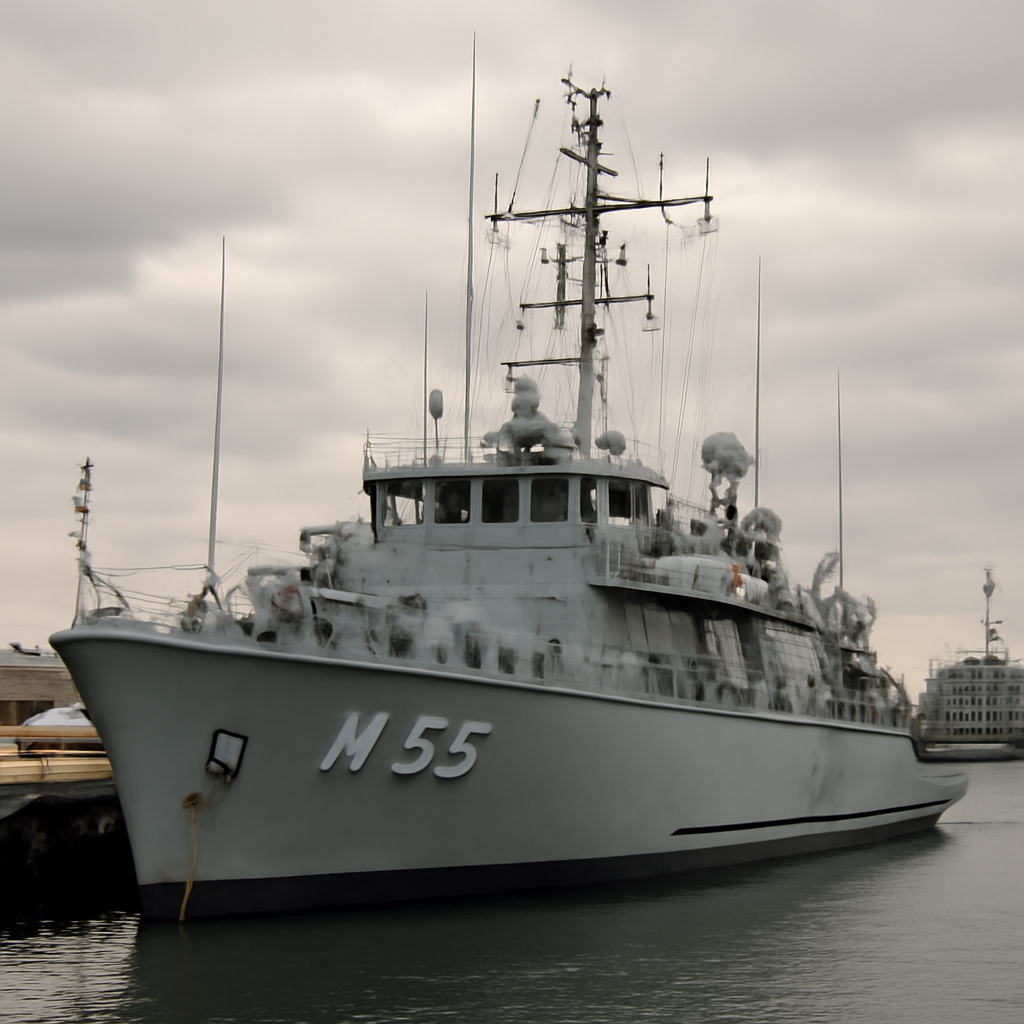
Australia has allowed its dedicated mine countermeasures force to decline from six Huon‑class minehunters to just two, leaving a capability once regarded as essential reduced to what the Royal Australian Navy called in March 2026 “minimally viable.”
Huon‑class minehunters: decline and legacy
The Royal Australian Navy began withdrawing Huon‑class minehunters from service in 2018 and now retains only two of the ageing vessels. The Huons were the successor to the Ton‑class minehunters after a 1989 Joint Committee on Foreign Affairs, Defence and Trade urged that mine countermeasures be treated as a core element of Australia’s maritime defence and developed as a coastal minehunter capability. Three decades later, the force that followed that recommendation has been allowed to run down while the vessels age toward retirement.
Project Sea 1905 cancelled — capability gap widened
Project Sea 1905, intended to replace the Huon class with a new approach that paired autonomous surface and underwater systems with crewed support ships, was cancelled in 2024. Sea 1905 was not a like‑for‑like replacement; it was designed to combine uncrewed systems that could search, detect, classify and identify mine‑like contacts with motherships able to transport, launch, recover and sustain them. With Sea 1905 abandoned, the RAN lacks those motherships and the sustainment architecture that would have extended the reach and endurance of uncrewed systems.

This site is the portfolio.
OSINTSights runs on Cloudflare Workers, D1, R2, and Vectorize, with an AI pipeline on Hetzner ARM. Nubivance designed, built, and operates it. We do the same for clients.
See what we buildSea 1778: experimental autonomy without a mothership
Under Project Sea 1778, the RAN introduced autonomous mine‑countermeasures systems experimentally. Those systems were meant to inform choices for Sea 1905. After Sea 1905’s cancellation, the experimental platforms acquired under Sea 1778 have become central to the RAN’s mine‑countermeasures posture. Without the planned crewed support ships, those autonomous systems have limited reach and a restricted ability to sustain extended operations — leaving the overall force reliant on two ageing minehunters and a small, deployable autonomous capability.
Strategic exposure: trade, fuel and the economic weapon of uncertainty
Mine warfare does not need to sink ships to be effective; ongoing tensions in the Strait of Hormuz demonstrate that the mere claim that mines have been laid creates uncertainty, raises insurance costs, delays shipping and inflicts economic harm. Australia is particularly exposed to this form of coercion: more than 99 percent of its international trade by volume moves by sea, and around 91 percent of its liquid fuel is imported. Mine countermeasures are therefore not a niche task confined to specialist crews — they are foundational to allowing submarines, destroyers and amphibious ships to deploy and for ports and maritime approaches to remain open during crises.
What this means for the RAN, policymakers, and insurers
- The Royal Australian Navy: With two Huon‑class ships and Sea 1778’s experimental systems, the RAN currently preserves specialist knowledge and provides a basic response, but described its capability as “minimally viable.” That posture leaves open the question — minimally viable for what scale and duration of operation? — and constrains the navy’s ability to clear or confirm wide maritime approaches and major ports.
- Policymakers and defence planners: The Australian National University’s National Security College, in an August analysis, identified mine countermeasures as a gap in the nation’s ability to protect critical seabed infrastructure and recommended maintaining the means to protect it. The cancellation of Sea 1905 and the drain on dedicated platforms create a policy choice: fund a rebuild of dedicated, sustained mine‑countermeasures capacity, accept higher risk to trade and infrastructure, or rely on broader autonomous undersea investments whose benefits may not yet be operationally mature.
- Insurers and commercial shippers: The record from other regions shows that perceived mine risk translates quickly into higher premiums, delays and economic disruption. Australia’s dependence on seaborne trade and imported fuel means commercial actors will remain sensitive to any reduction in credible mine‑clearing capacity.
Investments in wider autonomous undersea systems and converging functions — autonomous navigation, seabed mapping, sensing, post‑mission analysis and data processing — may eventually strengthen mine countermeasures as they overlap with hydrography, seabed surveillance and underwater infrastructure protection. But that convergence does not remove the immediate need to sustain a credible mine‑countermeasures force. Whether Australia is accepting too much risk in this area is a question that, according to the record here, demands closer scrutiny.