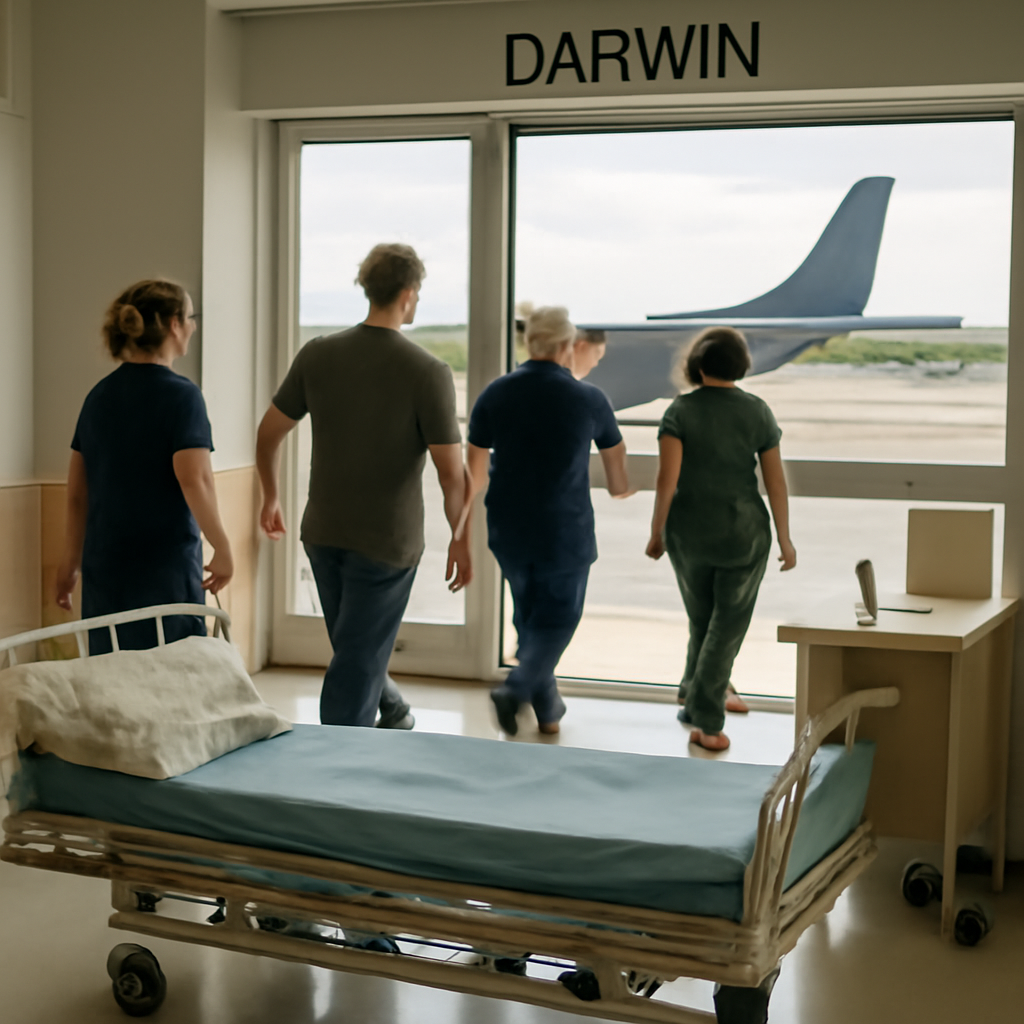
Casualty evacuations to Darwin from likely operating areas will probably take 10 to 14 hours, far longer than conventional trauma response standards.
Compressed timelines and an unsettled readiness clock
At the 2025 Shangri‑La Dialogue, US Defence Secretary Pete Hegseth highlighted the Indo‑Pacific as a priority theatre and emphasised the compressed timelines shaping allied planning. The source material reports that China is widely assessed to be aiming for readiness for military action against Taiwan by 2027. Those compressed timelines feed directly into logistics and medical planning: if regional forces face a high‑intensity contingency, the ability to absorb casualties and sustain operations will be determined as much by medical evacuation and hospital reception capacity as by combat power.
Darwin’s advantages — and the question of scale
A March paper co‑authored by the article’s author identified Darwin’s unique advantages: sovereign access, proximity to the northern approaches, and the National Critical Care and Trauma Response Centre (NCCTRC) acting as a bridge between civilian health capacity and defence medical requirements. The NCCTRC, alongside organisations such as CareFlight, NT Police and NT Health, demonstrated civil‑military integration during the 2023 US Osprey crash near the Tiwi Islands, when injured US marines were evacuated, stabilised at Royal Darwin Hospital and transferred onward.
That incident showed “what is possible,” the source notes — but it has not been matched by the agreements, capacity investments and exercising needed to scale that performance for a larger or prolonged contingency. Darwin is increasingly viewed as a sovereign medical gateway into Australia’s health system, yet it has not been tested against realistic demand.

Audit-ready is a season. It shouldn't be.
Evidence in spreadsheets, controls drifting between audits, frameworks multiplying on flat headcount. Nubivance runs continuous compliance on Rapid7 Cyber GRC - SOC 2, HIPAA, ISO 27001, PCI, CMMC.
End the scrambleThree implementation deficits: workforce, agreements, exercising
- Workforce and surge capacity. The Northern Territory health system already struggles with geographic isolation, shortages of specialist clinicians and limited infrastructure depth. Bridging the gap requires agreed workforce mobilisation arrangements, streamlined credentialling for allied medical personnel, and mechanisms to augment civilian health services through both the ADF and allied channels; without these, surge capacity largely exists on paper.
- Formal agreement architecture. The Australia–US Force Posture Initiative does not establish medical evacuation routing, hospital surge arrangements or provisions for pre‑positioned surgical and blood resupply capabilities. The result: one of the most reliable allied sovereign territories in the region lacks the legal and operational framework required to function as a designated medical hub. Formal medical annexes, evacuation agreements and clearly defined responsibilities are recommended priorities.
- Exercising against realistic demand. Effective mass‑casualty reception in Darwin requires coordination across Defence, civilian health systems, aeromedical evacuation providers, emergency management agencies and allied partners. These organisations do not routinely operate together at the scale a major regional contingency could demand; exercises should be designed around realistic casualty volumes and timelines rather than peacetime assumptions.
Distributed medical architecture and the Guam concentration risk
Darwin should be viewed as part of a distributed medical architecture. Guam remains critical to US force posture in the Indo‑Pacific, but the source points out that wargames have identified Guam as a concentration risk and a vulnerability at the start of a conflict. Distributed infrastructure does not replace forward hubs; it provides resilience when those hubs are degraded or inaccessible. Darwin’s value depends not only on geography and sovereignty but on its health, logistics and interagency systems functioning cohesively under stress.
What this means for Royal Darwin Hospital, the Australia–US Force Posture Initiative, and the NCCTRC
- Royal Darwin Hospital. The hospital needs scalable surge capacity and clear reception plans calibrated to casualty flows that may arrive after 10–14 hour evacuations; without these investments, continuity of care in a large contingency is at risk.
- Australia–US Force Posture Initiative. The initiative currently lacks medical evacuation routing, hospital surge arrangements and pre‑positioned surgical and blood resupply provisions — gaps that must be closed if Darwin is to serve as a designated allied medical hub.
- NCCTRC. The NCCTRC provides the institutional foundation for civil‑military medical integration; translating that foundation into a broader, networked system requires workforce mobilisation pathways, streamlined credentialling, and regular exercises calibrated to realistic contingencies.
The strategic logic for Darwin’s role is clear in the source material: sovereign access, proximity and an established trauma centre create an opportunity to buttress allied medical resilience in a contested northern approach. The unresolved problem is implementation. The recommended next steps—formal bilateral agreements with medical annexes, scalable surge capacity at Royal Darwin Hospital, pre‑positioned surgical and blood resupply capabilities, workforce mobilisation pathways, and a regular exercise program calibrated against realistic contingency scenarios—are concrete. The question left by the current record is whether those steps will be taken at the pace and scale the strategic environment demands.



