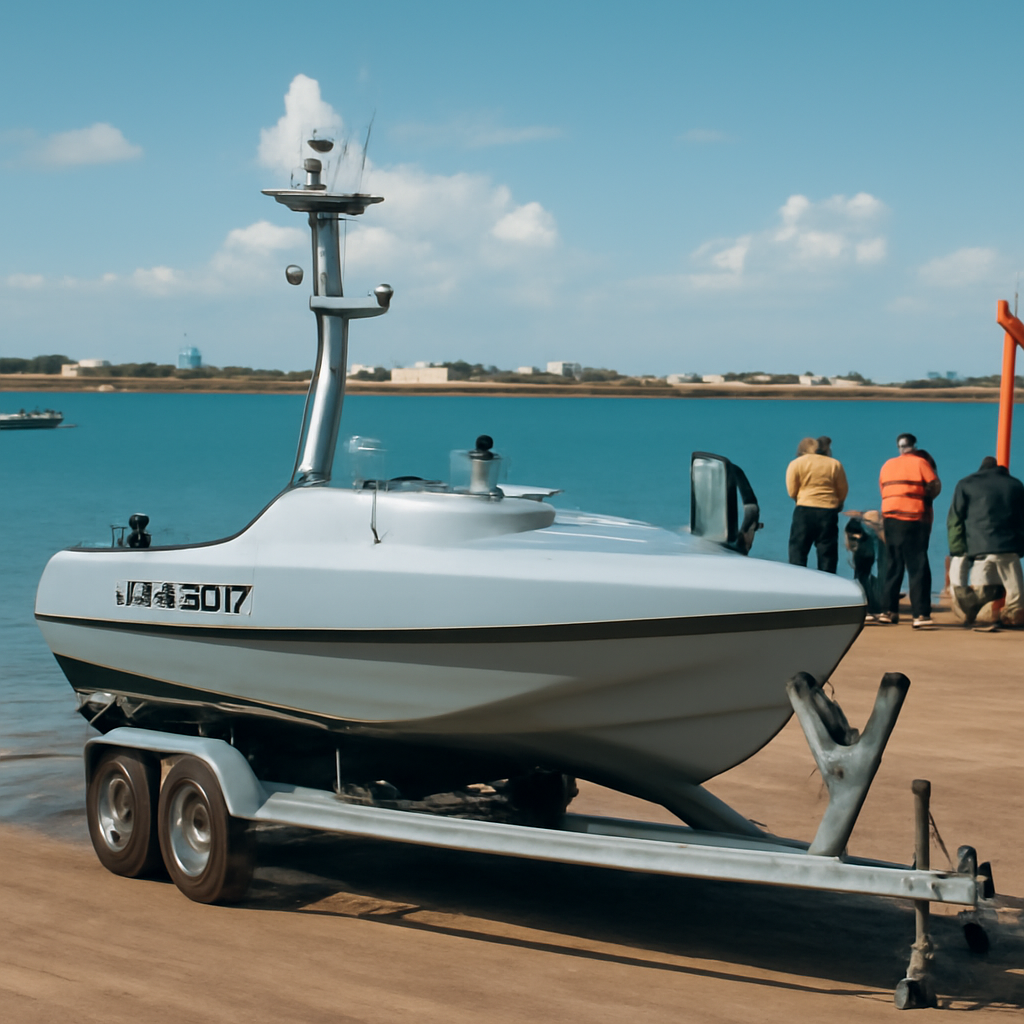
The Sea Archer uncrewed surface vessel can travel at up to 40 knots, has a range of 1,500 nautical miles (2,778 km) and carry around 900 kg of payload — a compact platform designed for speed, reach and mobility in Australia’s vast northern approaches.
Sea Archer: an Australian‑built USV
Leidos’s Sea Archer arrived in Darwin for trials and demonstrated a commercial approach to capability development: industry identifying a need and investing ahead of government requirements. At 11 metres long, Sea Archer is transportable in a standard 12‑metre‑long high‑cube shipping container and can be moved by road or sea. The design also allows strategic airlift by a Boeing C‑17 Globemaster; rotary‑wing sling‑loaded delivery is listed as a potential option into hard‑to‑reach locations but “hasn’t been tested or certified.”
The platform’s stated attributes — 40 knots (74 km/h) maximum speed, 1,500 nautical miles (2,778 km) range and roughly 900 kg payload — are intended to enable a set of four mission profiles the vendor proposes: strike; logistics resupply; intelligence, surveillance and reconnaissance (ISR); and electromagnetic warfare.
How Sea Archer fits into Australia’s uncrewed maritime ecosystem
Sea Archer was presented alongside existing Australian maritime uncrewed systems. The piece contrasts Sea Archer with Ocius’s Bluebottle, noting that Bluebottle provides persistent, low‑speed surveillance and “can remain at sea for months.” By contrast, Sea Archer emphasizes speed, payload and mobility: at 40 knots it is described as more than six times faster than Bluebottle, with greater payload and range.
That difference positions Sea Archer as complementary rather than substitutive: persistent slow surveillance for long‑dwell observation on one hand, and fast, reconfigurable effects and logistics on the other.

Audit-ready is a season. It shouldn't be.
Evidence in spreadsheets, controls drifting between audits, frameworks multiplying on flat headcount. Nubivance runs continuous compliance on Rapid7 Cyber GRC - SOC 2, HIPAA, ISO 27001, PCI, CMMC.
End the scramblePolicy context: Australia’s 2026 defence and industry strategies
The arrival of Sea Archer is framed against two 2026 documents. Australia’s 2026 National Defence Strategy is said to place greater emphasis on “self‑reliance, domestic industrial capability, resilience and closer collaboration with Australian industry.” The 2026 Defence Industry Development Strategy, the source notes, “puts industry at the centre of national defence and economic security,” including through “faster and more agile approaches to capability development and contracting.”
The Sea Archer example is used to illustrate an industrial model consistent with those documents: industry investing ahead of formal Defence requirements and offering commercially viable solutions the government can choose to use.
Operational use cases: Defence, the Australian Border Force and northern littoral tasks
The source links Sea Archer’s four proposed mission sets to the army’s emerging northern littoral capability and to broader maritime tasks. Sea Archer could be used to provide surveillance ahead of crewed forces, move supplies into areas where putting military personnel at risk is undesirable, carry electronic‑warfare payloads or, with appropriate integration, contribute to maritime strike.
Beyond Defence, the article points to peacetime constabulary needs. It highlights the scale of Australia’s maritime domain — stating that Australia’s Australian Fishing Zone covers more than 8 million square kilometres, while its Exclusive Economic Zone extends to just over 22 km from the coast — and stresses the difficulty of maintaining persistent presence across remote northern and north‑western waters.
An operational vignette in the piece notes that earlier this year at least two of the Australian Border Force’s eight Cape‑class patrol boats were undergoing maintenance “while there was an influx of foreign fishing vessels in Queensland waters.” In such scenarios, uncrewed capability is presented as a force multiplier that could supplement patrol boats by providing persistent surveillance, rapid repositioning and communications, freeing crewed vessels to conduct interception and boarding.
What this means for Defence, the Australian Border Force, and northern communities
- Defence: Sea Archer offers a way to augment the emerging littoral capability without immediately expanding the pool of crewed platforms or the demand on uniformed personnel; the article frames this as an opportunity to use scarce military personnel “where they add most value.”
- Australian Border Force (ABF): Uncrewed vessels could provide persistent surveillance and deterrence against illegal fishing or unlawful maritime arrivals, particularly during periods when crewed assets are limited by maintenance or sustainment cycles.
- Northern communities and other agencies: Commercially operated, Australian‑built USVs are presented as a means for agencies beyond Defence and ABF to access maritime surveillance or logistics without each agency having to acquire and sustain its own crewed fleet.
The article presents Sea Archer as an exemplar of “sovereign capability without waiting for a sovereign contract”: industry creating a production model designed to support manufacture across multiple Australian shipyards, “including two in Darwin,” and to scale without disrupting broader shipbuilding programs. It argues that the answer to monitoring the north may not be more government‑owned ships everywhere, but more Australian‑built capability, commercially operated and contractually available to government when and where it’s needed.
Whether Defence, the ABF and other agencies will adopt commercial operating models or integrate platforms such as Sea Archer into formal programs remains a policy and procurement decision. The practical question the facts leave open is straightforward: will governments choose to become the smarter customer the source advocates, and if so, how quickly will contracts and sustainment arrangements follow the industry bets already being placed?