"The time is right for Australia and the United Arab Emirates to deepen their defence relationship," the article argued — a concise judgement that both describes what is at stake and frames the policy choice facing Canberra and Abu Dhabi.
E-7A Wedgetail deployment and AIM-120 Amraam transfers
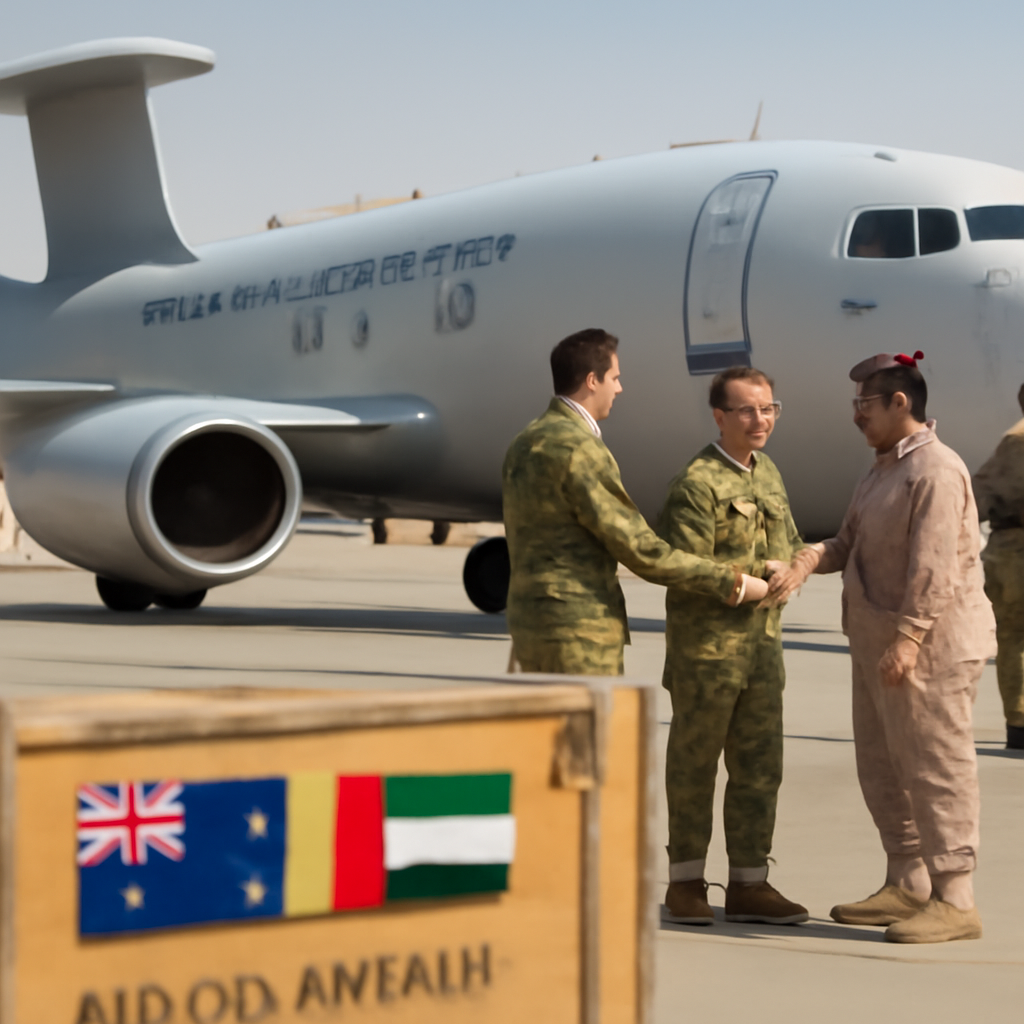
Since the Iran war began, Canberra has moved from rhetorical support to operational contribution. In March, Australia deployed an E-7A Wedgetail and roughly 85 personnel to provide airborne surveillance and battle management to Gulf air defences. Canberra also transferred AIM-120 Amraam missiles to replenish UAE stocks. The report describes these moves as among the most significant contributions Australia has made to a non-treaty partner in years, and as adding tangible operational substance to the relationship.
High-tempo diplomacy: Marles, Bin Zayed, and reciprocal visits
Momentum has been building with "the highest-tempo exchange of visits the two countries have ever shared." Defence Minister Richard Marles visited Abu Dhabi in May and met with UAE President Mohammed Bin Zayed. Soon after, UAE Minister of State for International Cooperation Reem Al Hashimy travelled to Canberra to meet Prime Minister Anthony Albanese. The visits followed and reinforced the operational steps noted above; the article frames them as evidence that Australia has shown the UAE it is a reliable partner.

This site is the portfolio.
OSINTSights runs on Cloudflare Workers, D1, R2, and Vectorize, with an AI pipeline on Hetzner ARM. Nubivance designed, built, and operates it. We do the same for clients.
See what we buildInstitutional foundations: 2008 treaty, Joint Defence Cooperation Committee, and the 2025 partnership
The two countries signed a defence cooperation treaty in 2008; by 2022 their Joint Defence Cooperation Committee had met 11 times. Out of Albanese’s visit to Abu Dhabi in September 2025 came a Comprehensive Strategic Partnership that provides a formal umbrella for cooperation, but the article stresses it remains "missing practical substance." The underlying legal framework exists, the piece argues, but must be used to create structured joint exercises, agreed information-sharing arrangements and a joint industrial mechanism.
Economic and industrial links: trade, the October 2025 FTA, and EDGE
Economic ties already give Canberra a direct stake. Two-way trade between Australia and the UAE totalled A$12.7 billion in 2024–25, and two-way investment stock reached A$23.7 billion. In October 2025 the countries signed a free trade agreement covering green energy, data centres, mining and food security — sectors the article identifies as central over the next decade. The UAE’s defence industry, anchored by advanced technology group EDGE, is described as maturing fast; the UAE is also characterised as having significant sovereign wealth and genuine ambitions to modernise its armed forces.
What this means for the Australian Defence Force, the UAE defence industry, and trade planners
- Australian Defence Force: The ADF already operates out of Al Minhad Air Base near Dubai — home to the headquarters for Joint Task Force 633 since 2003 — and Australian personnel were part of the recent operational deployment. The piece notes Iranian strikes hit Al Minhad in March, underlining the base’s vulnerability and the ADF’s direct stake in Gulf security and logistics access.
- UAE defence industry and planners: The UAE brings combat experience, sovereign funding and a fast-maturing industrial base centred on EDGE. The article says UAE entities will gain from links to technologies being driven by AUKUS investments — undersea systems, autonomous platforms and advanced sensors — capabilities the UAE cannot easily source elsewhere.
- Trade and investment planners: The FTA and existing two-way flows tie defence cooperation to economic resilience. The report points to Australia’s supply-chain exposure — including fuel and agricultural exports — and frames the FTA sectors (green energy, data centres, mining, food security) as opportunities to build shared strategic resilience.
Three practical steps to lock in momentum by the end of 2026
The article sets out a compact agenda to move from crisis-driven activity to durable partnership. First, establish a concrete program of joint exercises, logistics access provisions and a clear pathway to equipment interoperability under the 2008 defence cooperation treaty. Second, create a joint defence-industry working group focused on autonomous systems, surveillance and targeting technology, critical minerals and cybersecurity. Third, treat commitments on clean energy, AI infrastructure and critical minerals under the October 2025 FTA as opportunities for shared strategic resilience. These steps are presented as achievable, time-bound priorities that would convert recent goodwill into institutionalised cooperation.
The core question the reporting leaves on the table is practical: will Canberra and Abu Dhabi use the legal and diplomatic frameworks already in place to make interoperability, industrial cooperation and information sharing routine rather than episodic? The article closes on a warning and an exhortation — the UAE is not waiting for the world to stabilise, and Australia should not wait either.