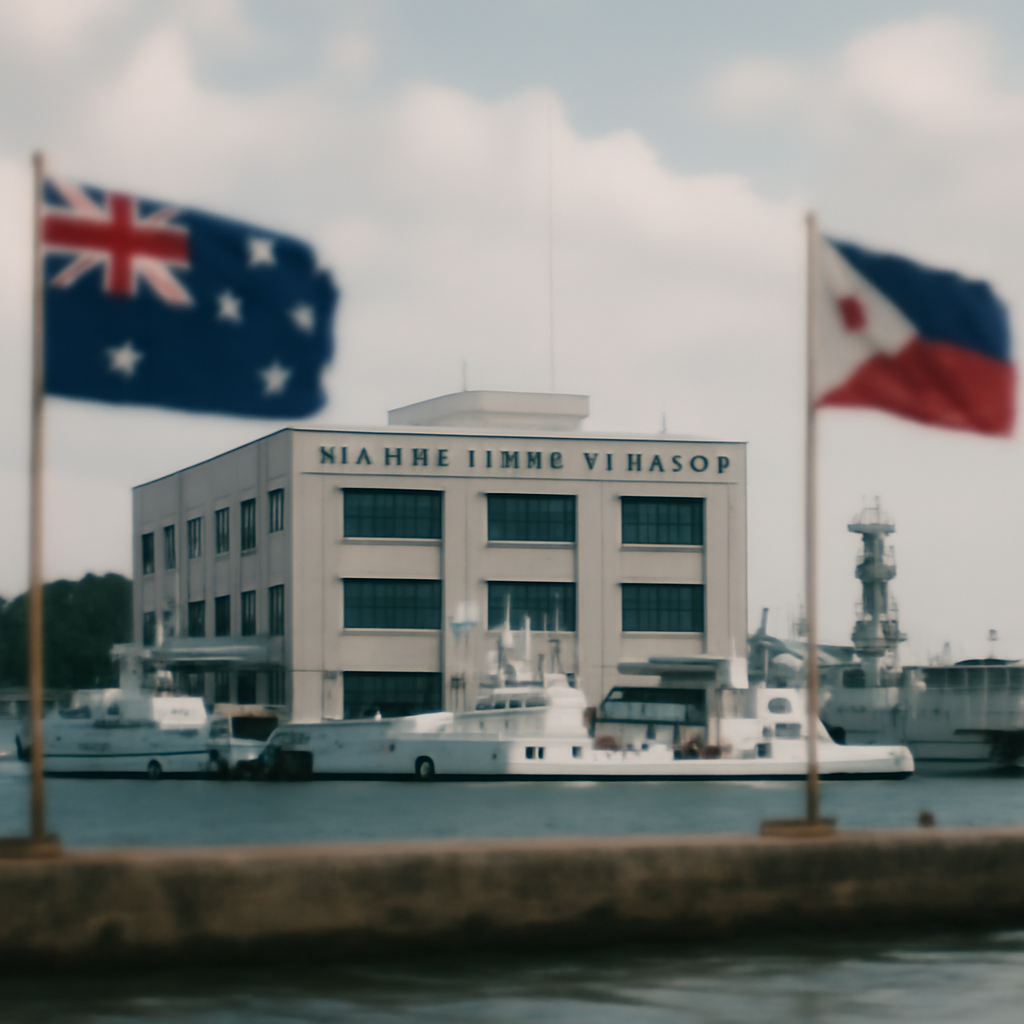
"destabilising and dangerous conduct," Foreign Minister Penny Wong said, naming China’s behaviour at the heart of a week of diplomacy in Manila.
Penny Wong’s message and the Manila interventions
At the ASEAN foreign ministers’ meeting in Manila, Foreign Minister Penny Wong placed Australian strategic messaging, funding and capabilities squarely behind the Philippines and the defence of international rules. Wong attended the Philippine Coast Guard headquarters on the sidelines of the meeting, publicly calling out China’s actions as “destabilising and dangerous conduct” in breach of the United Nations Convention on the Law of the Sea (UNCLOS). She also announced that Australia would provide the Philippine Coast Guard with “cutting-edge” American drone technology.
Wong met her Chinese counterpart, Foreign Minister Wang Yi, on the margins of the ASEAN Regional Forum meeting, raising concerns about the absence of safe and professional military conduct and stressing the importance of transparency. The bilateral exchange, conducted amid wider regional talks, reflected Canberra’s preference for engagement while insisting that stabilisation cannot be one-way.
The incident in the Philippines’ exclusive economic zone
The diplomatic intervention followed a violent maritime encounter. The day before the ASEAN meeting, China Coast Guard boats aggressively approached and rammed a Philippine Navy rubber boat in the Philippines’ exclusive economic zone. According to the account in this report, Chinese personnel then attacked Filipino navy personnel with wooden batons. Canberra and other partners framed the episode not as an isolated bilateral scuffle but as part of a pattern of coercive behaviour across the region.

Audit-ready is a season. It shouldn't be.
Evidence in spreadsheets, controls drifting between audits, frameworks multiplying on flat headcount. Nubivance runs continuous compliance on Rapid7 Cyber GRC - SOC 2, HIPAA, ISO 27001, PCI, CMMC.
End the scrambleAllied responses and the legal reference point
Several partners joined Australia in condemning the incident. The US ambassador to the Philippines provided a statement condemning China’s dangerous and escalatory actions; the EU Delegation in Manila expressed its deep concerns; and the British ambassador opposed escalatory action in the South China Sea and urged respect for international law. Earlier in July, 14 nations — “including the Five Eyes and Japan, the Baltics, Germany and Italy” — issued a joint statement reaffirming the decision “that there is no legal basis for China’s expansive maritime claims.” The EU issued a separate statement supporting international rules with somewhat weaker wording, while neither South Korea nor any member of ASEAN took part in the 14-nation statement.
The diplomatic chorus pointed to a concrete legal reference: this month marked the 10th anniversary of the Permanent Court of Arbitration in The Hague ruling under UNCLOS that found in favour of the Philippines and against China’s expansive claims in the South China Sea. That ruling, the article notes, “has ensured the world can point to an international ruling, not mere opinion, that China’s nine-dash line is a fiction.”
Australia’s Southeast Asian strategy: deterrence, resilience, and public attribution
Canberra frames its actions as part of a broader Southeast Asian strategy, complementary to its Pacific Step-Up. The approach, as described in this piece, is aimed at deterring China where possible and building regional resilience where necessary in the face of what it calls the inevitability of Beijing continuing to be aggressive. Australia and Japan are portrayed as accepting a heavier share of the burden to constrain China’s worst impulses and to empower smaller regional nations.
Public attribution features prominently in that toolkit. The article argues that naming coercive acts publicly undermines grey-zone tactics that rely on ambiguity and competing narratives. Attribution, the piece says, imposes reputational costs, reduces an adversary’s ability to exploit uncertainty and encourages coordinated responses from partners — serving legal, diplomatic and strategic purposes.
The account also notes a broader pattern of Chinese actions in the region, adding that this month included a test of a nuclear-capable submarine-launched missile that landed in the Pacific — a development offered as evidence that stabilisation efforts have not been reciprocated by Beijing.
What this means for the Philippines, ASEAN members, and Australia and Japan
- The Philippines: Canberra’s delivery of “cutting-edge” American drone technology and public diplomatic support are intended to strengthen maritime surveillance and the Philippines’ ability to document and respond to coercive encounters.
- ASEAN member states: Many continue to prefer hedging, prioritising strategic autonomy and constructive relations with both major powers; the article points out that this explains why several ASEAN states declined to join the 14-nation statement and why ASEAN communiques remain carefully crafted.
- Australia and Japan: The two democracies are described as taking on heavier roles to constrain Beijing and to back smaller claimants, while seeking to avoid unnecessary confrontation — a balancing act of deterrence, support and diplomacy.
Australia’s stronger language in Manila, the piece concludes, is not a renunciation of ASEAN centrality nor a wanton pursuit of confrontation. Rather, Canberra frames public condemnation and capability-sharing as necessary tools to preserve international rules, harden the region against coercion, and reduce the chance that aggressive behaviour will escalate into armed conflict. The remaining question, implicit in the region’s response, is whether sustained public attribution and partner support will be sufficient over time to change conduct that Australian officials describe as destabilising.