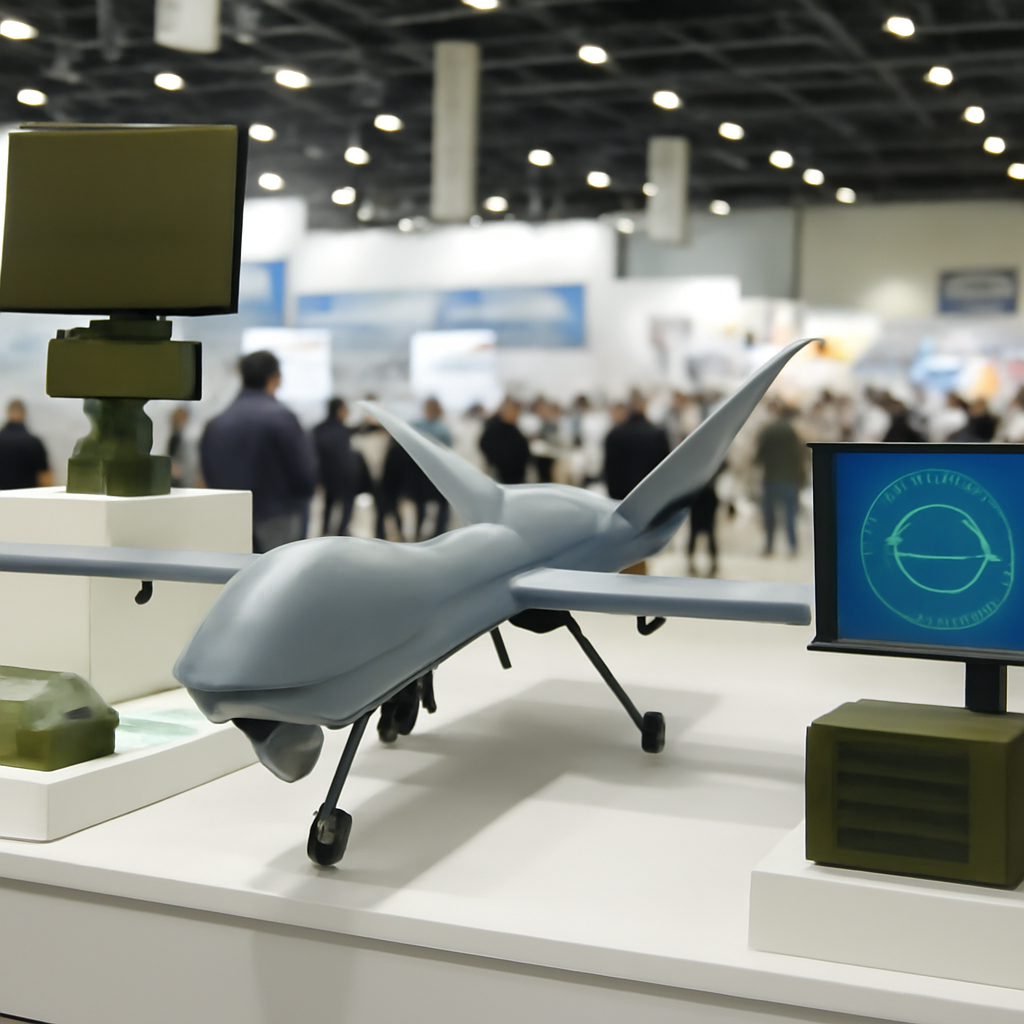
At the Farnborough International Airshow, ASELSAN is demonstrating a “complete sensor-to-shooter chain” for uncrewed aviation — a deliberate shift of emphasis from individual airframes to the integrated mission systems they carry.
Fulmar and MURAD: radars adapted for the uncrewed domain
ASELSAN placed radar technologies at the center of its airborne portfolio at Farnborough, showing the FULMAR 200 and FULMAR 500 alongside the MURAD AESA radar family. According to the company’s exhibit, these systems deliver all-weather surveillance, high-resolution imaging and multi-target tracking capabilities. The material on display highlights the integration of MURAD on advanced Turkish uncrewed platforms as an example of technologies once associated with fighter aircraft being adapted for the uncrewed domain.
ASELFLIR, TOYGUN, KARAT and ASELPOD: electro-optical and mission avionics
Complementing radar, ASELSAN’s electro-optical payloads shown at Farnborough include the ASELFLIR 410, ASELFLIR 510 and ASELFLIR 600 families, described as providing advanced surveillance, reconnaissance, targeting and tracking across a range of UAV classes. The company also presented avionics and mission systems such as the TOYGUN Electro-Optical Sensor System and the KARAT Infrared Search and Tracking System, which are positioned to enhance navigation, situational awareness and mission effectiveness for both crewed and uncrewed platforms. ASELPOD — ASELSAN’s combat-proven targeting pod widely used on fighter aircraft — was included to demonstrate the company’s experience in airborne sensing across multiple platform categories.

Audit-ready is a season. It shouldn't be.
Evidence in spreadsheets, controls drifting between audits, frameworks multiplying on flat headcount. Nubivance runs continuous compliance on Rapid7 Cyber GRC - SOC 2, HIPAA, ISO 27001, PCI, CMMC.
End the scrambleANTIDOT electronic warfare pods: sensing and shaping the electromagnetic battlespace
ASELSAN displayed electronic warfare (EW) payloads intended to expand what uncrewed platforms can do beyond observation. The ANTIDOT 2EA Electronic Warfare Pod and the ANTIDOT 2ES Electronic Support Pod are described as tools to detect, identify and influence the electromagnetic environment. ASELSAN frames these systems as enabling both electronic support and electronic attack missions, allowing uncrewed platforms “not only to observe the battlefield but also to shape it by suppressing, disrupting or degrading hostile systems.”
TOLUN, LGK-82, KGK-84 and GÖZDE: a growing family of precision-guided munitions
At Farnborough, ASELSAN presented the TOLUN family — TOLUN-L, TOLUN-P and TOLUN-F — alongside LGK-82, KGK-84 and GÖZDE precision-guided munitions. The company describes these as providing flexible and cost-effective precision-strike capabilities against both stationary and moving targets while maintaining stand-off engagement ranges. Paired with ASELSAN’s sensor and targeting solutions, the munitions are presented as elements of an end-to-end “sensor-to-shooter chain” that shortens engagement timelines and increases mission effectiveness.
What this means for platform manufacturers, procurement leaders, and operators
- Platform manufacturers: ASELSAN highlights “close cooperation with platform manufacturers” to optimize payload performance and to support future-generation autonomous systems currently under development, signaling continued integration efforts between payload and airframe design.
- Procurement leaders: The company’s presentation of modular sensors, EW pods and a family of munitions frames these items as interoperable options that can be paired to meet different operational requirements, with the company positioning them as flexible and cost-effective components of strike-capable uncrewed systems.
- Operators: ASELSAN’s material emphasizes a common operational architecture that combines sensors, electronic warfare, avionics and munitions — an approach the company says will enable operators to detect faster, decide faster and act more effectively across increasingly contested environments.
ASELSAN’s Farnborough exhibit makes a clear argument: as armed forces prioritize autonomy, endurance and decision superiority, the tactical value of UAVs will be judged less by airframe alone and more by the coherence of the mission system carried aboard. The company’s portfolio — radars, electro-optical suites, EW pods and precision munitions — is presented as components of a unified operational architecture intended to shorten the sensor-to-shooter cycle and expand what uncrewed platforms can accomplish.
For those tracking the evolution of uncrewed capabilities, the question ASELSAN poses is straightforward: in contested environments, will integrated payload ecosystems become the principal driver of operational effectiveness? The systems shown at Farnborough indicate the company expects the answer to be yes.
Original story: https://breakingdefense.com/2026/07/aselsan-showcases-integrated-uav-payload-ecosystem-at-farnborough/