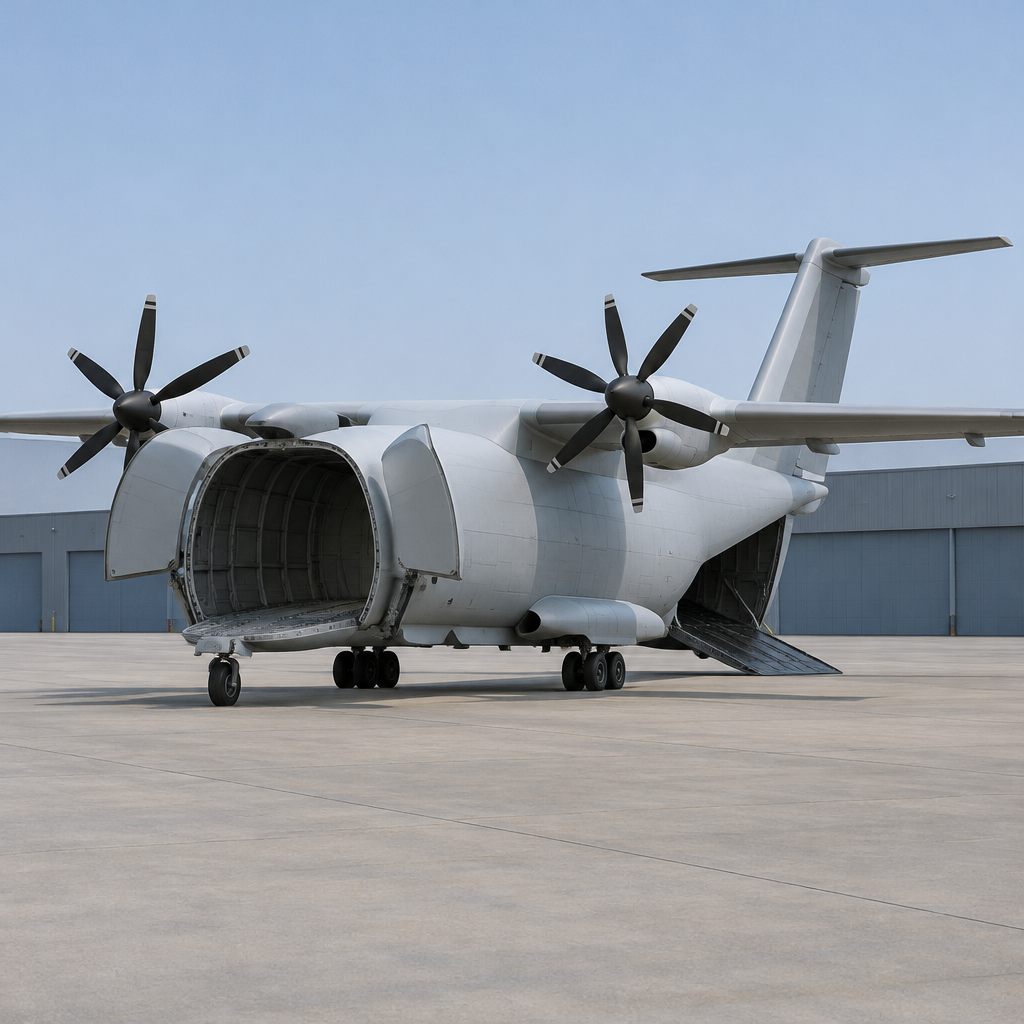
"Delivery of the MV-75 for testing will not occur by the end of 2026," a spokesperson for the Army Acquisition, Logistics and Technology (ASA(ALT)) office told Breaking Defense on Nov. 20.
ASA(ALT) confirms the missed delivery and program pacing
The Army’s acquisition office said the service will miss its goal of receiving the first MV-75 tiltrotor long-range assault aircraft for testing by the end of 2026. The statement framed the slip as the product of deliberate efforts and measurable progress, and asserted the program remains "on a path to complete development and testing in approximately half the time of comparable historical programs."
Earlier this year then‑Army Chief Gen. Randy George had said the service expected to accept an airframe for testing by the end of 2026. The ASA(ALT) spokesperson told Breaking Defense the Army has not yet determined a new date for first aircraft delivery and is working with the prime contractor to produce a revised, resource‑loaded integrated schedule and schedule risk analysis to set achievable milestones.
Funding shortfall, reprogramming, and Textron disclosures
Textron — Bell’s parent company — disclosed in a quarterly filing that the Army had spent nearly all of its available fiscal 2026 funding for the MV-75 by July, prompting a funding shortfall that affected program execution. Textron said the company continued work while reducing spending to manage that gap.
In July the Army requested $350 million to support Bell’s work building and testing eight prototype tiltrotors; Congress approved that reprogramming request during the third quarter. Textron’s CEO Lisa Atherton told investors in October that about $300 million was committed to the program in contract changes to cover costs the company and its suppliers had already incurred.

Audit-ready is a season. It shouldn't be.
Evidence in spreadsheets, controls drifting between audits, frameworks multiplying on flat headcount. Nubivance runs continuous compliance on Rapid7 Cyber GRC - SOC 2, HIPAA, ISO 27001, PCI, CMMC.
End the scrambleBell’s actions and a pause in communications
According to the ASA(ALT) spokesperson, Bell "chose to continue certain activities at its own risk without additional funding." The company and the Army said communications between them halted during the funding gap and did not resume until Sept. 28, when the service received the reprogrammed funds. Normal contract execution and communications resumed after that date.
The Army and Bell are now assessing how the funding gap affected the planned schedule. The ASA(ALT) office said the focus "is on disciplined execution with a risk‑informed path ahead that fits within the available budget."
Fiscal 2027 uncertainty and the timing of LRIP — CFO David Rosenberg
The Army requested more than $2 billion for the MV-75 program in fiscal 2027, all classified as discretionary spending. That request, the ASA(ALT) spokesperson acknowledged, could complicate the program’s timeline if approval is delayed.
David Rosenberg, the company CFO, told investors in October that a continuing resolution at the start of the fiscal year could push the timing of the low‑rate initial production (LRIP) award. "With the start of the fiscal year in a [continuing resolution], we’d expect a possible push in the timing of the LRIP award. Previously, we were thinking Q4 into Q1 of next year," Rosenberg said.
What this means for Army aviators, Bell, and Congress
- Army aviators: The service says the MV-75 remains a priority and is intended to extend the distance over which commanders can deliver, reinforce, and reposition assault forces; however, they will not receive the aircraft for testing by the previously expected end‑of‑year date and must await the outcome of the updated schedule and testing milestones.
- Bell / Textron: The company absorbed near‑term costs and continued limited work "at its own risk" during the funding gap, and must now align its production and test activities to a resource‑loaded integrated schedule once the Army and Bell complete their schedule and risk analysis.
- Congress and budget planners: The program’s near‑term trajectory depends on the approved fiscal 2027 funding. The previously requested $2 billion for FY27 and any delays in discretionary appropriations could shift the LRIP award timing and other contract milestones.
Senior Pentagon and program office voices remain publicly committed: Army Undersecretary Michael Obadal called the aircraft a "priority" and described delivery to aviators as "the culmination of one of the biggest Army acquisitions," while earlier remarks from Maj. Gen. Clair Gill emphasized the program's constrained reality — "It’s going to happen when it’s going to happen" — and a reluctance to commit to firm dates without funding certainty.
The immediate, concrete next steps are procedural: the Army and Bell must complete the updated, resource‑loaded integrated schedule and a schedule risk analysis, and Congress must complete appropriations for FY27 to avoid further slips into LRIP timing. Until those elements are resolved, the program’s key dates — the first aircraft delivery for testing and the LRIP award — remain undetermined.
Source: Breaking Defense, Nov. 20, 2026