Jason Levin and the F-35 formation flights
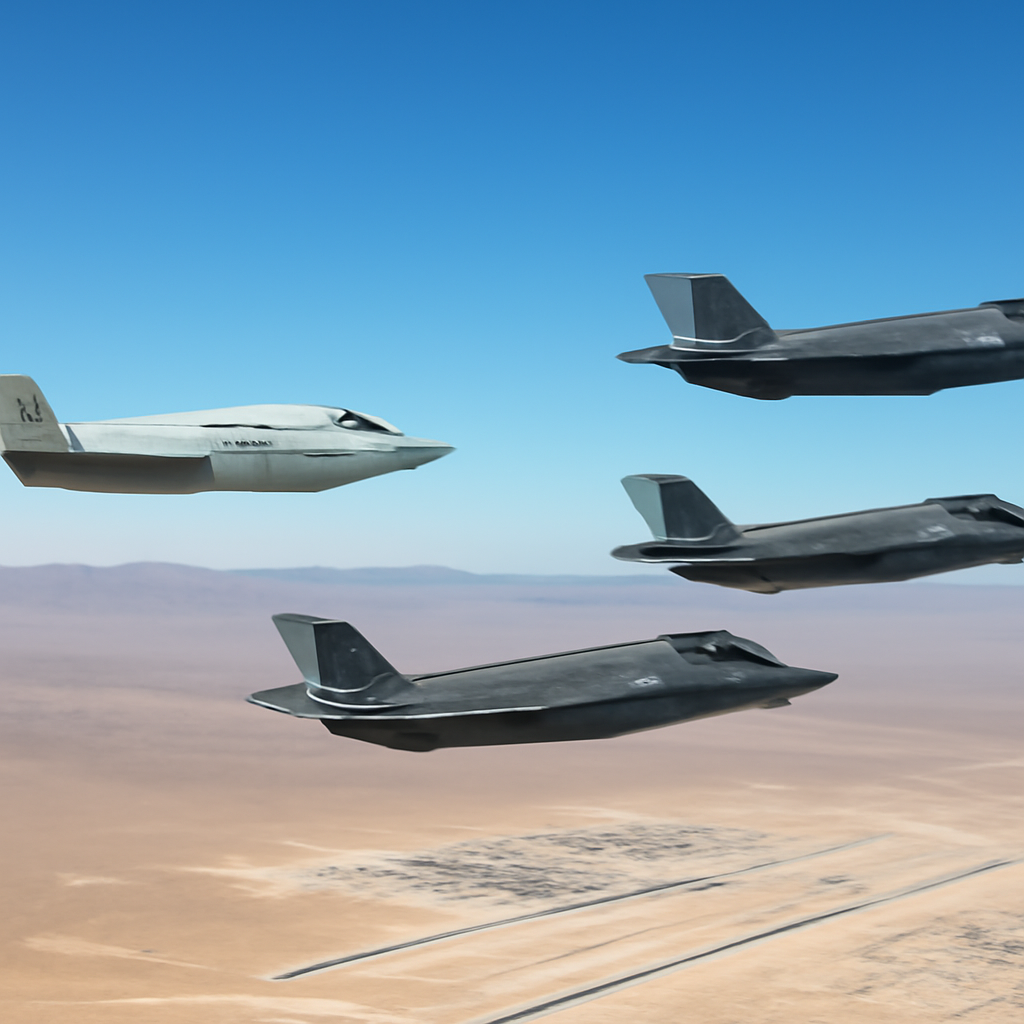
Levin and Aaron Simpson, vice president for Strategy for Air Dominance and Strike, disclosed that a YFQ‑44A Fury flew alongside F‑35s during a July exercise with the U.S. Air Force’s Experimental Operations Unit (EOU) at Creech Air Force Base, Nevada. Levin was explicit that those flights demonstrated formation operations but did not yet include control of the Fury from a crewed fighter: “But they’re not controlling it from the crewed fighter yet. Not yet.”
July Creech exercise with the Experimental Operations Unit
Anduril said the July testing advanced a progression that began with an April exercise at Edwards Air Force Base. At Edwards, Air Force personnel were trained to operate the aircraft and launched and recovered Fury using Anduril’s compact Menace‑T setup — described as a pair of ruggedized cases and a laptop rather than a conventional ground‑control station. By the July event at Creech, the EOU had reduced manpower and infrastructure further: a single EOU operator could launch and recover the aircraft after hours of training, while other Air Force personnel independently operated Fury’s Mission Autonomy system. Anduril has since delivered a Fury to the EOU at Creech, making it the first CCA permanently assigned to that unit; the service is flying the aircraft multiple times a day with a “very limited” Anduril presence, the company said.

This site is the portfolio.
OSINTSights runs on Cloudflare Workers, D1, R2, and Vectorize, with an AI pipeline on Hetzner ARM. Nubivance designed, built, and operates it. We do the same for clients.
See what we buildMission Autonomy, Lattice, and 'quarterback integration'
During the July events, Fury operated under Anduril’s Mission Autonomy software and ingested live sensor data while sharing airspace with crewed fighters, other CCAs and additional aircraft. Anduril described a “crawl, run, build‑up” approach toward manned‑unmanned teaming and said it has already begun work on what it calls “quarterback integration” — the ability for a crewed aircraft to direct or task autonomous aircraft. That work has been exercised in hardware‑in‑the‑loop and software‑in‑the‑loop environments and on the Fury itself. Levin said “most of those events will be coming up here in a matter of weeks or months,” and when asked whether they would involve live flying he replied, “Yes.”
Weapons integration and a live end‑to‑end kill chain
Anduril described a July weapons demonstration it characterized as a complete end‑to‑end kill chain rather than a captive‑carry or basic weapons‑release test. In that event, Fury launched from Edwards with a single operator, received an externally generated track over a beyond‑line‑of‑sight connection, ingested that track into Anduril’s Lattice AI‑infused autonomy software, and was tasked by the operator to engage. Fury then launched an AIM‑120 AMRAAM and guided the weapon to the target, a sequence Anduril framed as demonstrating offboard targeting, mission systems processing, operator tasking, and a live air‑to‑air engagement.
On payloads, the production FQ‑44 is being designed with four external hardpoints to carry four AIM‑120 AMRAAMs for the Air Force’s primary air‑to‑air mission set; the demonstration aircraft can currently carry two. Anduril said it is conducting integration and fit checks for a broader portfolio — 500‑pound guided bombs, Small Diameter Bombs, low‑cost cruise missiles including its Barracuda 500, other air‑to‑air weapons, rocket pods and targeting pods — while stressing those are integration and engineering efforts rather than claims of completed flight tests.
Assembly, planned production, pricing, and operational concepts
Anduril said assembly of Fury airframes has begun at its Arsenal facility, with production aircraft expected to start coming off the line early next year. The company built the facility and supply chain around a potential production capacity of 150 aircraft per year, a planning figure rather than an existing Air Force order. Anduril said it had advanced procurement of long‑lead items and worked with Tier‑1, ‑2 and ‑3 suppliers to support that rate while examining additional production lines. The company described the production line as designed for rapid reconfiguration, allowing capacity to be shifted between products in weeks rather than months or years.
On cost, Anduril said the Fury’s unit price is “well below $20 million” at the quantities currently contemplated, while noting current Air Force pricing is based on a substantially lower annual buy than the 150‑per‑year planning capacity. The broader Air Force objective, the company noted, is a CCA force much larger than initial buys: the service is aiming to have at least 500 CCAs in service by 2032, a tally likely to include later increments.
What this means for the Air Force EOU, technologists, and procurement leaders
- Air Force EOU: The EOU moved from supervised flights to operating Fury multiple times a day with limited Anduril presence; the unit will watch upcoming live quarterback integration events and continue refining launch/recovery and disaggregated operating procedures.
- Technologists and autonomy teams: Engineers will be focused on human‑machine interfaces (Anduril cited tablet‑based control as a likely first step), sensor fusion, track discrimination and the software‑in‑the‑loop and hardware‑in‑the‑loop work required before transferring authority to crewed platforms.
- Procurement leaders: With an Arsenal facility designed around 150 aircraft per year and early delivery of a permanent Fury to the EOU, acquisition planners will weigh production capacity, long‑lead procurement and unit cost assumptions as service targets move toward larger CCA fleets.
Anduril’s public account leaves the next major milestone clearly defined: move from formation flying and autonomous operation toward an F‑35 (or other crewed platform) actively commanding Fury in live flight. Levin’s timeline — hardware and software events “in a matter of weeks or months” and live quarterback flights to follow — makes that milestone the immediate technical and operational checkpoint for both the company and the Air Force.