"Every month waiting for the promised extension makes rebuilding slower, costlier, and closer to infeasible," Paul "Gu$" Garcia wrote, summing the central dilemma facing the A-10 community.
The Air Force's 2030 extension and the fiscal 2027 budget
The Air Force announced it would keep the A-10 flying through 2030, but its fiscal 2027 budget undermines that pledge. The budget funds zero dollars of A-10 modernization, cuts depot maintenance below the service’s own stated requirement, and applies "sunset" policy and institutional resistance tied to an “upcoming divestment.” In short, the headline extension exists; the financial and institutional support to preserve combat power does not.
Combat employment: Strait of Hormuz, Sandy recovery, and Pacific experiments
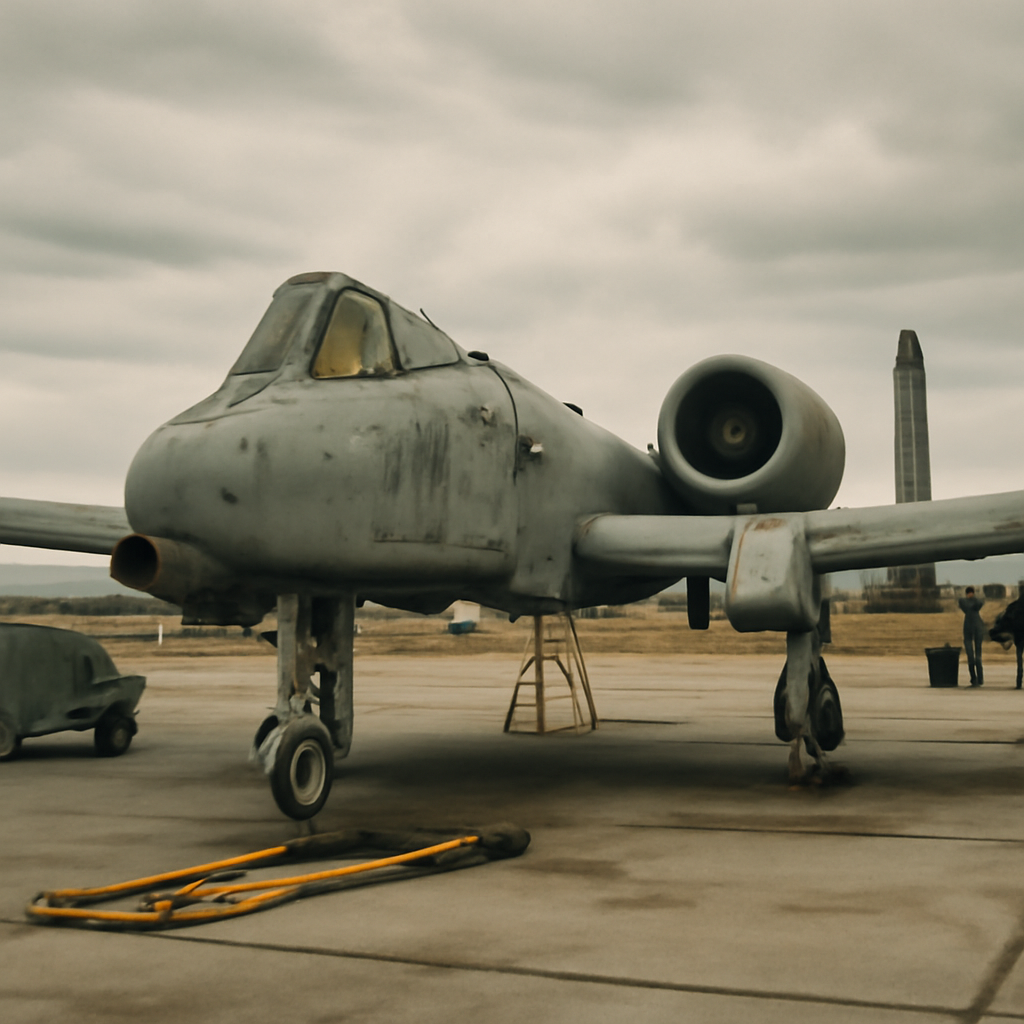
Operational demand drove the reversal. This September the A-10 was scheduled to make its final flight; instead the jet deployed again, supporting combat operations over the Strait of Hormuz where it struck Iranian fast-attack craft and maritime threats. The A-10 also served as the “Sandy” escort that recovered two downed F-15E airmen from inside Iran. Simultaneously, the platform has sustained operations in both Europe and the Middle East and supported Air Force strategy in the Pacific by developing distributed combat employment, maritime strike, and advanced weapons integration.
The A-10 community has integrated new capabilities rapidly, fielding AGR-20 APKWS, Small Diameter Bomb, ADM-160 MALD employment, beyond-line-of-sight communications, maritime strike weapons, and network-enabled command and control—often moving from test to combat in weeks. One example cited: the A-10 integrated a new refueling probe that was tested and then in combat in a matter of weeks.

Audit-ready is a season. It shouldn't be.
Evidence in spreadsheets, controls drifting between audits, frameworks multiplying on flat headcount. Nubivance runs continuous compliance on Rapid7 Cyber GRC - SOC 2, HIPAA, ISO 27001, PCI, CMMC.
End the scrambleInstitutional collapse: training, depot, weapons school, and operational test
Combat capability is not the airframe alone; it resides in maintainers, instructor pilots, operational test teams, weapons officers, logistics pipelines, and institutional continuity. Those elements are at risk of rapid erosion. The A-10 fleet numbered more than 280 aircraft a few years ago, and 162 at the start of fiscal 2026; it is set to fall to 54 next year and to just 36 by 2030. The Air National Guard’s A-10 force—47 aircraft as recently as last year—goes to zero, its flying hours swapped for a new cyber mission. Of the “three squadrons to 2030” the Chief of Staff promised, the active-duty force shrinks to a single squadron of 17 jets with no spares behind it.
Training closures compound the risk. The formal A-10 training unit at Davis-Monthan, the 357th Fighter Squadron—the schoolhouse home to the Sandy qualification—graduated its last class in April 2026 and is set to inactivate this year. The Air Force has confirmed there is no transition underway to move the Sandy mission to any other airframe, and no successor qualification program is in development. By the end of this year the A-10 community faces being without depot support, without a training pipeline, without weapons-school instruction, and without operational-test capacity.
Historical testing underlines how perishable this expertise is: a 2018–2019 Pentagon flyoff that compared the F-35 to the A-10 for close air support, FAC-(A), and CSAR required F-35 crews to be staffed with former A-10 pilots; the report showed mission performance depended on the aircrew, not only the airframe.
Financial investments: $2.1 billion in re-winging and budgetary friction
The Air Force has already invested heavily to extend the A-10’s structural life: roughly $1.1 billion to re-wing 173 aircraft (completed in 2019) and a follow-on contract worth up to $999 million to put new wings on the remaining 109—for a total of about $2.1 billion to extend the fleet into the late 2030s. Yet those investments faced Air Force resistance: the service repeatedly placed A-10 funding on its “unfunded requirements” list rather than the base budget, and in 2021 the Air Force spent just $15.6 million of $100 million Congress had appropriated to sustain the fleet into the 2030s. Allowing the enterprise behind those re-winged jets to collapse would forfeit taxpayer and congressional investment while leaving operational demand unmet.
Retiring the A-10 does not erase operational requirements for CSAR escort, permissive strike, armed reconnaissance, and distributed operations; those missions and their costs will migrate to higher-cost aircraft, increase flight hours and maintenance burdens elsewhere, and inflate schoolhouse demand across other communities.
How the Air Force, Congress, and the A-10 community are affected
- The Air Force: must choose whether the 2030 extension is an operational commitment or a paper promise—restoring protected funding for depot maintenance, training, operational-test, and maintainer retention is essential if meaningful capability is to survive.
- Congress: has previously appropriated funds and repeatedly acted to preserve the fleet against service resistance; persistent budgetary mismatch means congressional investments risk being written off unless the service funds the enterprise to match its stated intent.
- The A-10 community: faces inactivation of the 357th Fighter Squadron, loss of the Sandy qualification pipeline, and a rapid exodus of maintainers and instructors—once those personnel and institutional processes dissolve, rebuilding capability will be slower and costlier, if not impossible.
The Air Force has announced the A-10 will fly to 2030. The record in the budget and the pending inactivation of the schoolhouse makes this a deadline more binding on calendars than capabilities. Unless the service pairs the extension with the depot support, training, testing, and funding already paid for through earlier re-winging programs, the A-10 risks becoming a preserved airframe without the combat system that made it valuable.