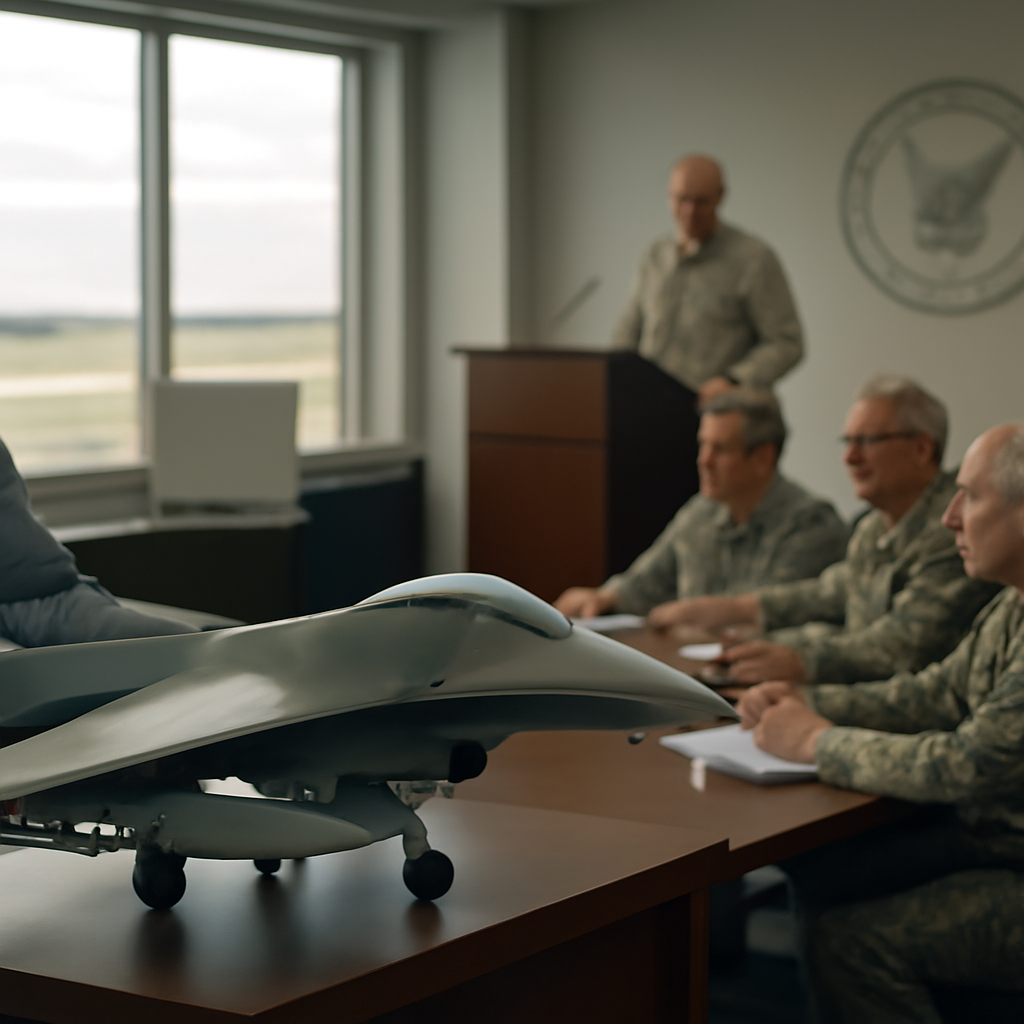
“We are looking at the long term, and we’re setting a chart to get there,” Air Force Lt. Gen. David Tabor told reporters, as the service told Congress it expects to need 1,509 combat‑ready fighter jets by 2035 to meet a “moderate risk” operational profile.
Moderate‑risk and low‑risk projections: 1,509 versus 1,723 aircraft
The Air Force’s congressionally mandated fighter force‑structure report, dated August 2026, lays out two headline figures: 1,509 combat‑ready aircraft to meet a moderate‑risk posture and 1,723 to achieve a low‑risk posture by 2035. The report’s low‑risk number (1,723) is notably higher than last year’s comparable prediction of 1,558, a jump the report describes as the product of refreshed analysis covering fiscal year 2026.
Tabor said officials “generally don’t plan to low risk,” making the moderate‑risk figure the most relevant planning target. He also cautioned that exact figures are “debatable” and subject to continual analytic refreshes, and that last year’s report did not include a medium‑risk projection for direct year‑to‑year comparison.
Counting combat capability: CC TAI versus PMAI
The Air Force makes a parallel case in the report for changing how fighter inventories are counted. The service favors a Combat Coded Total Aircraft Inventory (CC TAI) metric that adds backup and attrition‑reserve aircraft to the Primary Mission Aircraft Inventory (PMAI). The Air Force argues CC TAI “is fundamentally more accurate” and “a much more kind of honest look” at combat capability, because backup and attrition reserve jets will be called upon in wartime, as they were during Operation Epic Fury.
Congress, however, has set a PMAI floor of 1,145 tactical aircraft — a threshold the Air Force does not currently meet. Critics cited by Air & Space Forces Magazine argue CC TAI can leave the service shortchanged because PMAI aircraft are funded at different rates than backup and attrition reserve jets. Tabor said the Air Force is in ongoing talks with Congress about transitioning to CC TAI and that any change would be gradual, not “a flip of the switch.”

This site is the portfolio.
OSINTSights runs on Cloudflare Workers, D1, R2, and Vectorize, with an AI pipeline on Hetzner ARM. Nubivance designed, built, and operates it. We do the same for clients.
See what we buildBudget reality: FY27 buys, reconciliation uncertainty, and TOA
The service’s FY27 budget request illustrates the fiscal squeeze behind the numbers. The Air Force’s base budget includes funds for 24 F‑15EXs and 24 F‑35s, but the plan counts on reconciliation to fund an additional 14 F‑35s — a reconciliation bill that Tabor acknowledged is “now in doubt.”
On the floor of acquisitions and appropriations, Tabor was blunt: “Without the TOA [total obligation authority], the money available, we’re not going to be able to do this.” He added that while shifting baseline funds could be considered if reconciliation fails, such alternatives are not desirable, because “the baseline premise is we need it all.”
Industry capacity and modernization setbacks: F‑35 and F‑15EX delivery risks
The report ties the ability to reach 1,509 aircraft to industry performance. It notes modernization setbacks for the Lockheed Martin F‑35 have driven delays, while production struggles have postponed Boeing’s F‑15EX deliveries. Boeing told Breaking Defense it “is working closely with the U.S. Air Force and Department of War to ramp up F‑15EX production, including investing across the production system and expanding team training to increase production capacity.”
A Lockheed spokesperson described the F‑35 as “indispensable to global security,” adding the aircraft “has flown more than 1.2 million hours, with more than 1,375 aircraft delivered and a fleet operated by 13 nations—and growing.” Lockheed also noted that TR‑3 development completed in 2025, and that the company was “on pace to deliver 156 aircraft in 2026,” while progressing Block 4 modernization.
What this means for Congress, the Air Force, and Boeing and Lockheed
- Congress: Lawmakers will weigh whether to keep the PMAI floor, embrace CC TAI, and fund procurement timelines that the Air Force says are necessary to meet the 2035 target.
- The Air Force (planners and acquisition): Planners must balance force‑structure targets with constrained budgets, potential production shortfalls, and operational lessons from conflicts such as the Iran campaign and Operation Epic Fury, which the report cites for changing sustainment and attrition assumptions.
- Boeing and Lockheed: Both firms face pressure to accelerate production and modernization. The report and company statements frame multi‑year procurement negotiations as a potential stabilizer; Tabor said such agreements would give industry a predictive demand signal and be “a good incentive for them to actually see the money into the future.”
The Air Force’s requirement of 1,509 combat‑ready fighters by 2035 is a concrete numeric target threaded through budget requests, industrial capacity concerns, and a counting‑method debate with Congress. The service has set a course and asked for predictable funding and production; whether Congress and industry will deliver the necessary trajectory is the question the report leaves squarely in play.