Air Force budget directs 26 HH-60Ws to AFDW
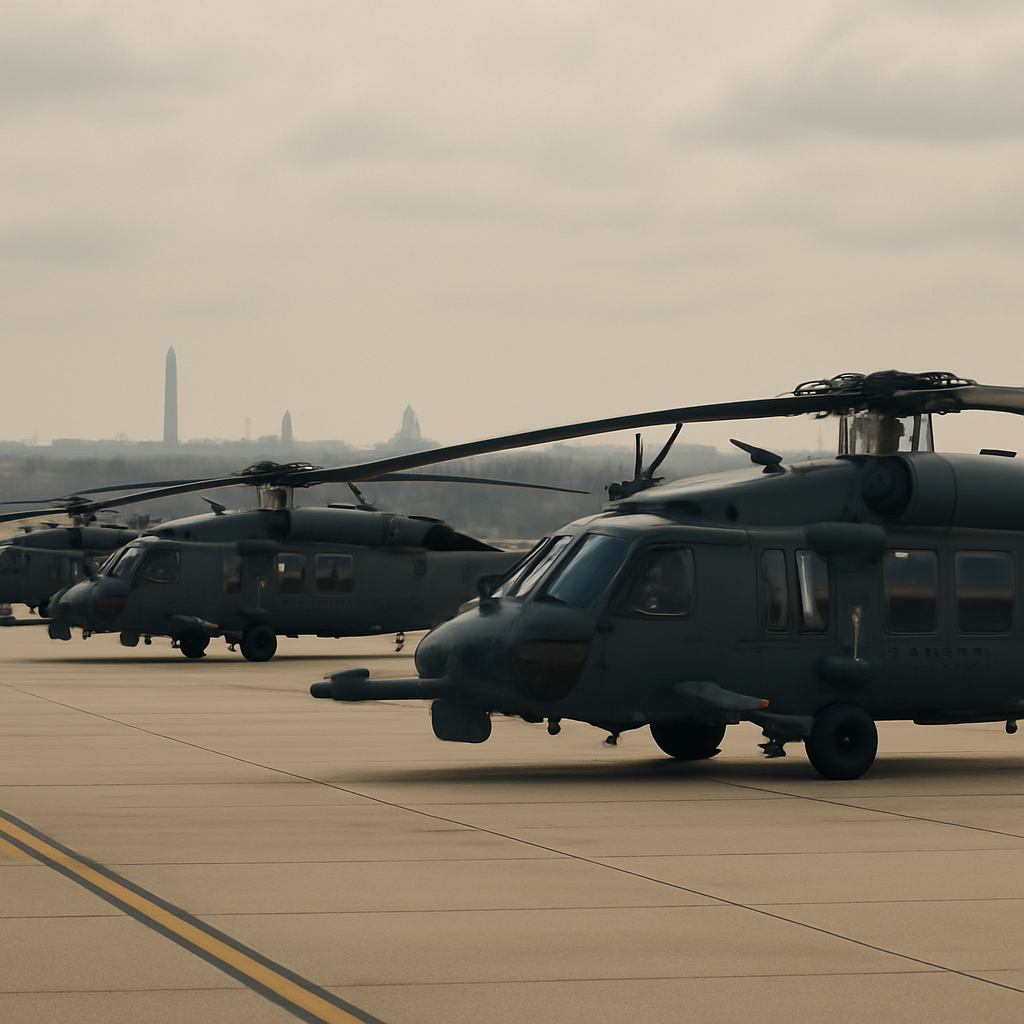
The Air Force’s 2027 Fiscal Year budget request formally assigns 26 HH-60W Jolly Green II helicopters to the Air Force District of Washington (AFDW) for continuity of government and VIP transport missions across the National Capital Region (NCR). The documents make explicit that those 26 aircraft will supplant the aging UH-1N Twin Hueys based at Joint Base Andrews, where routine AFDW sorties and continuity-of-operations taskings are currently flown.
The budget also confirms the service will continue procurement of the MH-139A Grey Wolf, but primarily to provide security around Minuteman III intercontinental ballistic missile silos rather than to assume AFDW duties.
Planned AFDW modifications to the HH-60W
The Air Force intends to reconfigure the HH-60W’s baseline CSAR fit to favor passenger ferrying and continuity missions while preserving key capabilities. Official contract language notes potential removal of: Rescue Team Seat, Isolated Personnel Litter, Gun System, Chaff/Flare Buckets, and Doors/Floor Armor. At the same time, modifications may include installation of ARC 210 Gen 6 radios, an Infrared Countermeasure (IRCM) system, and an alternate seating arrangement.
A separate contracting notice specifies cabin refit details: seating for 11 passengers meeting crash and safety standards and emergency egress requirements, with interior reconfiguration done so as to preserve critical CSAR gear such as the rescue hoist, defensive weapons, and medical stations. The service has not indicated any plan to remove the HH-60W aerial refueling capability—an advantage not shared by the UH-1N or the MH-139, neither of which are capable of in-flight refueling.

Audit-ready is a season. It shouldn't be.
Evidence in spreadsheets, controls drifting between audits, frameworks multiplying on flat headcount. Nubivance runs continuous compliance on Rapid7 Cyber GRC - SOC 2, HIPAA, ISO 27001, PCI, CMMC.
End the scrambleIRCM decision: CIRCM versus AN/AAQ-45 (DAIRCM) and contractors
The budget request and recent contracting notices highlight the integration of an infrared countermeasure system as a central technical thread. The Air Force solicited industry information on integrating either the Army-managed Common Infrared Countermeasure (CIRCM) or the Navy-managed AN/AAQ-45 Distributed Aperture Infrared Countermeasure (DAIRCM) onto the HH-60W fleet.
Prime contractors named in the notices include Northrop Grumman for CIRCM and Leonardo DRS for DAIRCM. The AN/AAQ-45 had previously been used on the Air Force’s older HH-60G Pave Hawks; CIRCM is already being installed on U.S. Army UH-60 Black Hawks. The Air Force’s move to evaluate both systems underscores a long-standing interest in providing the Jolly Green II with organic countermeasures against heat-seeking threats.
Operational trade-offs for CSAR and the National Capital Region
Re-rolling 26 helicopters to AFDW will have ripple effects across the Jolly Green II program. The Air Force’s planned HH-60W fleet has been scaled back over time from an original 113 to a current program of record of 91 aircraft. Absent additional procurement, the transfer of 26 aircraft represents roughly 30 percent of that planned fleet being reassigned away from a dedicated combat search and rescue (CSAR) posture.
The move brings tangible capability gains to the NCR: the HH-60W offers greater speed, range, payload, and in-flight refueling capability compared with the UH-1N and the smaller MH-139—attributes beneficial for continuity-of-government evacuations in congested, tightly controlled airspace. But the HH-60W’s recent operational exposure also highlights risks: the type was central to CSAR activity following an F-15E Strike Eagle shoot-down in Iran, an event that illustrated the threats HH-60Ws can face during recovery missions.
In the NCR context, continuity flights can arise at night, during crises that reduce situational awareness, and amid dense traffic that may include Marine Helicopter Squadron One (HMX-1), U.S. Park Police helicopters, other law enforcement aircraft, and civilian platforms. The Air Force plans to begin formal development of the AFDW configuration in Fiscal Year 2027 and to start refitting aircraft in Fiscal Year 2028.
What this means for AFDW planners, CSAR units, and defense contractors
- AFDW planners and continuity-of-government officials: They gain a more capable, refuelable platform for rapid evacuation and VIP movement across the NCR, with seating for 11 and preserved medical and hoist capabilities—beneficial in dense, heavily monitored airspace.
- CSAR units and fleet managers: They face a reduced pool of pure CSAR-configured HH-60Ws unless additional airframes are procured; roughly 30 percent of the planned fleet is slated for re-role, raising questions about surge capacity for contested recovery operations.
- Defense contractors (Northrop Grumman, Leonardo DRS, Lockheed Martin/Sikorsky): Integration work on IRCM systems and cabin refits represents near-term contract opportunities as the service transitions from requirements studies in FY2027 to physical modifications beginning FY2028.
The Air Force’s decision trades quantity in the strictly CSAR inventory for a platform that better matches the multifaceted demands of continuity-of-government and VIP transport in the National Capital Region. With development slated to begin in FY2027 and refits to start in FY2028, the coming fiscal year will determine how quickly the Jolly Green II shifts from a dedicated rescue helicopter into a dual-role workhorse over the nation’s capital — and how the remaining CSAR force will absorb that change.