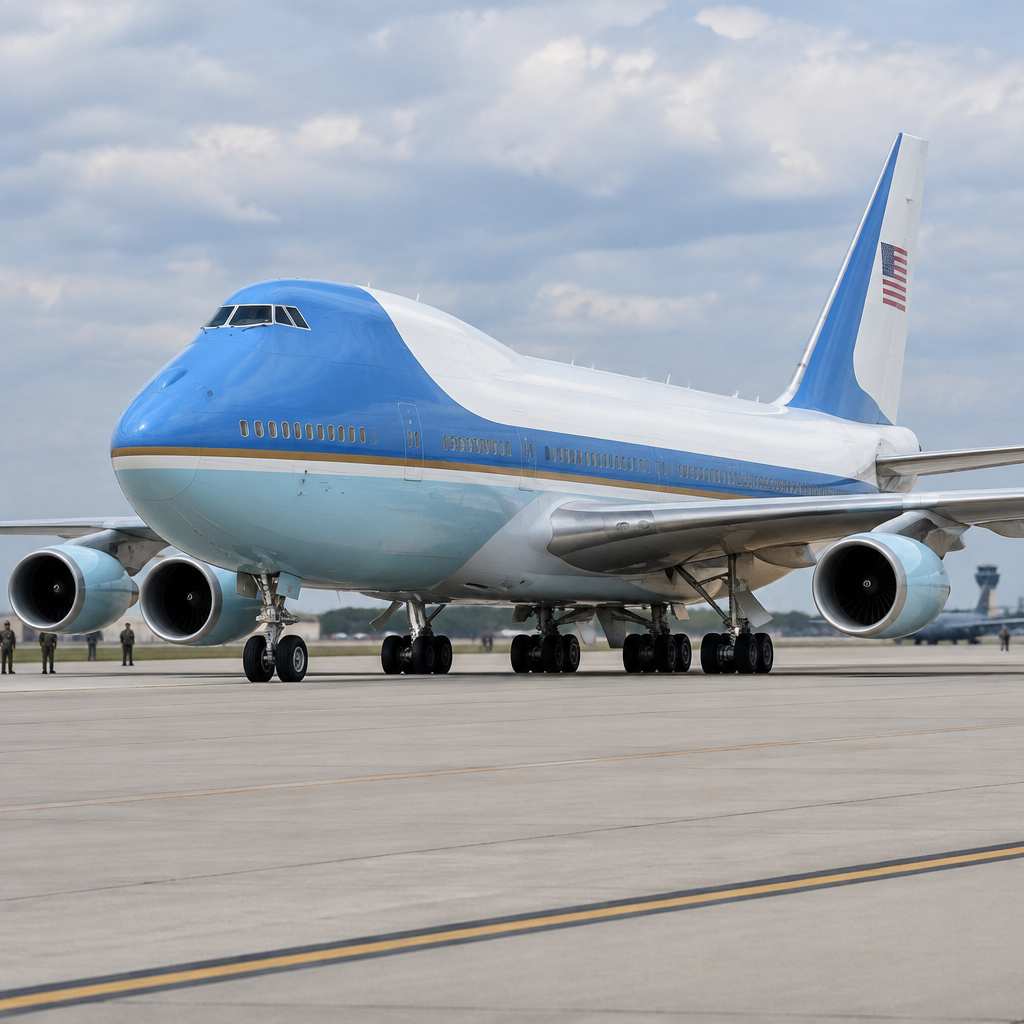
"The longest flight ever taken by Air Force One," President Donald Trump said after returning from Shenzhen — a claim backed by a White House flight card that described a near-15-hour, nearly one‑million‑pound takeoff and a 7,500‑nautical‑mile journey from Shenzhen to Joint Base Andrews (JBA).
The president’s claim and the flight’s particulars
Pool reporters received a card bearing the president’s signature and an official stamp stating the VC-25B “conducted the heaviest takeoff in Air Force history, at just under one million pounds, and completed the longest, nonstop Air Force One sortie to date, at nearly 15 hours.” The pool noted the aircraft lifted off Shenzhen at 5:54 p.m. local time and was “wheels down” at JBA at 8:01 p.m. EST, with no refueling stop. The card listed the track as passing over Shanghai; Tokyo; Shemya, Alaska; Winnipeg, Canada; and Cleveland, Ohio.
What the VC-25B Bridge jet is and how it stacks up
The plane used on the trip is a modified Boeing 747-8i—referred to as the VC-25B Bridge jet—that had been accepted formally by the Air Force less than two months before the Shenzhen trip. The 747-8i type has a published maximum gross takeoff weight of 987,000 pounds, and 15–16 hours is commonly quoted as that airframe’s maximum endurance. Boeing lists a maximum range for the 747-8i of nearly 7,800 nautical miles, so the 7,500 nautical miles flown on this mission falls within the commercial variant’s published limits.
Observers noted the VC-25B Bridge jet is likely significantly lighter than a fully loaded commercial 747—even with maximum fuel—although the Boeing Business Jet conversion process might include extra tanks. The Bridge jet used for this mission was modified in 10 months by defense contractor L3Harris, which performed the conversion work.

Audit-ready is a season. It shouldn't be.
Evidence in spreadsheets, controls drifting between audits, frameworks multiplying on flat headcount. Nubivance runs continuous compliance on Rapid7 Cyber GRC - SOC 2, HIPAA, ISO 27001, PCI, CMMC.
End the scrambleAerial refueling: a capability removed from the new presidential jets
Crucially, the VC-25B Bridge jet cannot be refueled in flight. The two future VC-25B aircraft Boeing is under contract to provide will also lack aerial refueling capability, according to the reporting. By contrast, the two aging VC-25A aircraft are capable of aerial refueling, although that capability is used only in emergencies; on the return from China, the two VC-25As stopped in Alaska first to be refueled before continuing home. The Air Force’s E-4C airborne command posts—based on the same 747 model—will retain aerial refueling capability.
That removal of in‑flight refueling capability traces to a policy change: President Donald Trump eliminated the aerial refueling requirement for the VC-25B program in 2017 during his first term as a cost‑cutting measure, the source reports.
Range requirements, weight, and revised expectations for the VC-25B program
Program documents and prior reporting show a downward revision in range expectations for the new presidential jets. The original range requirement for the VC-25B was about 7,100 nautical miles; the Air Force later revised that to an expected 5,900 nautical miles. By comparison, the VC-25A can fly roughly 6,800 nautical miles without refueling, per the official Air Force fact sheet. The reporting points to weight—the result of tailored systems, defenses and nuclear hardening—as a likely driver of the reduced requirement, noting the Bridge jet is not as deeply modified as the production VC-25Bs will be.
Given the revised 5,900 nautical mile expectation, the report observes that unless the production VC-25Bs can drastically exceed their reformed requirements, they will not be able to replicate the Shenzhen-to‑JBA nonstop flight the Bridge jet achieved.
How the Air Force, Boeing, and continuity planners are positioned
- Air Force: The service accepted the Bridge jet less than two months before the flight and is being asked—along with Boeing—to confirm the specific weight and duration figures provided to the press pool.
- Boeing and contractors: Boeing supplied the 747-8i platform; L3Harris performed the Bridge conversion and has been quoted as downplaying risks. Boeing is under contract to provide two VC-25B replacement aircraft that will differ from the Bridge configuration.
- Continuity-of-government and command planners: The reporting highlights that the ability of Air Force One to remain airborne is central to continuity-of-government planning and strategic command and control, especially in high‑end crises. Removing aerial refueling limits flexibility and the capacity to keep senior officials airborne for extended periods, a capability the E-4C variants will retain by design.
The nonstop flight from Shenzhen is a clear operational milestone for the VC-25B Bridge jet and a public demonstration of range and endurance. The facts presented, however, also underscore a tension between that single performance and program-level constraints: revised range requirements, removed aerial refueling capability for the production VC-25Bs, and the heavier weight expected once full presidential mission systems are installed. Air Force and Boeing have been asked to confirm the pool figures; officials and L3Harris have said operational concerns have been addressed and risks downplayed, but the reporting leaves open whether the production VC-25Bs will match the Bridge jet’s uncommon nonstop feat.