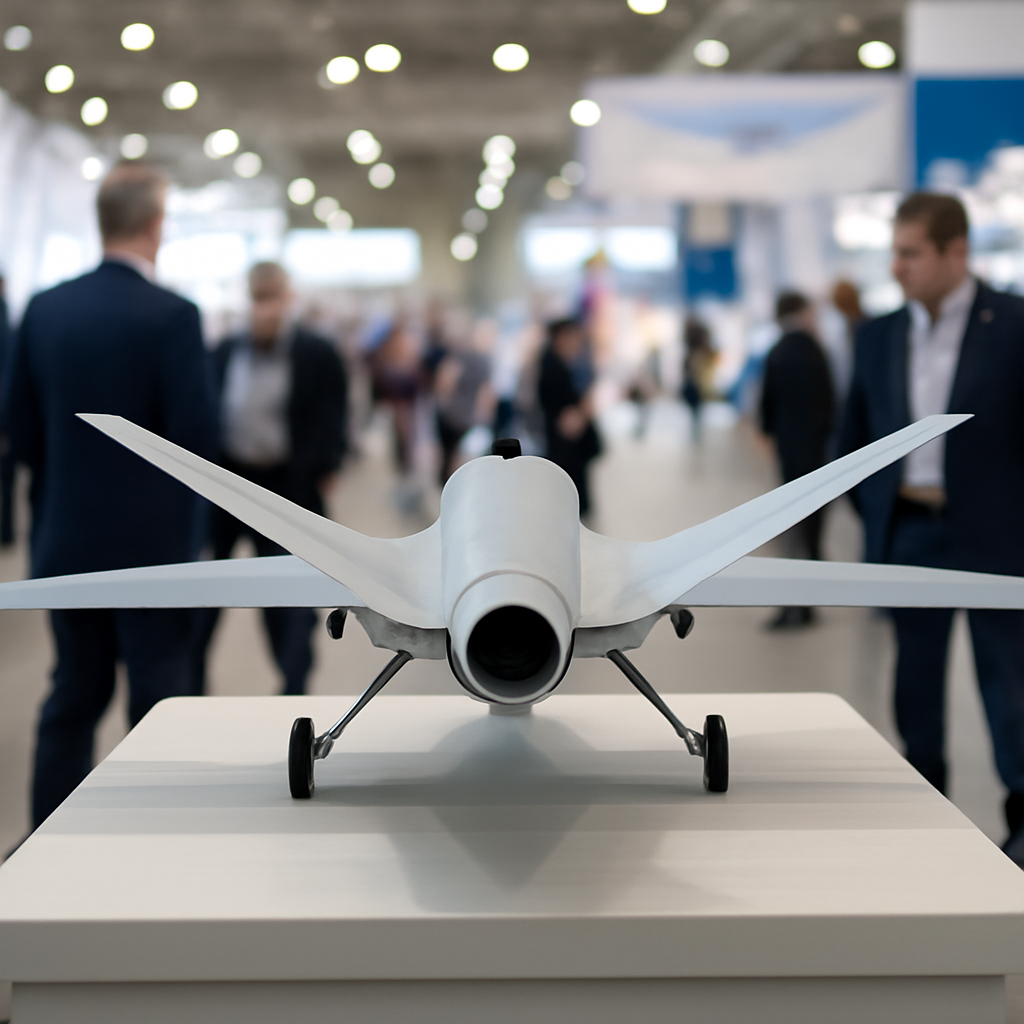
"We will continue to maximize competition through all the phases of CCA increment 2," Col. Timothy Helfrich said, laying out a plan that will pare a field of nine vendors to as many as six next year as the Air Force advances its next wave of collaborative combat aircraft development.
Where the program stands: concept refinement and the downselect
Speaking at a media roundtable in Dayton, Ohio, during the Life Cycle Industry Days conference, Helfrich said the Air Force’s ongoing "concept refinement" stage will last "another approximately 10 months." At the end of that period the service expects to receive up to "six closed conceptual designs." The path after concept refinement mirrors the Collaborative Combat Aircraft (CCA) program’s first increment: conceptual design, followed by prototyping awards and, eventually, production contracts.
Helfrich did not specify when prototyping or production deals would be awarded, nor did he say whether the up-to-six conceptual designs would automatically carry forward into prototyping. He emphasized that the service intends to "maximize competition" across all phases and that new entrants who lose earlier contests could still compete for later stages.
Design spectrum: attritable to "exquisite" and who already entered production
The Air Force’s concept refinement is intentionally broad, Helfrich said, evaluating designs ranging from cheaper, more loss‑tolerant (attritable) drones to higher-end, "exquisite" designs. The Air Force’s first CCA increment has already moved into production with drones developed by Anduril and General Atomics, providing a production benchmark even as increment 2 casts a wider design net.

Audit-ready is a season. It shouldn't be.
Evidence in spreadsheets, controls drifting between audits, frameworks multiplying on flat headcount. Nubivance runs continuous compliance on Rapid7 Cyber GRC - SOC 2, HIPAA, ISO 27001, PCI, CMMC.
End the scramblePropulsion investments: two thrust classes and development approaches
As part of the increment 2 effort, the Air Force is deliberately investing in previously dormant segments of the propulsion market to expand options for potential CCA wingmen. One set of awards to four vendors is developing engines in a lower class of roughly 1,400 to 1,600 pounds of thrust; a second set of contracts to two firms targets a "medium" thrust class of 5,000 to 6,000 pounds.
Helfrich made clear that CCA increment 2 drones are not "constrained" to those thrust classes, but that the engine work is intended to offer ready options if a selected drone design needs those attributes. John Sneden, chief of the Air Force’s propulsion directorate, said the medium thrust engines could be either a "ground up, new design" similar to the lower-thrust work or could be modified from designs "already available off-the-shelf." He added, "we're not taking something directly off-the-shelf 'because we think that the requirements and the needs are going to be greater for CCA increment 2, and we need to have propulsion systems ready for that.'"
Mass Modular Aircraft (MMA) competition and the MQ‑9A replacement
In parallel with CCA work, the Air Force, working with the Defense Innovation Unit (DIU), is seeking a cheaper, more loss‑tolerant replacement for the MQ‑9A Reaper. DIU launched the Mass Modular Aircraft (MMA) competition on July 7. The program posting framed "exquisite" drones as those that cost $30 million or more, and stated that viable MMA proposals should cost less than that figure.
Col. John Dayton, the Air Force’s portfolio acquisition executive for ISR and SOF, said the DIU competition generated "a very robust industry response." Col. Todd Dye, the senior materiel leader for ISR/SOF medium‑altitude ISR, said similar to the CCA program, contract awards for the MMA’s "concept refinement phase" are expected to be issued in the first quarter of fiscal 2027.
What this means for Anduril and General Atomics, propulsion firms, and new entrants
- Anduril and General Atomics: Having drones from the first CCA increment in production positions these companies as incumbents to watch. The existence of production systems provides the Air Force with an operational baseline as increment 2 concepts are evaluated.
- Engine developers awarded work in the 1,400–1,600 and 5,000–6,000 pound thrust classes: Those firms are building options the Air Force can select if designs need those propulsion characteristics; their work could be either new "ground up" engines or modified off‑the‑shelf designs, depending on requirements.
- New entrants and the nine initial vendors: The Air Force’s intent to "maximize competition" and allow firms that miss early awards to compete later means companies outside the incumbents will likely continue investing in concept development through the roughly 10‑month refinement window.
The next measurable milestones are the roughly 10‑month concept refinement period that should yield up to six closed conceptual designs and the first‑quarter FY2027 timing for MMA concept refinement awards. Between those checkpoints the Air Force has signaled it will keep the field broad—both in aircraft form and in propulsion—while insisting competition remain central to how increment 2 moves toward prototyping and production.