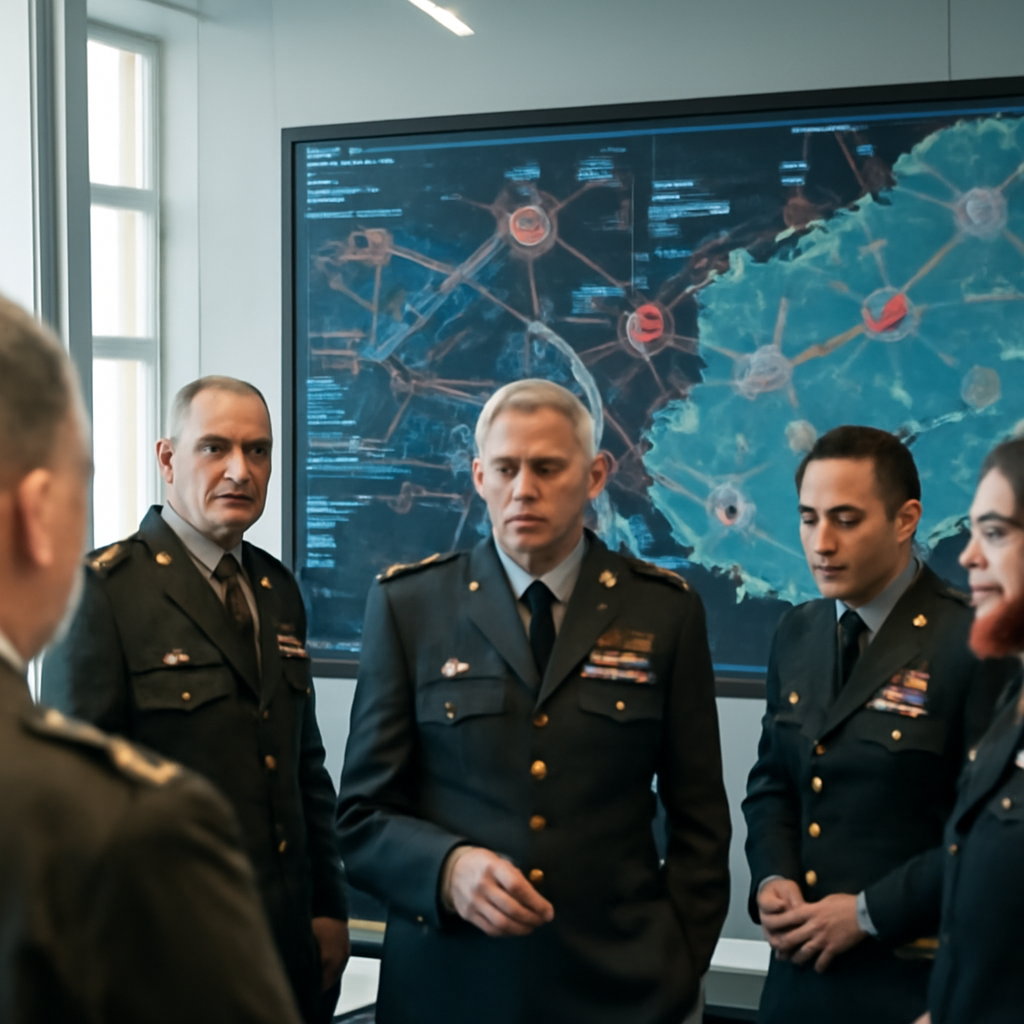
US Central Command claimed that American forces struck more than 1,000 targets in the first 24 hours of Operation Epic Fury in early 2026 — a tempo its account says was enabled by AI-assisted systems. That scale of action captures what is changing: machines are already taking on parts of the targeting task, and when those machines learn and adapt after deployment, the line between predictability and peril narrows.
Operation Epic Fury (early 2026) and AI-assisted operational tempo
The source describes Operation Epic Fury as an early-2026 instance where US Central Command reported very high operational tempo: more than 1,000 targets struck in the opening 24 hours. It states that "AI-assisted systems helped achieve this operational tempo." The passage uses that claim to illustrate the central point: AI’s ability to process large volumes of information at machine speed is changing how militaries identify and engage targets.
Continual learning versus static systems: why adaptability matters
The piece distinguishes two modes of machine learning. Most deployed systems are static: they learn from fixed training data and do not change after validation. By contrast, continual learning systems keep updating using new data after deployment. That continuing adaptation makes their behaviour harder to anticipate, the source warns, because a system can change as it encounters conditions not present during initial training. This difference matters for testing, certification and predictable conduct in combat.

Audit-ready is a season. It shouldn't be.
Evidence in spreadsheets, controls drifting between audits, frameworks multiplying on flat headcount. Nubivance runs continuous compliance on Rapid7 Cyber GRC - SOC 2, HIPAA, ISO 27001, PCI, CMMC.
End the scrambleField incidents: June 10, 2026 'Terminator' drones and July 2026 Zaporizhzhia strike
The source cites two incidents to show humans are already ceding parts of the kill chain to machines. On 10 June 2026, a report surfaced claiming Ukrainian forces had used 10 AI-controlled "Terminator" drones to identify and attack targets without a human in the loop. Ukrainian drone developer Alexander Kokhanovskyy is quoted as saying the drones were cut off from their communications link and relied on onboard AI to identify and engage targets, reportedly killing Russian soldiers.
In a separate case in July 2026, an AI drone that killed three civilians in Zaporizhzhia, Ukraine, was reportedly found with an onboard Nvidia chip and cameras but "apparently no antenna for communication with a human operator." Ukrainian air defence commanders concluded the drone was guided fully autonomously. The source stresses that these incidents do not document adaptive learning in action; their significance is that they demonstrate humans are already relinquishing parts of targeting to machines — a precondition for the harder questions that adaptive weapons create.
How battlefield manipulation and certification collide
The narrative explains a technical and operational collision: adaptive systems gain capability by learning from operational data, but that same battlefield data can be deliberately distorted. Adversaries can use camouflage, deception, electronic warfare and other techniques to manipulate what an AI system observes and thereby exploit how it adapts. For static systems, developers can test known scenarios and commanders can judge reliability before deployment. For adaptive weapons, the source warns, "certification may lose its certainty" once the system continues to learn in the operational phase.
The accountability gap: commanders, operators, developers, engineers, and certifiers
The source frames responsibility as a distributed problem. It poses the scenario of an adaptive weapon misidentifying a civilian vehicle after adapting to new operational data and notes the difficulty of locating responsibility among the commander who authorised its use, the operator who activated it, the developer who designed it, the engineers who trained its model, and the authority that certified it. The machine itself cannot carry legal or moral responsibility, creating an "accountability gap." The source argues this gap requires rethinking beyond the assertion that a "human in the loop" alone is sufficient.
What this means for technologists, policymakers, and armed forces
- Technologists and security teams: must design continuous-monitoring mechanisms and reliable means to intervene, deactivate or reassess systems when behaviour changes.
- Policymakers and regulators: need lifecycle approaches to human control that set clear limits on where and when adaptive systems can operate and that recognise certification at one point in time may not remain valid once a system adapts.
- Armed forces and commanders: should expect that delegating targeting functions to adaptive machines will raise hard questions about foreseeability and legal responsibility, and they will have to mandate operational limits and oversight measures if the practice continues.
The source closes on a pointed observation: military AI does not need to become conscious to outpace human control. It only needs to be sufficiently autonomous, adaptive and opaque so that humans cannot confidently predict how it will behave when conditions change. Addressing that risk, the source argues, means extending human control across a weapon’s lifecycle, instituting continuous monitoring and intervention mechanisms, and clarifying who answers when the machine makes the immediate decision.