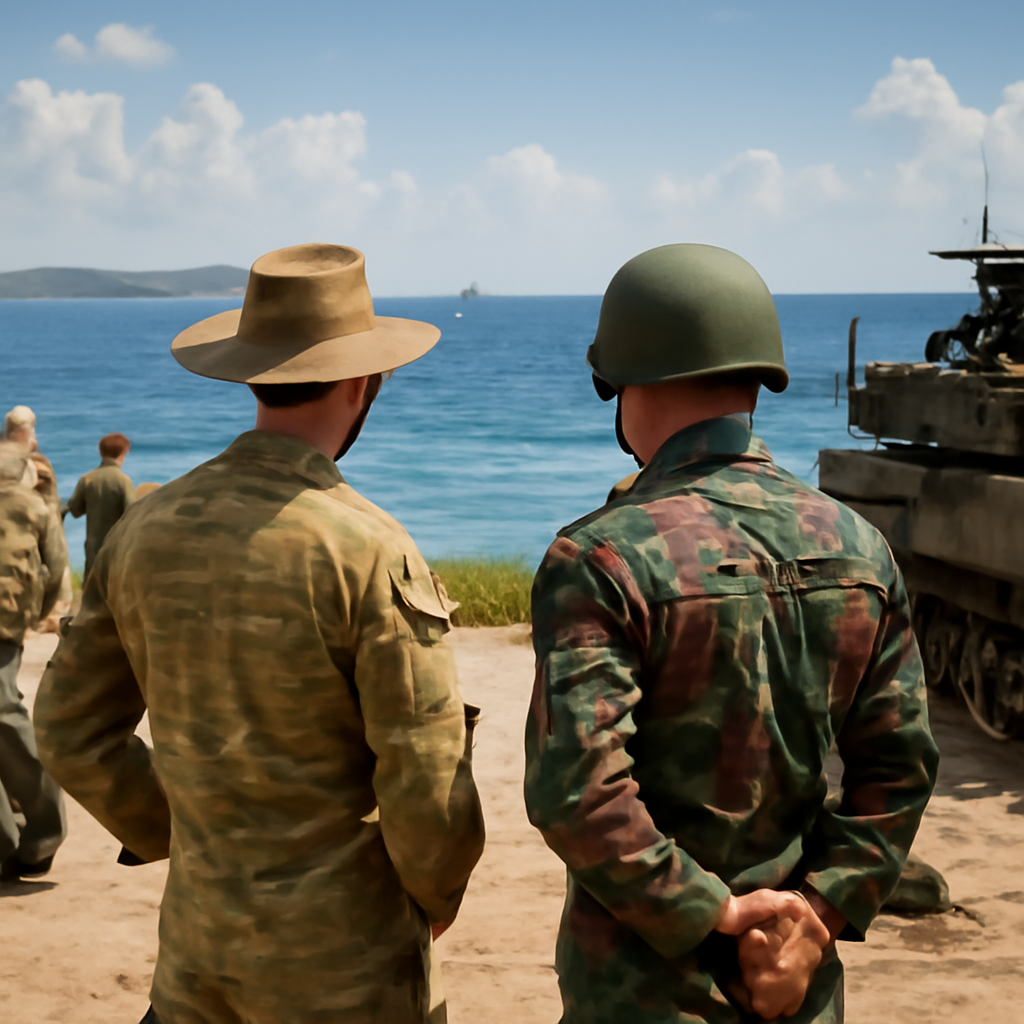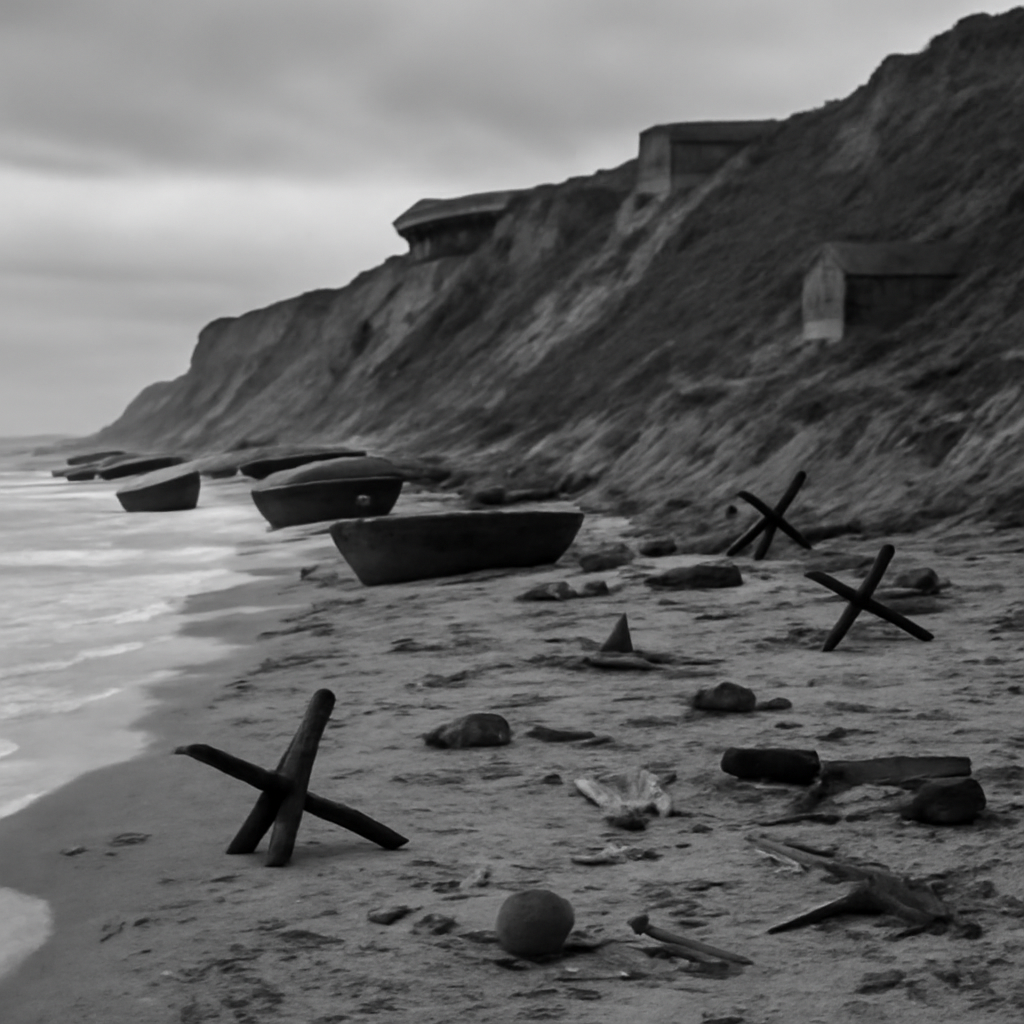
"So here we are, all seasick, ahead of everyone else, no bomb craters to get in, and heading straight into machine gun fire," recalled Private First Class John Robertson.
Omaha Beach on June 6, 1944
The scene that met 1st Lieutenant Jimmie Monteith Jr. and the 1st Infantry Division’s first wave at Omaha Beach was one of "utter chaos and horror." Unanticipated cloud cover blinded high‑altitude Allied bombers and left German defenses intact. The Atlantic Wall of pillboxes, bunkers and artillery was "well‑camouflaged" and sited on steep bluffs overlooking more than 200 yards of open sand. Stormy weather and strong tidal currents swept many landing craft off course, denying tanks and supporting fire to the assault. Many landing craft flooded with seasick men; entire squads were cut down as ramps fell and men waded into machine‑gun fire or sank weighted by equipment.
Monteith repeatedly exposed himself to withering fire to rally survivors, led men through minefields, assaulted a German bunker and captured critical high ground that opened a route off the beach. He perished in the assault and received a posthumous Medal of Honor at age 26.
Eight Medal of Honor recipients from D‑Day and Normandy
The D‑Day landings and the Normandy campaign produced eight Medals of Honor, each spotlighting extreme valor. The article names the eight and summarizes their cited actions:
- Private First Class Charles N. Deglopper, 82nd Airborne glider infantryman — despite wounds, advanced on a German unit to cover his comrades' withdrawal across the Merderet River and died in the effort.
- Lieutenant Colonel Robert G. Cole, 101st Airborne — drew a .45 pistol and led a bayonet charge to relieve pinned troops; he was killed months later.
- Sergeant Frank Peregory, 116th Infantry (National Guard) — attacked a German machine gun position with grenades and bayonet, killing eight and capturing 35 before being killed on June 14.
- Corporal John D. Kelley, 79th Division — singlehandedly assaulted a pillbox outside Cherbourg, succeeding on his third attempt, and was killed in action months later.
- Brigadier General Theodore Roosevelt Jr., assistant commander of the 4th Infantry Division — landed at Utah Beach in the first wave despite poor health, repeatedly exposed himself to enemy fire to rally men; he died of a heart attack a little over a month after D‑Day.
- Lieutenant Carlos C. Ogden, 79th Division — advanced alone on a pinned unit, captured an 88‑mm gun and a machine gun despite being shot in the head, survived and ended the war as a major.
- Staff Sergeant Walter Ehlers, 1st Infantry Division — fought off Omaha in the second wave, destroyed several machine gun nests and carried a wounded soldier to safety despite serious wounds; he survived, while his brother Roland Ehlers was killed on Omaha Beach.
- 1st Lieutenant Jimmie Monteith Jr., 1st Infantry Division — see above; posthumous Medal of Honor recipient.

This site is the portfolio.
OSINTSights runs on Cloudflare Workers, D1, R2, and Vectorize, with an AI pipeline on Hetzner ARM. Nubivance designed, built, and operates it. We do the same for clients.
See what we buildThe Normandy American Cemetery and the human cost
The Normandy campaign’s toll was staggering: more than 225,000 dead, wounded or missing, the article reports — including 134,000 Americans, 91,000 British, Canadians and Poles, and an estimated 18,000 French civilians. Nearly 10,000 U.S. war dead are interred at the Normandy American Cemetery. More than 1,500 whose remains were never recovered are carved on a circular "Wall of the Unknown" under the inscription "Comrades in arms whose resting place is known only to God."
The cemetery is the final resting place of 39 pairs of brothers and a father and son, Col. Ollie Reed and Lt. Ollie Reed Jr. Gen. Omar Bradley is quoted as saying "every man who set foot on Omaha Beach that day was a hero." Gen. Mark W. Clark’s words on the cemetery wall are cited as well: "If ever proof were needed that we fought for a cause and not conquest, it could be found in these cemeteries."
The Marshall Plan, NATO, and "the World America Built"
The piece casts the postwar reconstruction that followed Normandy — specifically the Marshall Plan and the founding of NATO — as the institutional outgrowth of the campaign’s ideals. The Marshall Plan helped rebuild defeated foes, and those efforts "underwrote formation of NATO," the article says, calling these the "foundation stones of the World America Built." That order, the author writes, has lasted "more than eighty years" and produced a prolonged era of prosperity and relative peace among major powers. The author warns bluntly: "There can be no coming back from squandering that kind of inheritance."
Forces of "empire lust and ultranationalism" loosed again upon Europe — and what that means for allied leaders, policymakers in Washington, and cemetery visitors
The author ties Normandy’s memory to present dangers: "Today the forces of empire lust and ultranationalism are loosed again upon Europe, with hundreds of thousands already killed in a brutal war of conquest." The piece also notes that "another autocratic hegemon arises in the east to challenge our allies in the Indo‑Pacific" and that "war toxins have spread to poison the Middle East," concluding that "doubts have arisen about America’s intentions and trustworthiness that have not darkened allied counsels in over half a century."
- Allied leaders: The article suggests allies will be sensitive to any erosion of the trust that the postwar order rested upon, since decades of cooperation rested on "fundamental American intentions."
- Policymakers in Washington: The author frames stewardship of the postwar inheritance — institutions like NATO and the reconstruction ethos — as a policy responsibility that, if squandered, has no easy recovery.
- Cemetery visitors and the public: As the visitor center intones names and "Taps" is played, the author argues those rituals carry a civic message; "they have important news to pass along."
The crosses on the bluff above Omaha Beach, the carved names on the Wall of the Unknown and the words of figures from the war are presented not only as memory but as admonition: the liberties and alliances that followed came at enormous cost, and the article closes on the literal and moral invitation to listen — and act — so those sacrifices remain honored.
https://breakingdefense.com/2026/06/a-message-from-normandy-82-years-later/