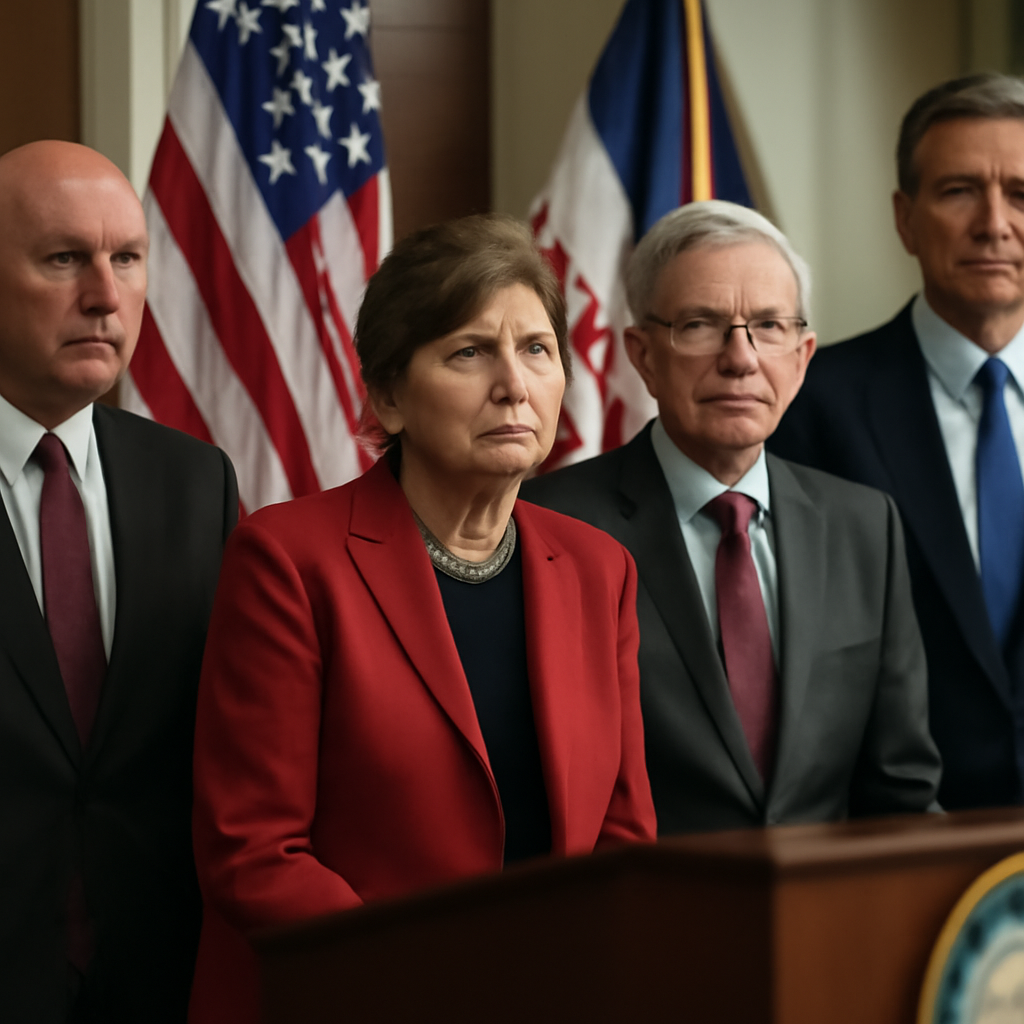
"There isn’t going to be a third reconciliation package. So anything that’s in there is not going anywhere,” said Sen. Jeanne Shaheen, D-N.H., capturing the skepticism running through a bipartisan group of senators at the Farnborough Airshow this week.
Sen. Jeanne Shaheen on priorities and discipline
Shaheen, a member of both the Senate Armed Services and Appropriations committees, warned that Congress must be “disciplined” about funding choices if reconciliation fails to carry additional defense money. Her remarks framed a central tension: lawmakers may be preparing reconciliation language, but without a viable path to enactment those provisions risk remaining aspirational. Shaheen stressed that appropriators ultimately must ensure the Pentagon’s base budget includes the funds necessary for national security priorities.
House budget resolution: $60 billion versus a $350 billion request
The House moved this week to debate a budget resolution that would kickstart reconciliation and add $60 billion for defense — a figure far below the Pentagon’s $350 billion request. Senators at Farnborough treated that gap as a practical reality as much as a political one: even the addition of $60 billion would face an uphill climb with midterm elections approaching, and several lawmakers expressed doubt that the House and Senate could both pass a third reconciliation package.

Your town's IT department is one person. Maybe.
Ransomware crews target small municipalities because nobody's watching. Nubivance gives Maine and New Hampshire towns a security program sized to a town budget.
Protect the town officeAppropriations timeline, the NDAA and the continuing resolution
Lawmakers face a compressed calendar. House Speaker Mike Johnson hopes to pass the fiscal 2027 National Defense Authorization Act and a continuing resolution that would extend government funding until Dec. 4 before the House departs for an August recess on Friday. The Senate’s NDAA has stalled as Democrats press GOP leaders on the topline for the FY27 defense appropriations bill, and the Senate is scheduled to recess on Aug. 8. That leaves only a few weeks in September to act on a continuing resolution ahead of the fiscal year’s October start — itself a month in which Congress will again be largely in recess before the election.
Sen. Jeanne Shaheen said a short-term CR that carries through the election could be “helpful,” but cautioned that “you can’t really write the CR without the anomalies,” and that obtaining those anomalies requires a directive from the administration. Sen. Jerry Moran, R-Kansas, warned that an extended CR is “one of the most damaging things that we can do” for the Defense Department and its industrial base, and urged bipartisan cooperation to avoid it.
Sen. John Kennedy and the mood at Farnborough
Of the delegation at Farnborough, Sen. John Kennedy, R-La., was the most optimistic that a reconciliation vehicle could ultimately deliver defense funds. “The military needs money, and the only way to get it to them in this environment is through reconciliation,” he said, adding that he would prefer “a little bit heavier” defense funding than the House outline proposes. Kennedy also painted a picture of congressional confusion: “Both chambers kind of look like the happy hour at an airport Chili’s,” he said. Yet he was explicit about timing: “Anybody who thinks we’re going to do an NDAA before the midterm needs to back off the crank.”
Industry skepticism: Honeywell Aerospace CEO Jim Currier
Industry leaders showed similar caution. Honeywell Aerospace CEO Jim Currier told Breaking Defense that the budget situation is “concerning, because I think reconciliation is not going to happen.” Currier also noted that Honeywell would be insulated to some degree because many of its military parts have commercial applications. “Being a commercial business,” he said, “allows you to invest with very, very low risk as to what’s going to be happening in the defense market.”
What this means for the Pentagon, Congress, and defense contractors
- Pentagon: Programs the department plans to fund through reconciliation — including items like Golden Dome, which senators specifically mentioned — could be at risk if Congress does not appropriate those dollars in its annual bills.
- Congress: Appropriators face pressure to fill gaps in the base budget if reconciliation 3.0 fails; several senators urged Congress to “take back its responsibility of funding government” and to move forward on appropriations bills.
- Defense contractors: Companies with dual-use products — as Honeywell emphasized — may weather shortfalls in defense-specific funding better than pure-play defense firms, but an extended CR and unresolved toplines remain a concern for planning and investment.
The facts are straightforward and the calendar is not forgiving: with a House resolution proposing $60 billion for defense against a Pentagon request for $350 billion, with senators and industry executives openly doubting a successful reconciliation package, and with recesses and midterms compressing the schedule, the burden falls on appropriators to translate priorities into enacted funding. Whether they will do so in time — or whether some programs will be left waiting for a political moment that may never arrive — is the immediate question hanging over the defense budget debate.