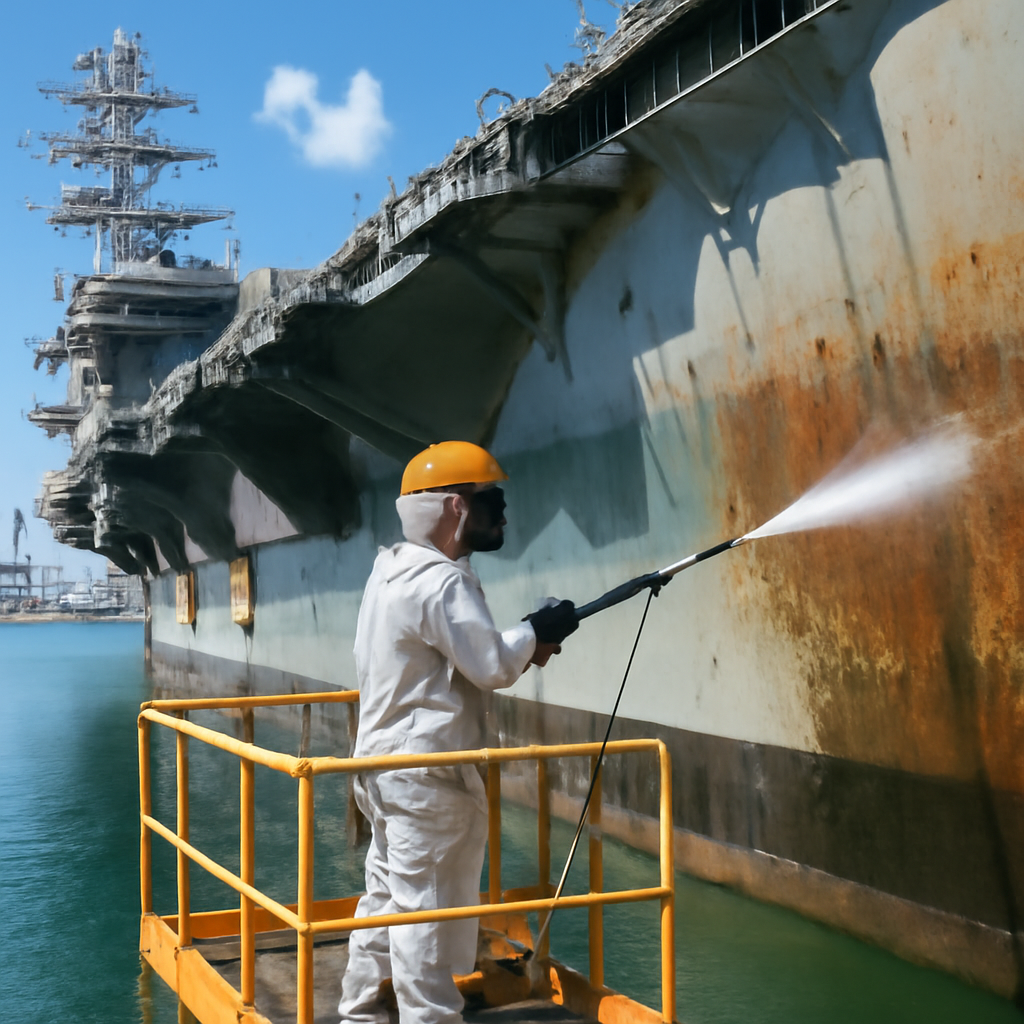
Two local workers in silver protective suits, yellow helmets, face shields and black boots were filmed on a scaffolding platform spraying the side of the supercarrier — removing most of the visible rust and a broad swath of green algae — moments after the USS Abraham Lincoln (CVN-72) arrived in Laem Chabang Port on Sept. 2, 2026.
Arrival at Laem Chabang: visible wear after a long deployment
The Lincoln pulled into the Thai port looking “very much like it just spent 286 days at sea,” with running rust and algae caked along the hull and rough patches visible around the edges of the flight deck and sponsons, according to photographic and video material referenced in the reporting. The carrier’s appearance reignited public interest and social-media attention after video emerged showing local workers cleaning the hull.
Photographs credited to Thananuwat Srirasant/Getty Images document the carrier’s arrival on Sept. 2, 2026, and social posts — including a tweet by the account Comandante — circulated footage of the cleaning work. Reporters note that the footage shows significant improvement in the section being worked on, while panning shots also highlight areas still needing attention.
Cleaning work: scheduled maintenance or reactive scrubbing?
It is unclear from the available reporting whether the scrubbing in Laem Chabang was part of routine maintenance already planned for the port call or an ad hoc response after images of the ship’s condition circulated. Port calls typically bring support personnel, supplies and time ashore for crew; the reporting notes that “it’s no surprise that the Lincoln would be swarmed with support personnel and supplies while much of her crew enjoys being on land once again for a few days.”
How long the clean-up will last, or how much will be completed before the carrier departs Thailand, was not specified. The account concludes that, from what was seen while the ship was in port, “it will look much better leaving Thailand than when it arrived.”

This site is the portfolio.
OSINTSights runs on Cloudflare Workers, D1, R2, and Vectorize, with an AI pipeline on Hetzner ARM. Nubivance designed, built, and operates it. We do the same for clients.
See what we buildOperational context: a long deployment and combat operations
The Lincoln and Carrier Strike Group 3 carried out the opening salvo of strikes on Iran on February 28 as part of what the U.S. military called Operation Epic Fury. The strike group continued to support Epic Fury and subsequent operations against Iran for months thereafter. The carrier’s prolonged operational tempo and role in sustained operations are presented in the reporting as central to the ship’s condition and the pressures on the crew.
After months on station, the decision was made last month to rotate the carrier out of the region following multiple reports of severely flagging morale and mental health among sailors aboard the Lincoln.
Crew welfare and public scrutiny
Reporting cites serious crew issues: one sailor was rescued last month after deliberately jumping overboard, and there were reports that at least one other individual onboard had attempted the same. Those incidents contributed to the decision to rotate the carrier out of the operational area.
Public and political attention has been intense. President Donald Trump and Defense Secretary Pete Hegseth publicly pushed back on concerns about mental health and other issues on the ship. The visible condition of the hull also tapped into an ongoing debate about ship appearance and maintenance: earlier criticism of “running rust” on U.S. Navy vessels has drawn remarks from senior figures and congressional testimony.
At a congressional hearing last year, John Phelan — shown a picture of the Arleigh Burke-class destroyer USS Dewey — said, “It’s terrible. I think they should be ashamed,” and asked, “Would you want to go on that ship?”
Ship maintenance, policy and the Navy’s rust problem
Mark Lattner, director of the Navy’s Ship Integrity and Performance Engineering, Naval Systems Engineering Directorate, addressed the operational trade-offs that drive visible corrosion. Speaking in January at the Surface Navy Association’s annual symposium — an event attended by the reporting outlet — Lattner said, “We know what to do, but we choose not to do it. And we choose not to do it because there’s always some other problem I’ve got to fix. I don’t have time. Our corrosion can wait. And so we don’t implement the fixes.”
The reporting connects Lattner’s work on the rust problem to fallout stemming from earlier intense scrutiny: it notes that finding a solution became one of his main missions after President Trump sent late-night texts to Navy officials demanding answers about the condition of the guided missile destroyer USS Dewey when pictures showed running rust during a Singapore port call last year.
What this means for the Navy, the crew, and U.S. officials
- The Navy: Hot deployments and sustained combat operations are shown as constraining routine corrosion control and shipboard maintenance; leaders will need to balance operational demands with time for preventative fixes that reduce visible wear and long-term material degradation.
- The crew: Extended time at sea and repeated operational stressors are linked in the reporting to eroding morale and mental-health crises aboard the Lincoln, factors that shaped the decision to rotate the carrier out of the region.
- U.S. officials and public observers: Visible hull deterioration continues to be a flashpoint in public optics and political scrutiny, prompting reactive attention during port calls and renewed debate over maintenance priorities.
The image of the Lincoln arriving in Thailand — and the swift, public scrubbing that followed — leaves two clear, immediate facts on the table: the carrier had visible surface corrosion and biological growth after a prolonged deployment, and local workers began removing that material while the ship was in port. Whether the cleaning was pre-planned or prompted by viral images remains unresolved, as does how much permanent repair and preventative work will follow before the carrier sails again.