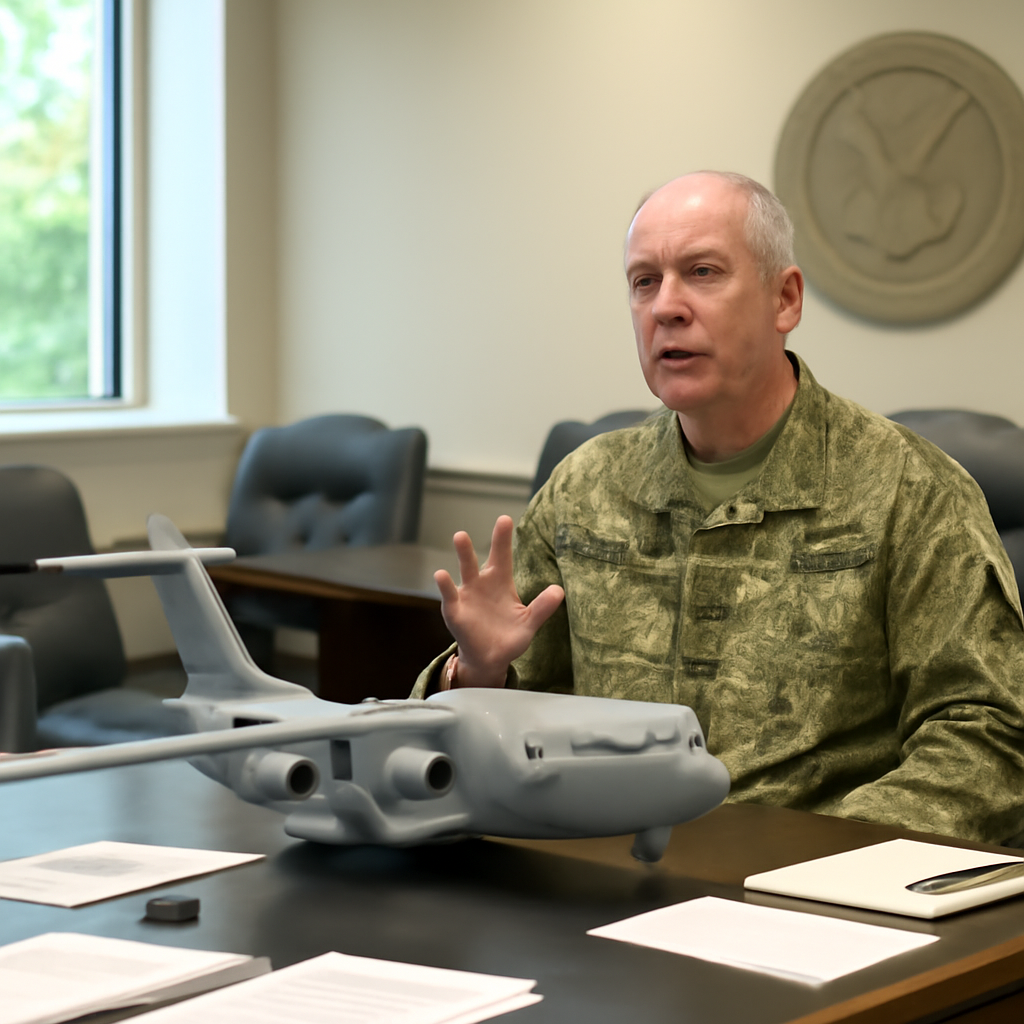
"Heck yeah, but with a caveat, right?" Lt. Gen. Daniel Tulley, head of Air Mobility Command, said when asked directly about restarting C-17 production during a roundtable at the Air & Space Forces Association’s 2026 Air, Space & Cyber Conference.
Lt. Gen. Daniel Tulley outlines where the Air Force is looking
Tulley framed the question about a production restart inside the broader, still-evolving effort to define a Next-Generation Airlift (NGAL) platform that would ultimately replace both the C-17 Globemaster III and the C-5M Galaxy. He said the Air Force is about to begin an Analysis of Alternatives to replace those two airlifters, and that “all options are on the table.”
He emphasized three lines of inquiry: service-life extension of existing C-17s; the feasibility and price of restarting Boeing’s C-17 assembly line, which Boeing closed in 2015; and whether modernized or redesigned approaches might better meet future needs by adding connectivity, defensive measures, and other technologies the current C-17 lacks.
Production realities, cost and international interest
Tulley noted practical questions the service has asked vendors: Do manufacturers store the dies and tooling necessary to restart an assembly line, and what would the price tag be? The RAND Corporation’s prior analysis — completed more than a decade ago — concluded any course would likely require billions of dollars of new investment and would carry risk.
Boeing told TWZ in June that unnamed C-17 operators had been reaching out about restarting the line and that the company was “encouraged” by those discussions. At the same time the service weighed those conversations, the C-17 design marked the 35th anniversary of its first flight “yesterday,” according to the reporting.
Foreign operators of the Globemaster III include Australia, Canada, India, Kuwait, Qatar, the United Arab Emirates, and the United Kingdom; the Strategic Airlift Capability initiative also operates three aircraft. Tulley and the Air Force are therefore considering whether foreign participation in a new production run could help defray costs.

The cyber insurance questionnaire just landed. Now what?
SOC 2, HIPAA, insurance renewals - someone has to own security strategy. Nubivance provides fractional CISO leadership without the full-time salary.
Get a security leadNGAL competitors and clean-sheet thinking
Boeing is not the only company positioning itself for NGAL work. The source references Radia, which is actively pitching a clean-sheet design called Windrunner that the company says is physically larger than either the C-17 or C-5 and geared for greater operational flexibility. Radia is targeting a first flight of Windrunner “by the end of the decade,” but the project remains aspirational.
Tulley cautioned that even rebuilt or modernized C-17s—analogous to how the C-130J evolved—may not represent the optimal long-term investment if new technologies could be integrated more effectively in a different design.
Advanced Tanker Systems, autonomy, and survivability
Separately, the Air Force continues to shape what it calls Advanced Tanker Systems (ATS) to follow the KC-135 fleet, while still expanding the KC-46A buy in the near term. The reporting notes persistent technical and other issues with the KC-46A design that continue to present hurdles.
On autonomy and tanker survivability, Tulley said an ATS solution “does not have to be manned,” raising the possibility of optionally manned or unmanned tankers and of a family of solutions. He referenced the Navy’s MQ-25 Stingray and its recent move to a low-rate initial production contract, and asked how the Air Force would apply similar concepts at greater scope, scale, and range.
William Bailey, the official performing the duties of the Assistant Secretary of the Air Force for Acquisition, Technology and Logistics, told TWZ the Air Force has looked to industry proposals for more survivable tankers but found many offerings incremental. Bailey said the service will not constrain itself to simply trying to make a stealthy tanker; instead, it will consider the full set of systems required to give a tanker operational “access,” including layered defensive approaches across electromagnetic and kinetic domains.
What this means for Congress, operators, and industry
- Congress (the House Armed Services Committee) – The committee directed the Air Force to prepare a formal briefing on new C-17 production in the report accompanying the draft FY2027 National Defense Authorization Act, signaling legislative attention and a request for detailed analysis.
- Operators (U.S. mobility forces and allied users of the C-17) – The C-17 fleet remains in high demand, the reporting says, especially amid the ongoing conflict with Iran. Service-life extension, connectivity upgrades such as MAF NEXUS, and improved self-protection measures are immediate priorities.
- Industry (Boeing, Radia, Lockheed Martin, others) – Companies have both commercial and strategic incentives to propose upgraded or new designs: Boeing has signaled interest and said operators reached out; Radia is pitching Windrunner; Lockheed Martin’s Skunk Works has previously offered stealthy, potentially uncrewed tanker concepts.
For now, the Air Force is methodically gathering answers: vendor feedback on restart feasibility, cost estimates, and how new technologies could change the calculus. The next formal steps named in the reporting are the Analysis of Alternatives for NGAL and the briefing to Congress requested in the FY2027 NDAA draft. Those processes will determine whether the C-17’s production line remains a historical footnote, a revived workstream, or a bridge to a clean-sheet future.