"If you don't like losing an MQ-9A that cost on the order of $50 million, with the sensors, you're probably not going to like losing an MQ-9B at a higher price point," Lt. Gen. Christopher Niemi told reporters at a Pentagon roundtable yesterday, according to Breaking Defense.
Lt. Gen. Christopher Niemi lays out the arithmetic: $10 million airframe target
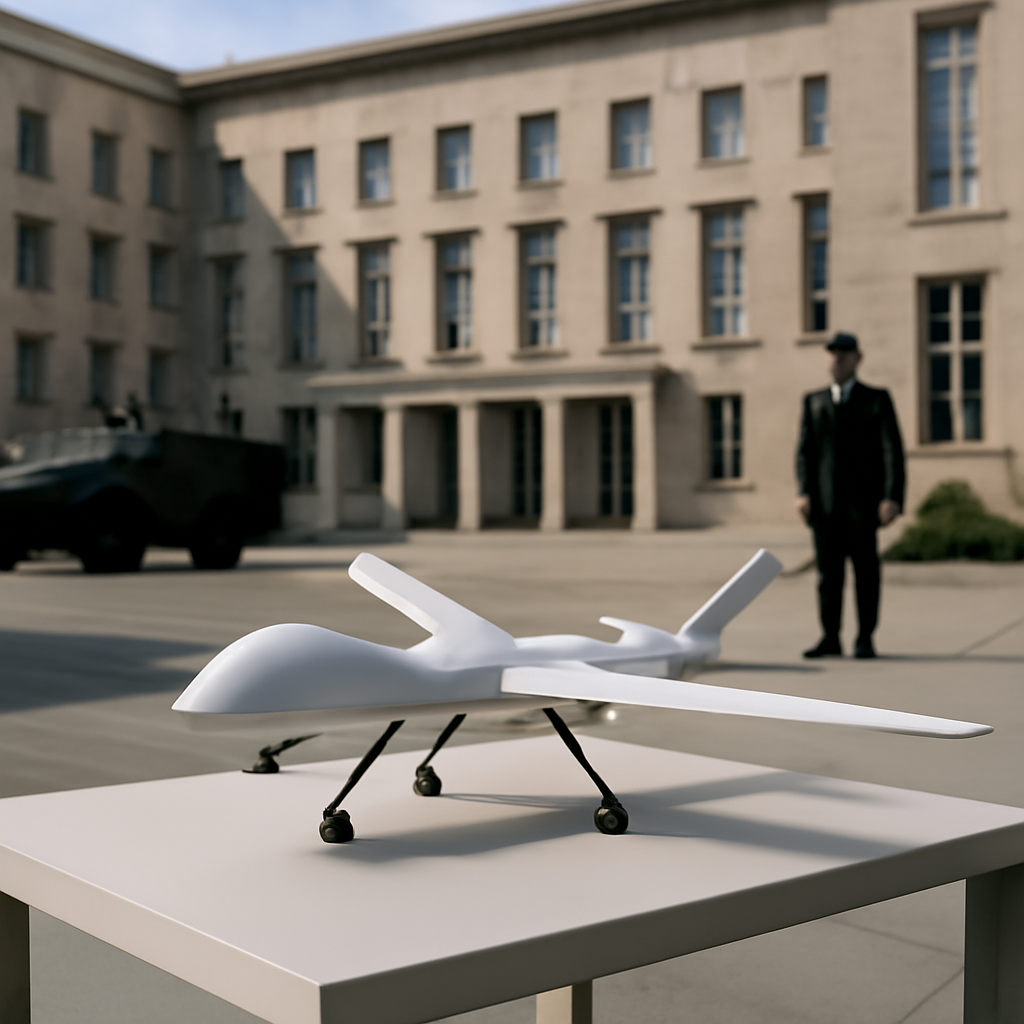
The U.S. Air Force is pursuing a dramatic unit-cost reduction for a Reaper successor. Niemi, the service's Chief Modernization Officer, said the Massed Modular Aircraft (MMA) should approach an approximately $10 million unit price — explicitly excluding sensors and certain other systems — a figure the Air Force describes as "closer to half" the cost of a Collaborative Combat Aircraft (CCA). The service also hopes that CCAs will decline to about $20 million each after full-rate production, Niemi said, according to reporting from Breaking Defense.
An Air Force spokesperson clarified that the MMA cost estimate cited by Niemi "includes only the cost of the air vehicle, without being fully missionized," the reporting states. For context the MQ-9A in service today is generally reported to cost between $30 million and $50 million when sensors, weapons and mission equipment are included — a number Niemi used explicitly while arguing against relying on the in-production MQ-9B to meet current needs.
MMA performance goals and the trade-offs the Air Force is willing to make
The Air Force has set concrete performance requirements for the MMA that mirror the MQ-9A's mission set: at least 200 knots true airspeed; a munition and sensor payload capacity of at least 2,800 pounds; an unrefueled combat radius of at least 2,300 nautical miles with payload; one-way self-deploy capability of at least 8,000 nautical miles; and the ability to operate from runways no longer than 6,000 feet. The MMA must also be highly modular and use open architecture mission systems to simplify future integrations.
Niemi acknowledged bluntly that reaching the $10 million airframe goal will require compromises. "You're going to have to certainly give up something," he said, per Breaking Defense. He added that much of the aircraft's basic performance is "proven, decades-old technology" and suggested the MMA will look much like an MQ-9 in general configuration — likely turboprop-powered with a similarly shaped main wing — so cost savings will come from "smart design compromises" and proven systems rather than cutting-edge airframe breakthroughs.

This site is the portfolio.
OSINTSights runs on Cloudflare Workers, D1, R2, and Vectorize, with an AI pipeline on Hetzner ARM. Nubivance designed, built, and operates it. We do the same for clients.
See what we buildAttrition in operations against Iran and Yemen is accelerating the timeline
The push for a lower-cost, mass producible drone is driven in large part by combat losses. The Air Force has lost MQ-9A aircraft "in the dozens" during operations against Iran this year, and is understood to have lost dozens more Reapers last year during operations targeting Iranian-backed Houthi militants in Yemen. The service reported its MQ-9A fleet had shrunk to 135 airframes as of May, down from an official total of 165 at the start of Fiscal Year 2026; those counts do not include Reapers operated by the Marine Corps or the Central Intelligence Agency.
Air Force officials have praised the MQ-9A's operational performance even as they call the attrition rate "concerning." The MMA program was announced in July with a stated goal of having an initial operational fleet of 20 drones by 2031; the Air Force is now trying to accelerate that schedule but still expects fielding to be "around three years away, at least," while ultimately hoping to acquire at least 180 MMAs.
Industry reactions: General Atomics pushes back while other contractors circle
General Atomics, the long-time maker of the MQ-9 family, has publicly criticized framing the MMA as a lower-cost "disposable" aircraft. C. Mark Brinkley, a General Atomics spokesperson, warned that calls for cheap, disposable designs ignore hard lessons about icing, weather, weapons integration and survivability upgrades on existing platforms. Brinkley has argued that General Atomics' new Wildfire design addresses MMA requirements, could be delivered years earlier, and would preserve the capabilities that "make Reaper special" without breaking the bank.
Niemi, meanwhile, rejected the notion that the MQ-9B — an evolved design developed from the Reaper — can be quickly acquired in large numbers to plug shortfalls, saying the idea that the Air Force could "walk down there with a big fat check and have 100 of them this year" is not reality, per Breaking Defense. The reporting also notes that the competitive field for an MQ-9 successor has broadened beyond the legacy maker, with firms such as Northrop Grumman and Lockheed Martin long discussed as contenders and additional new entrants now seeking to scale production at lower cost.
What this means for policymakers, operators, and General Atomics
- Policymakers and procurement leaders: Budget timing and program structure will determine whether the Air Force can accelerate MMA buys; the service has said it "can't buy an MMA today" and also does not expect to buy many MQ-9Bs immediately because of budget and other constraints.
- Operators and combat commanders: Continued attrition of MQ-9As — reported in the dozens this year — raises near-term readiness and ISR/strike capacity questions; a lower-cost MMA that can be fielded in numbers would be intended to absorb anticipated losses in high-attrition scenarios.
- General Atomics and rival vendors: Expect an active competition between evolved, higher-capability platforms such as MQ-9B/Wildfire and cheaper, mass-producible designs that meet the MMA's stated trade-space; General Atomics is publicly positioning Wildfire as an earlier delivery and capability-preserving option.
The Air Force has set a clear, if ambitious, arithmetic: drive down the airframe price to roughly $10 million while preserving the MQ-9A's ISR and strike reach. Whether the service can reconcile that cost target with the stated performance requirements — and whether industry can deliver a modular, mass-producible design fast enough to blunt current attrition trends — are the immediate questions the MMA program must answer as it moves toward competitive rounds and accelerated fielding.