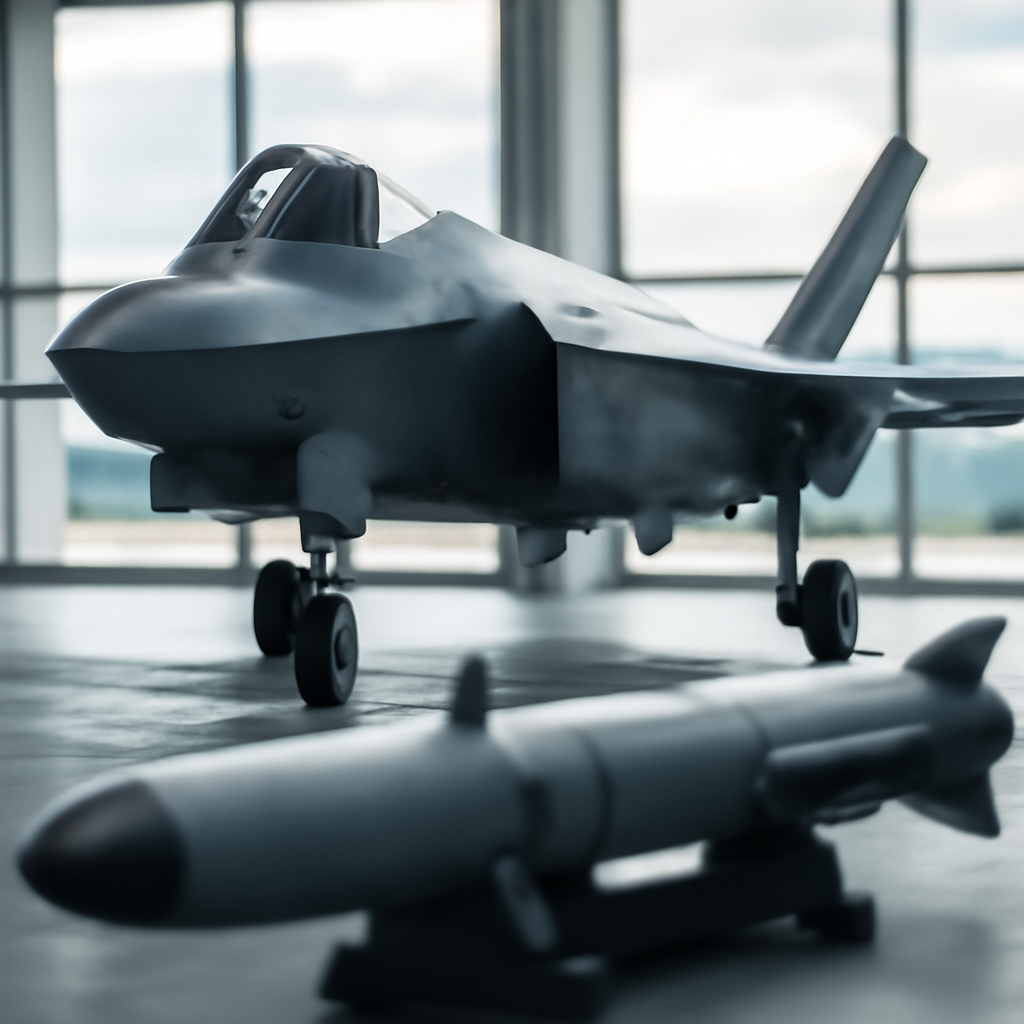
"The AFLRW is aimed at addressing the next generation of Air-Launched Standoff Weapon variants in line with Department of War priorities," according to the industry day notice.
AFLCMC Armament Directorate (EB) industry day at Eglin AFB, Aug. 25–26
The Air Force Life Cycle Management Center’s (AFLCMC) Armament Directorate (EB) has scheduled a two‑day, classified industry engagement at the Guided Weapons Evaluation Facility (GWEF) at Eglin Air Force Base in Florida on August 25 and 26. The notice sets the event at the Secret classification level and requires appropriate security clearances for attendees. The meeting is presented as an opportunity for the service to share requirements for the new Air Force Long Range Weapon (AFLRW) program and to assess industry options.
AFLRW: a 1,000‑nautical‑mile threshold and two variants
The notice makes clear that AFLRW will include both air‑to‑air (A/A) and air‑to‑surface (A/S) variants and places a threshold minimum range of 1,000 nautical miles on both types. It emphasizes a focus on the A/A solution for Initial Operational Capability, says AFLRW "may select multiple vendors for both the Air‑to‑Air (A/A) and Air‑to‑Surface (A/S) variants," and seeks a "Master Integrator" to assemble components into an all‑up‑round. The Air Force also told industry to expect a quick‑turn whitepaper Request for Information following the event.

Audit-ready is a season. It shouldn't be.
Evidence in spreadsheets, controls drifting between audits, frameworks multiplying on flat headcount. Nubivance runs continuous compliance on Rapid7 Cyber GRC - SOC 2, HIPAA, ISO 27001, PCI, CMMC.
End the scrambleComparisons with legacy and recent missile efforts
By the numbers, the AFLRW threshold is striking. The notice contrasts with the generally understood maximum reach of the AIM‑120D‑3 AMRAAM—around 100 miles (close to 87 nautical miles). The source material notes AIM‑120 longer‑range versions may be in development and that the AIM‑260A Joint Advanced Tactical Missile (JATM) likewise lists extended reach as a key requirement, but the JATM is still not expected to approach AFLRW’s 1,000‑nautical‑mile benchmark.
The record of past programs shows ambition but not at this scale. The Cold War Advanced Strategic Air‑Launched Missile (ASALM) targeted a maximum range of about 300 miles (260 nautical miles). Joint efforts since the mid‑2000s—Joint Dual‑Role Air Dominance Missile (JDRADM), the Next Generation Missile (NGM), and related initiatives such as the Triple Target Terminator (T‑3) and the Long Range Engagement Weapon (LREW)—have explored dual‑role and extended‑reach concepts but did not publicly reach the AFLRW threshold. The Navy’s recent Advanced Emission Suppression Missile (AESM) notice seeks a long‑range anti‑radiation missile capable of engaging air and surface targets, and the Navy has begun fielding an air‑launched version of SM‑6, designated the AIM‑174B, which observers place in a broadly similar range category to ASALM rather than near 1,000 nautical miles.
Targets, doctrine, and the networked kill web
The notice and related analysis make explicit the types of targets AFLRW is intended to threaten: airborne early warning and control (AEW&C) aircraft, tankers, bombers, surveillance and reconnaissance platforms, electronic‑warfare aircraft, and other high‑value aerial assets operating well behind front lines. TWZ and the Air Force’s own 2024 report to Congress described such "AWACS killer" effects; the 2024 Air Force report warned that "Counterair weapons with ranges out to over 1,000 miles and supported by space‑based sensors will place aircraft, such as tankers, that have traditionally operated with impunity, at risk."
Because launch platforms will not carry the sensors needed to find and track targets at those distances, AFLRW concepts in the notice implicitly require deep integration into a distributed, multi‑domain "kill web"—one that draws on air, land, sea, space, and cyber layers. The source highlights the growing role of space‑based aircraft tracking and distributed satellite constellations providing AMTI/GMTI capability as essential enablers for these long‑range kill chains.
What this means for the Air Force, the Navy, and space sensor programs
- Air Force: The service is seeking a weapon that can hold priority air, land, and sea targets at risk from very long standoff distances, and it is already considering nontraditional launch concepts—such as employing the B‑21 Raider as a "weapons truck"—to field such capability.
- Navy: The Navy’s AESM notice and the AIM‑174B effort place naval concepts in proximity to AFLRW aims; the services’ separate efforts indicate overlapping interest in long‑reach anti‑air and anti‑radiation effects.
- Space sensor programs: The notice and the Air Force’s 2024 report link weapon effectiveness directly to space‑based tracking and GMTI/AMTI constellations, which the U.S. military is actively working to field to support long‑range kill chains.
The Air Force has made clear, in a classified industry engagement framed by the AFLCMC notice, that it wants a solution capable of killing aircraft a thousand nautical miles from launch. The immediate next steps the notice sets in motion are the classified August industry day and a rapid whitepaper RFI; beyond that, the notice signals a major development challenge—propulsion, seeker design, targeting networks, and integration—before AFLRW could move from requirement to fielded system.
Source: TWZ — USAF Wants Air‑To‑Air Missile With A Whopping 1,000‑Mile Range