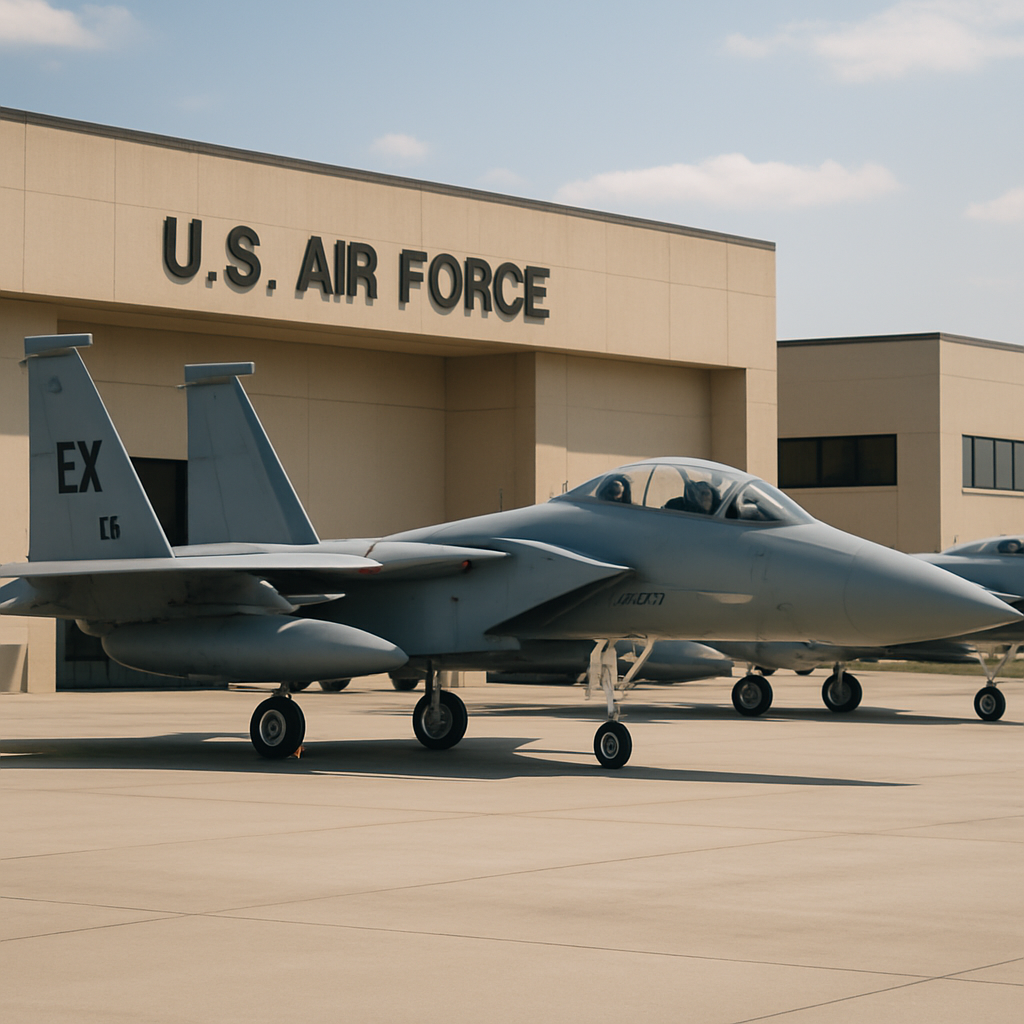
"The planned buy now reportedly standing at 267 jets."
The numbers: a sudden, large shift in the FY2027 buy
The U.S. Air Force’s fiscal 2027 budget request, disclosed in late April 2026, includes an explicit push to expand the F-15EX program from previously planned totals to a fleet goal of 267 aircraft. Breaking Defense reported that the FY2027 request would buy another 24 F-15EXs at a cost of $3 billion, and that the service intends to more than double an earlier buy that had stood at 129 jets. The Air Force expects an overall budget increase of roughly 38 percent versus FY2026, to $338.8 billion, and procurement spending is projected to rise by about 30 percent as part of that package. The plan is presented inside a larger defense request described by the source as “the Trump administration’s gargantuan defense budget for fiscal 2027, which requests approximately $1.5 trillion.”
Why the Air Force says it needs more F-15EXs
An Air Force spokesperson told Breaking Defense the ramp-up is primarily intended to “begin to recapitalize the aging F-15E fleet.” The FY2027 request also includes a proposal to retire 20 F-15Es — specifically the oldest examples, which contain the less powerful Pratt & Whitney F100-PW-220 engines. The service has signaled that keeping the F-15EX production line open longer would allow it to acquire both fifth-generation F-35As and additional F-15EXs, with a third production line only envisioned once a sixth-generation F-47 enters series production.
Operationally, the immediate priority for the F-15EX has been air-to-air missions, reflecting the fact that the Air National Guard — which performs homeland air sovereignty missions — is receiving the first jets. The source argues the F-15EX’s payload, range, open architecture, advanced electronic surveillance and warfare suite, and adaptability make it suitable for homeland defense tasks where stealth is not a necessity, and where rapid response and remaining fuel on arrival are critical.

Audit-ready is a season. It shouldn't be.
Evidence in spreadsheets, controls drifting between audits, frameworks multiplying on flat headcount. Nubivance runs continuous compliance on Rapid7 Cyber GRC - SOC 2, HIPAA, ISO 27001, PCI, CMMC.
End the scrambleCapabilities, sustainment, and test outcomes
The F-15EX’s combat and sustainment profile figures heavily in the rationale. The Office of the Director, Operational Test & Evaluation’s (DOT&E) 2025 annual report is cited as offering a strong endorsement: “Against the level of threat tested, the F-15EX is operationally effective in all its air superiority roles, including defensive and offensive counter-air against surrogate fifth-generation adversary aircraft, as well as basic air-to-ground capability against the tested threats.”
Specific performance and loadout details in the source include a current ability to carry 12 AIM-120 missiles, with future potential to nearly double that air-to-air magazine depth and to host smaller air-to-air weapons that would further expand magazine capacity. The platform is also described as capable of carrying outsized payloads — including hypersonic missiles — over long distances, an attribute tied to potential use as an “arsenal ship” in concert with stealthy aircraft and to serving as a two-seat ‘drone controller’ for a forthcoming Collaborative Combat Aircraft (CCA).
On sustainment, Boeing’s Rob Novotny is quoted saying the F-15EX has a 20,000-hour airframe service life, enabled by a long-duration full-scale fatigue test and structural redesigns that address fatigue-critical locations. The source frames that airframe life as a major contributor to lower lifecycle cost and longer-term value.
What this means for the Air Force, Congress, and the Air National Guard
- For the Air Force: a larger F-15EX buy would create flexibility to retire and replace aging F-15Es, and to cover some retirements of F-16s and A-10s, while keeping a production line “healthy and warm” to meet demand across multiple mission sets.
- For Congress: lawmakers must still approve the FY2027 proposal; the source cautions the budget is “controversial” and expects at least some changes during the appropriations process.
- For the Air National Guard: the ANG — already slated to receive the first F-15EXs and pressing Congress for multiyear funding for large annual fighter buys — stands to get aircraft tailored to homeland air sovereignty and quick-reaction alert duties without relying on stealth attributes.
Conclusion
The Air Force’s FY2027 posture folds tactical, sustainment, and industrial considerations into a single argument: buy more F-15EXs now to recapitalize aging fleets, preserve production capacity, and field a high-payload, long-endurance platform for air superiority and strike roles. The proposal ties into larger program trade-offs — including F-35 Block 4 timing, which the Pentagon says it could accelerate to 2030 if reconciliation is approved — and to planned retirements of legacy types. Congress retains the final say; whether lawmakers will accept the scale of the increase, and how the service will allocate the expanded force among squadrons and mission sets, are the immediate open questions.