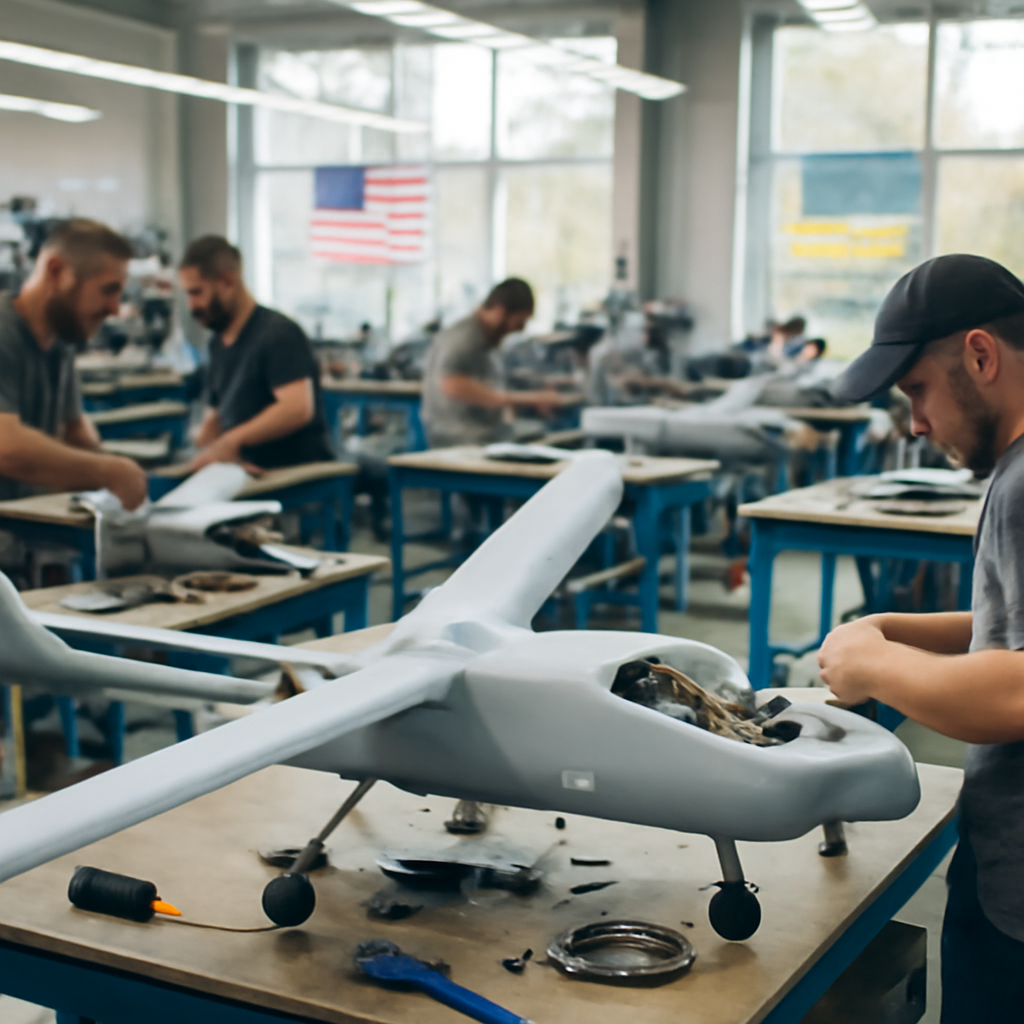
One Ukrainian manufacturer plans to produce more than 3 million first-person-view (FPV) drones in 2026 — roughly ten times the approximately 300,000 drones produced across the entire United States in 2025 — a gap that helps explain why Kyiv and Washington are drafting a memorandum to route Ukrainian drone technology into joint ventures on American soil.
The draft memorandum negotiated by the State Department and Olha Stefanishyna
According to reporting first published by CBS News on May 12, the United States and Ukraine have drafted a memorandum that would create a legal channel for Ukrainian drone technology to enter the American defense supply chain through joint ventures and technology‑transfer arrangements with U.S. firms. The memorandum was negotiated between the State Department and Ukrainian Ambassador to the United States Olha Stefanishyna. It would also permit Ukraine to sell weapons to the United States for the first time since Kyiv effectively restricted arms exports at the start of Russia’s full‑scale invasion in 2022 to preserve stocks for its own forces.
Scale and the structural gap: $1 billion to $35 billion, and rising to $55 billion
Defense News and other reporting cited in the draft show why Washington and Kyiv are moving: Ukraine’s defence production capacity has grown dramatically since the invasion, rising from $1 billion to $35 billion, while domestic contracts covered only about a third of that last year. The National Security and Defence Council projects capacity will reach $55 billion in 2026, against approximately $15 billion in domestic purchasing power. President Zelensky told a May 13 summit in Bucharest that surplus capacity in some weapon categories has reached 50%.

Audit-ready is a season. It shouldn't be.
Evidence in spreadsheets, controls drifting between audits, frameworks multiplying on flat headcount. Nubivance runs continuous compliance on Rapid7 Cyber GRC - SOC 2, HIPAA, ISO 27001, PCI, CMMC.
End the scrambleDrone Deals, CORPUS, and a web of export and procurement initiatives
The memorandum is one thread in a broader export architecture that has unfolded across multiple tracks. On April 28, President Zelensky announced the “Drone Deals” framework — bilateral agreements covering drones, missiles, artillery shells, military vehicles, and software — and said nearly 20 countries are involved at various stages, with four agreements already signed. Two days later, Ukraine and five European nations — Finland, Italy, Norway, Sweden, and the United Kingdom — signed the CORPUS (Coalition for Resilient Procurement and Unified Support) Memorandum, launching a defence‑procurement coalition. Arsen Zhumadilov, who also heads Ukraine’s Defence Procurement Agency, told Kyiv Independent that CORPUS would begin with information sharing and could expand to joint procurement; Denmark, France, and the Netherlands have registered interest in joining.
Defense News reported new joint ventures and cooperation declarations elsewhere as well: six new joint ventures with Germany announced over the last month, and Norway signed a cooperation declaration to mass‑produce Ukraine’s mid‑range strike drones. Zelensky has announced plans to open ten weapons export hubs across Europe in 2026, and production lines are already running in the United Kingdom.
Direct U.S. links: purchases, joint production, and Pentagon outreach
Some Ukrainian companies have already brought technology to the United States. CBS News reported that General Cherry, one of Ukraine’s largest drone manufacturers, signed a deal in March 2026 to produce drones alongside American military manufacturer Wilcox Industries. The U.S. government has bought an initial 1,000 P1‑SUN interceptor drones from Ukraine, and the Pentagon has invited Ukrainian companies to participate in its Drone Dominance initiative — a $1.1 billion program aimed at identifying drones for U.S. military contracts. Separately, Defense News noted Washington lifted a 1997 import ban during a fortnight in which Kyiv adopted its “Drone Deals” export framework, launched European procurement cooperation, and signed several bilateral export contracts while pursuing roughly 20 more across the Middle East and partner countries.
The record also contains signs of earlier resistance: the Kyiv Post noted broader defence cooperation previously faced opposition within parts of the Pentagon and White House, particularly after the start of the U.S.‑Iran war, and reported President Trump publicly stated that the United States “does not need external support” in drone defence. The draft memorandum, if finalized, would represent a significant policy shift from restrictions imposed in 2022.
What this means for Ukrainian manufacturers, U.S. procurement leaders, and European partners
- Ukrainian manufacturers: Firms with large production lines — including the company projecting more than 3 million FPV drones in 2026 — will gain legal pathways to access U.S. capital, joint‑production facilities, and broader export markets through the memorandum and the “Drone Deals” framework.
- U.S. procurement leaders and the Pentagon: The memorandum dovetails with existing U.S. initiatives like the $1.1 billion Drone Dominance program and recent purchases (1,000 P1‑SUN interceptors), creating new options to source tested systems while shifting some manufacturing onto American soil under joint ventures.
- European partners and CORPUS members: The procurement coalition and bilateral joint ventures (including six with Germany and Norway’s cooperation declaration) signal coordinated approaches to scale production and share supply‑chain burden, with Denmark, France, and the Netherlands having registered interest in joining CORPUS.
The draft memorandum sits at the intersection of surging Ukrainian industrial capacity, urgent Western procurement needs, and a nascent, multilateral export architecture. With roughly 800 manufacturers active in Ukraine’s defence sector, four bilateral export contracts already signed and about 20 more under pursuit, the immediate next questions are legal — can the memorandum clear U.S. regulatory hurdles and finalize technology‑transfer guardrails — and operational: how quickly will joint ventures translate inventory on European and American soil into deployable systems?