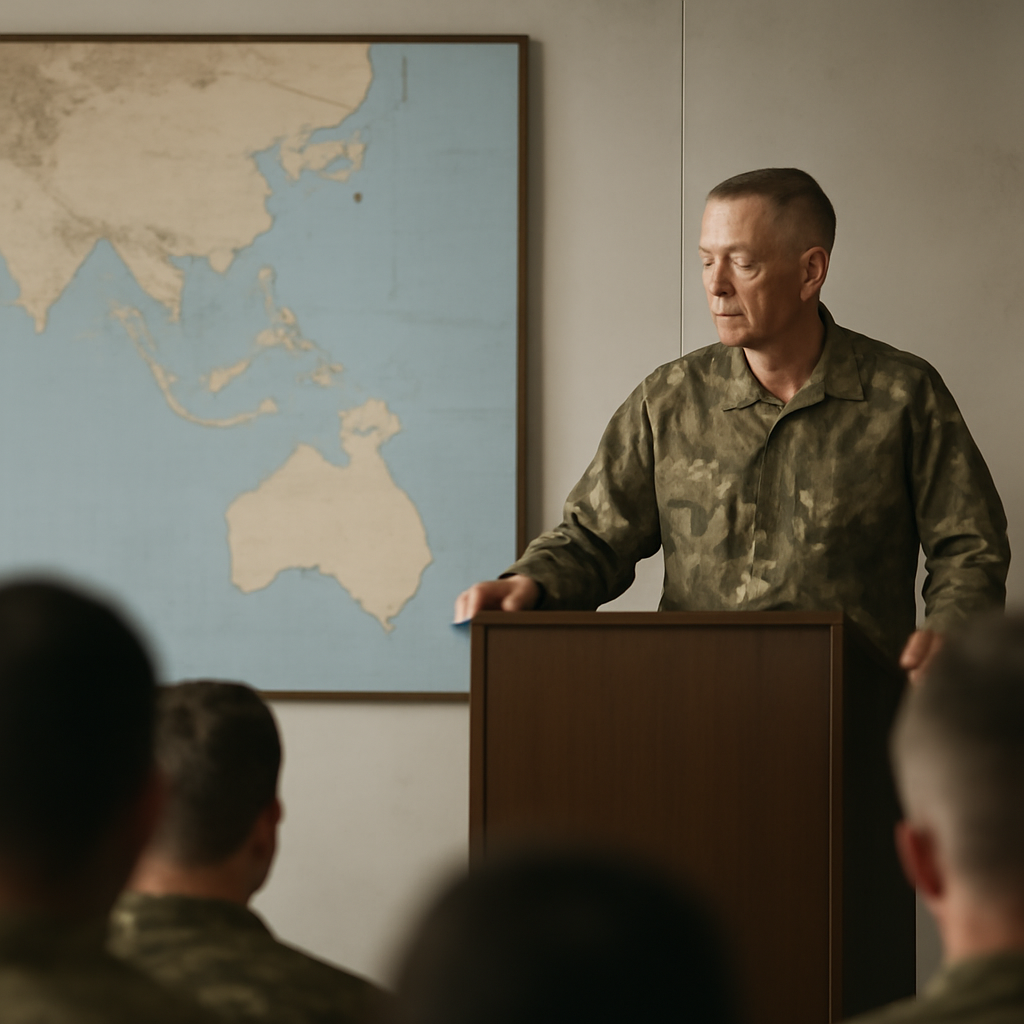
"If an adversary believes that a direct military confrontation with the United States or our allies is likely to end badly for them, that doesn’t necessarily make competition disappear," Army Brig. Gen. Michael Rose warned at the Indo‑Pacific Irregular Warfare Symposium in Hawaii last week.
Rose: conventional superiority pushes adversaries below the threshold
Brig. Gen. Michael Rose, the incoming commander of Special Operations Command Pacific (SOCPAC), told symposium participants that the U.S. advantage in conventional forces changes the nature of competition. Rather than seek open, conventional battle, he said adversaries "look for seams. They operate below thresholds. They exploit ambiguity. They use proxies, information, economic coercion, cyber capabilities, maritime forces, and other asymmetric approaches to achieve objectives without presenting us with a conventional fight for which we are preparing."
That logic, Rose argued, means the U.S. must broaden its approach beyond traditional kinetic deterrence. In the Indo‑Pacific theater the "fundamental problem" is scale: distances are vast and strategically important locations numerous, making persistent presence unsustainable. Autonomy, Rose added, "potentially changes that equation" by expanding reach without commensurate manpower increases.
Autonomy as campaign concept, not just a weapons category
Rose pressed a conceptual shift: "moving beyond autonomous systems towards autonomous campaigning, moving beyond exquisite systems toward distributed networks, moving beyond U.S. capability toward allied and partner ecosystems, moving beyond conventional deterrence to deterrence through resilience and denial, and moving beyond asking how many autonomous systems will help us win a future war, and instead asking how they can help us shape today’s competition."
That formulation reframes autonomy as a means of shaping competition in peacetime and below conventional thresholds rather than simply a force-multiplier for high‑end warfighting.

This site is the portfolio.
OSINTSights runs on Cloudflare Workers, D1, R2, and Vectorize, with an AI pipeline on Hetzner ARM. Nubivance designed, built, and operates it. We do the same for clients.
See what we buildMaj. Gen. Jeffrey Van Antwerp: don't buy tech for its own sake
Maj. Gen. Jeffrey Van Antwerp, who earlier this month turned over SOCPAC command to Rose and now leads the Army’s 25th Infantry Division, urged caution. "You can get caught up in trying to get the better technology, but you haven’t done the fundamental things to be able to leverage that technology well," he said, warning against unfocused experimentation. "We don’t have the time just to experiment without established objectives."
Van Antwerp’s point was procedural as much as strategic: leaders must define the problems they want technology to solve before rushing procurement or trials.
Adm. Frank Bradley and the contested multi‑domain environment
Admiral Frank Bradley, head of U.S. Special Operations Command, framed the threat set in sweeping, technical terms. "We face an increasingly weaponized cyber domain, a virtual domain that is transpiring and transmuting across our societies, an increasingly challenged space‑based surveillance environment, a contested electromagnetic spectrum, and a rapidly emerging agent‑driven artificial intelligence challenge to our security of our digital ecosystems," Bradley said, listing domains that complicate decisionmaking and operations.
Bradley’s description underscores the diversity of non‑kinetic pressures that Rose said adversaries will exploit when conventional confrontation appears risky.
Deputy INDOPACOM Lt. Gen. George Rowell on information dominance
Marine Lt. Gen. George Rowell, deputy INDOPACOM commander, reiterated what he called the megatrend shaping conflict: "the absolute dominance of information in decision superiority." He added that forces must be organized to "observe, orient, decide, act, and learn faster than the adversary," and that "whoever can adopt that mindset, whoever can adopt those technologies and training fastest will certainly win the day."
Rowell’s remarks tie the push for autonomy and distributed networks to a narrower competition over speed of decision and quality of information—not merely platforms or weapons.
What this means for allied and partner ecosystems, U.S. forces, and procurement leaders
- Allied and partner ecosystems: Rose explicitly argued for moving "beyond U.S. capability toward allied and partner ecosystems," signaling an expectation that autonomy and distributed networks will be developed and fielded in multinational configurations rather than as U.S.-only systems.
- U.S. forces and commanders: Rowell’s demand to organize to "observe, orient, decide, act, and learn faster" places information‑centric training, rapid lesson‑cycle management, and integration across cyber, space, and electromagnetic domains at the top of operational priorities.
- Procurement and capability developers: Van Antwerp’s warning—to avoid buying "the better technology" without defined objectives—translates into a practical requirement: establish measurable missions and doctrine before scaling autonomy or other advanced systems.
The symposium threaded a common theme: superior conventional forces can deter open war but will not remove competition—rather, they reshape it. U.S. leaders at the event tied that reality to concrete priorities: build distributed networks, integrate autonomy into campaigning, organize for faster information decision cycles, and temper procurement with clear objectives. The remaining question, left in plain view at the close of the forum, is how quickly those concepts will be translated into interoperable systems and shared doctrine across allied and partner ecosystems.
Source: Defense One — A Pacific conflict may not look like conventional war, SOCPAC commander says