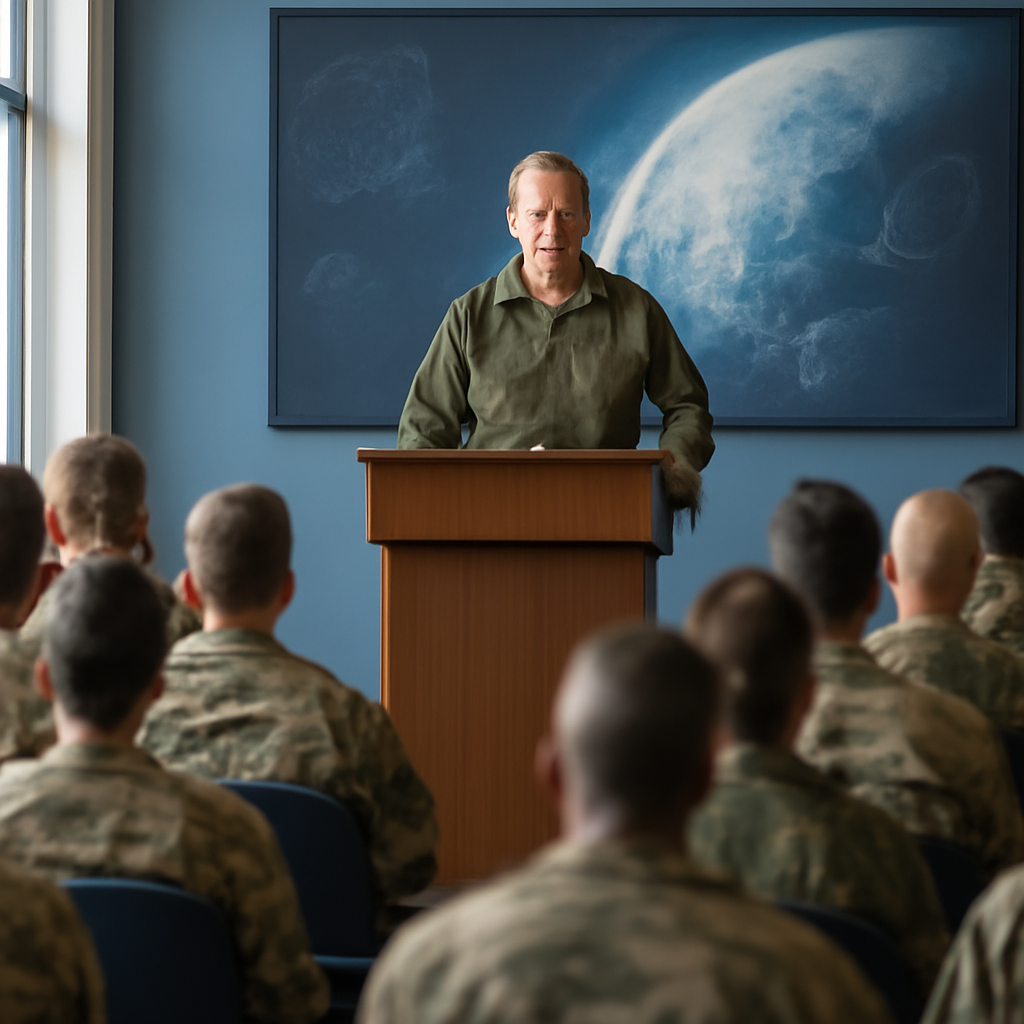
“We fight to win wars,” said Gen. Stephen Whiting, head of US Space Command, Wednesday at the Space and Missile Defense Symposium in Huntsville, Ala. “To win, we need credible, acknowledged, kinetic and non-kinetic fires. They are a key component of how we establish space superiority and restore credible deterrence.”
Gen. Stephen Whiting’s core assertion
At the center of the remarks is a compact, three-part claim: the United States must be prepared to "fight to win wars"; that preparation requires weapons and capabilities described as "credible" and "acknowledged"; and those capabilities include both "kinetic and non-kinetic fires." Gen. Stephen Whiting made this argument publicly at the Space and Missile Defense Symposium in Huntsville, Ala., linking the existence or demonstration of those capabilities to the twin goals of establishing "space superiority" and restoring "credible deterrence." The sentence is literal and tightly packed; each modifier — credible, acknowledged, kinetic, non-kinetic — is presented by Whiting as essential to the end state he describes.
Why the distinction between kinetic and non-kinetic matters
Whiting’s pairing of "kinetic and non-kinetic fires" places physical and non-physical effects on the same conceptual plane. By naming both, he framed a strategy that does not rely exclusively on physical strikes nor exclusively on non-destructive measures; instead, both are presented as components of a broader posture. The public invocation of both categories in the same breath — in a high-profile speech at a formal defense symposium — signals a deliberate emphasis on a multi-domain approach to capabilities in and affecting space.

Audit-ready is a season. It shouldn't be.
Evidence in spreadsheets, controls drifting between audits, frameworks multiplying on flat headcount. Nubivance runs continuous compliance on Rapid7 Cyber GRC - SOC 2, HIPAA, ISO 27001, PCI, CMMC.
End the scramble“Credible” and “acknowledged” as policy signals
Two modifiers in Whiting’s line deserve attention: "credible" and "acknowledged." Credibility is explicitly linked by him to the objective of deterrence — the more believable a capability, the more it supports deterrent effects. The adjective "acknowledged" suggests that, in Whiting’s framing, deterrent value is not only a matter of possessing capability but of openly associating that capability with policy or posture. Together, those terms point to an argument in which visibility and declared capability play a role alongside technical effect.
What this means for policymakers and regulators, technologists and security teams, and adversaries and threat actors
- Policymakers and regulators will need to weigh the balance between public acknowledgement and strategic ambiguity: Whiting’s words put explicit value on capabilities that are both credible and acknowledged, forcing a policy discussion about how much the United States should signal versus conceal.
- Technologists and security teams will be asked to reconcile dual requirements: build forces that can generate both "kinetic" and "non-kinetic" effects while meeting the standards of credibility Whiting describes — a task that touches engineering, testing, and demonstrable performance.
- Adversaries and threat actors will, by Whiting’s logic, be observing public statements and demonstrations for signs of capability and will interpret both the presence and the admission of capability as inputs into their own deterrence calculations.
Setting and coverage: the Space and Missile Defense Symposium in Huntsville
Whiting delivered the remarks at the Space and Missile Defense Symposium in Huntsville, Ala., a venue where military and defense officials traditionally discuss force posture and emerging capabilities. Breaking Defense’s continuing coverage of day two of the symposium is being led on site by Multimedia Director Daniel Woolfolk and Space correspondent Theresa Hitchens, who are in Huntsville "to break down key developments," according to the reporting note accompanying Whiting’s quote.
That logistical fact — the remarks were made publicly at a major symposium and are the subject of immediate, detailed coverage — highlights both the intended audience and the expectation of follow-on explanation. The line between a declaratory statement and a policy announcement is often navigated at venues like this one; the presence of on-site reporters signals that Whiting’s framing will be parsed and amplified to wider audiences.
Conclusion
Gen. Stephen Whiting framed a narrow but consequential argument in Huntsville: to "win" in conflict, the United States must possess and, in certain respects, acknowledge a mix of kinetic and non-kinetic fires that are demonstrably credible. That linkage — capability, acknowledgement, credibility, deterrence — sets the terms for debates that will be fleshed out in the symposium’s continuing sessions and in subsequent coverage. Breaking Defense’s Daniel Woolfolk and Theresa Hitchens are on the ground to do exactly that work of parsing specifics and implications.
Original story: https://breakingdefense.com/2026/08/should-the-us-demonstrate-its-space-weapons/