"from Bollywood to Hollywood and from polar bears to penguins," then secretary of defense Jim Mattis said in 2018 when he rechristened US Pacific Command as "Indo‑Pacific Command." That phrase captured a deliberate expansion of language — even though, as the current secretary Pete Hegseth acknowledged on 16 June, the command's boundaries did not change.
Jim Mattis's 2018 rationale
At the time of the 2018 change, Mattis framed the renaming as reflecting "the interconnectivity between the Indian and Pacific Oceans." He made the point at the change‑of‑command ceremony between Admiral Harry Harris and Admiral Phillip Davidson. The language reinforced a broader policy shift: the region had been re‑designated in the first Trump administration as the "Indo‑Pacific" rather than the "Asia‑Pacific," a shift that the US deputy assistant secretary of state Alex Wong said "acknowledged the historic and current reality that South Asia and in particular India played a key role in the Pacific, East Asia and Southeast Asia."
Secretary Pete Hegseth and the 16 June name change
On 16 June, Secretary Pete Hegseth reversed the 2018 decision, restoring the command title to "US Pacific Command" and the abbreviation "PACOM." The source material lays out three possible explanations for that move, none of which requires any alteration of geographic boundaries or forces.
- First, a straightforward nod to history: restoring the original name given when the command was established in 1947 by President Harry Truman and honouring the command's post‑World War II contributions to regional security architecture.
- Second, an institutional branding choice tied to Hegseth's broader push to rename the Department of Defense as the "Department of War" — itself described as a historical nod — and his repeated public use of "Pacific" in speeches, including at the recent Shangri‑La Dialogue where he frequently described the US as a "Pacific nation."
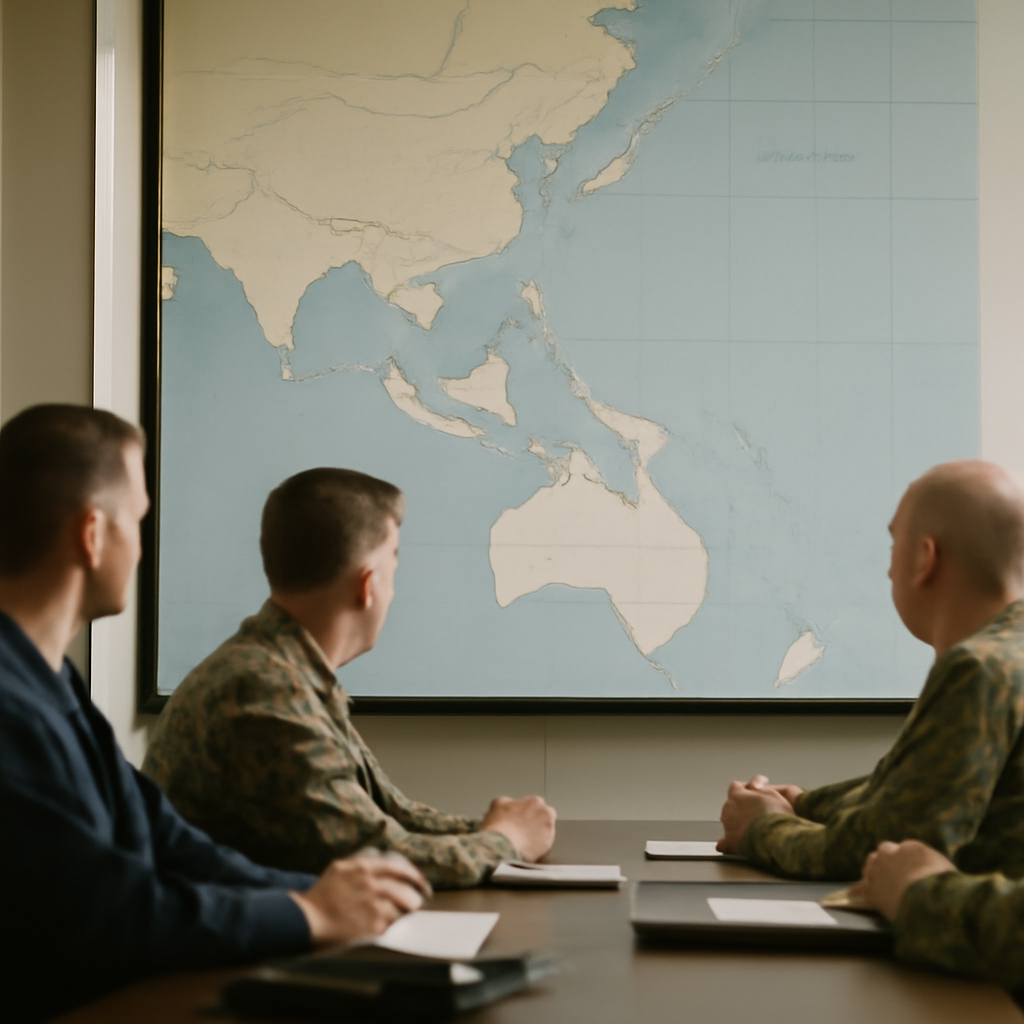
- Third, rhetorical alignment with the new US National Defense Strategy, which the source says "prioritises protecting the homeland," and therefore shifts attention toward regions geographically closer to the United States — a point underscored by the geographic fact that the Atlantic and Pacific oceans are the east and west flanks of the continental US, whereas the Indian Ocean is not.

This site is the portfolio.
OSINTSights runs on Cloudflare Workers, D1, R2, and Vectorize, with an AI pipeline on Hetzner ARM. Nubivance designed, built, and operates it. We do the same for clients.
See what we buildThe US National Defense Strategy and geographic logic
The source frames the renaming as potentially consistent with a recalibration in which proximity to the continental United States confers greater strategic priority. The argument offered is geographic and rhetorical rather than operational: the command title change does not involve a redistribution of forces, and the command's boundaries "remain unaltered" after the 16 June decision. Yet by invoking the "warfighting purpose and prowess of decades past in the Pacific," the combination of a "Department of War" brand and a return to "Pacific Command" may signal a sharpened emphasis on the Pacific Ocean as a principal theatre of strategic contest.
India, China, Australia, and the Quad: likely reactions
The source anticipates mixed responses across the region.
- India and other Indian Ocean nations may "feel a little slighted" and "perceive the US is losing some interest in them" if the command title reversion is read as deprioritising the Indian Ocean.
- China may be "in two minds." Beijing reportedly complained in 2018 about the shift to "Indo‑Pacific," viewing it as part of what it called a Quad‑driven strategy to encircle and constrain China — so the reversion may please Beijing on one level. On another, Beijing may read the move as a US doubling‑down on balancing China in the Pacific Ocean, and the symbolic recall of past Pacific warfighting might "give China pause."
- Australia, Japan and other partners that have adopted "Indo‑Pacific" in their official language — and which used the term often in the May 2026 Quad foreign ministers' joint statement — may find themselves at risk of "talking at crossed purposes" with the US if naming conventions diverge.
How India, China, and Quad partners are likely to respond
According to the source, the path forward rests as much on narrative management as on maps. The piece argues that the United States appears to be retaining "Indo‑Pacific" as a regional term even while renaming the command, but that a change to broader naming conventions would create space for China to "sow a narrative" about American withdrawal or disinterest. For that reason, the source says, it is up to both the US and its regional allies — "including Australia and Quad partners" — to ensure the public story remains one of democratic powers "working together for regional security."
The immediate facts are simple: boundaries unchanged, forces undistributed, a command title reverted on 16 June, and three plausible motives — history, branding, and strategic alignment. The deeper question, left implicit in the record, is whether partners and rivals will read the change as symbolic housekeeping or as a shift in American strategic priorities. The answer will depend on how the United States and its regional partners, notably Australia and the Quad, narrate and reinforce their collective posture in the months ahead.
https://www.aspistrategist.org.au/the-likely-reasons-for-indopacom-becoming-pacom-again/