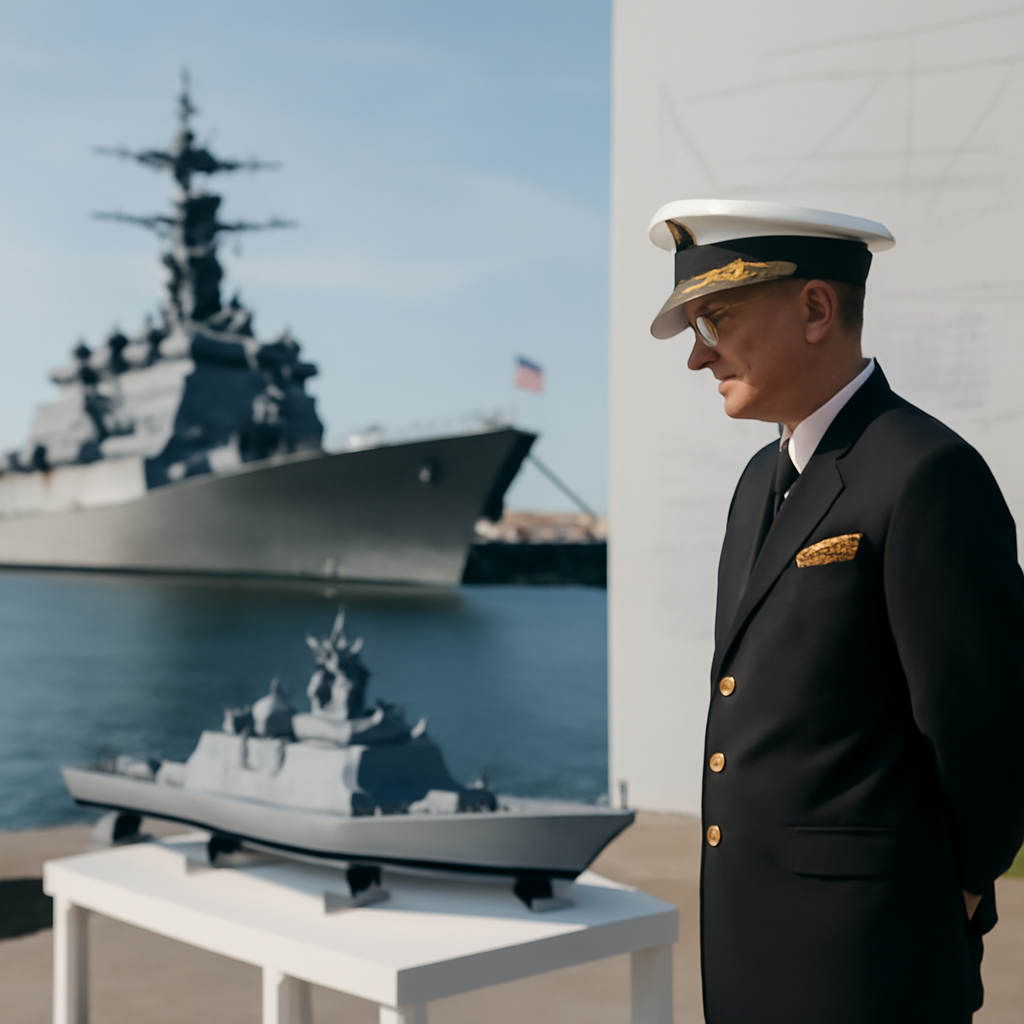
"We see this as reflecting a high level of trust in and appreciation for equipment that embodies the advanced technologies of our ships," Adm. Saito Akira told The Diplomat on September 8 — a measured welcome from Japan as Washington weighs allied frigate designs for the U.S. Navy.
What Washington is reviewing and how it is funded
Reports in U.S. and defense media in June and September show the White House and the U.S. Navy examining three allied frigate designs: Japan’s upgraded Mogami class (the New FFM or 06FFM), South Korea’s Chungnam class (the FFX Batch III design), and Turkiye’s Istanbul class. USNI News on September 1 said the review could allow up to two ships to be built overseas before production moves to U.S. yards. The Pentagon’s fiscal year 2027 budget proposal included $1.85 billion for an effort involving foreign warship designs, placing Japan and South Korea at the center of the discussion.
Adm. Saito Akira: a public signal from Japan
At the September 8 press conference, MSDF Chief of Staff Adm. Saito Akira declined to comment on specific U.S. shipbuilding plans, saying he was “not in a position to comment on individual U.S. Navy shipbuilding plans.” But he framed possible U.S. interest as a compliment: “I am frankly pleased,” he added, and said that if Japan received requests for cooperation, “we would respond proactively.” Saito also said he regularly exchanges views with U.S. Navy counterparts about defense equipment, capability enhancement, and operational cooperation.

Audit-ready is a season. It shouldn't be.
Evidence in spreadsheets, controls drifting between audits, frameworks multiplying on flat headcount. Nubivance runs continuous compliance on Rapid7 Cyber GRC - SOC 2, HIPAA, ISO 27001, PCI, CMMC.
End the scrambleThe technical contenders: New FFM versus Chungnam (and a third option)
The New FFM — Japan’s upgraded Mogami class — is being touted for export after a visible win in Canberra. The New FFM is expected to feature a 32-cell vertical launch system, long range, stealth-oriented design features, and reduced manning, attributes the U.S. Navy has expressed interest in for a frigate that can shoulder lower-end missions now handled by Arleigh Burke-class destroyers.
South Korea’s Chungnam class (FFX Batch III) is the other principal candidate in the U.S. review. USNI News’ reporting identified both it and the New FFM as under consideration, but described no single favorite. Turkiye’s Istanbul class also appears on the short list.
Industrial posture: Hanwha, HD Hyundai, JMU, and U.S. outreach
South Korea brings industrial scale and a growing U.S. footprint. Hanwha acquired Philly Shipyard in 2024, giving a South Korean company direct U.S. shipbuilding presence. U.S. officials have repeatedly visited South Korean yards, and in December 2025 U.S. President Donald Trump said the Navy would work with Hanwha on a new frigate. That U.S. footprint fits the administration’s described “Finland model”: initial construction overseas followed by investment and production in the United States.
But Hanwha is not the lead designer of the Chungnam class. The detailed design and lead ship were handled by HD Hyundai Heavy Industries, while Hanwha Ocean and SK Oceanplant are building follow-on ships. That distinction matters because Hanwha’s shipyard investment in the United States does not automatically translate into a decisive design advantage for the Chungnam class.
Washington’s engagement has not been limited to Seoul. Then-Navy Secretary John Phelan visited Japan in April 2025, meeting Adm. Saito and touring Japan Marine United (JMU). The Navy said the visit aimed to learn industry best practices and encourage investment in American shipyards.
Australia’s choice and the adaptation challenge
Australia’s procurement process provides a recent precedent. In 2024 Canberra identified Japan’s Mogami class and South Korea’s FFX Batch II and III among exemplars for its future general-purpose frigate, later narrowing the field to Mitsubishi Heavy Industries and Germany’s TKMS and then selecting the upgraded Mogami — the New FFM — in August 2025. That export success gives Japan a tangible case study of the New FFM in coalition procurement.
Neither the New FFM nor the Chungnam design would be plug-and-play for the U.S. fleet. Both would require adaptation to U.S. Navy combat systems, weapons, communications, cybersecurity, and information-security requirements. Congress also remains wary of building U.S. warships overseas — a political constraint that could shape how many hulls, if any, are constructed abroad before U.S. yards take over.
What this means for U.S. policymakers, U.S. shipbuilders, and Japan and South Korea
- U.S. policymakers and Congress: They must balance two questions Washington is effectively weighing — which ally can best help rebuild the U.S. shipbuilding industrial base, and which frigate design best fits fleet needs — while confronting political sensitivity about foreign construction of U.S. warships.
- U.S. shipbuilders and yards: Firms will watch any commitment to initial overseas construction followed by U.S. production, and how lessons from visits to Japanese and Korean yards inform potential investment or technology transfer that could relieve domestic capacity constraints.
- Japan and South Korea defense industries and navies: Japan can point to the New FFM’s recent export win and Adm. Saito’s public openness; South Korea offers greater production capacity and an existing U.S. yard footprint through Hanwha — advantages that amount to an industrial head start, not an inevitable design victory.
The contest, then, is both industrial and technical. South Korea’s U.S. investments give it important initial advantages on capacity. Japan’s New FFM carries export credibility and design features aligned with U.S. frigate needs. Washington’s decision will hinge on which combination of industry, capability adaptation, and political feasibility best serves the Navy’s stated goals.
https://thediplomat.com/2026/09/japan-and-south-korea-face-off-again-in-the-us-navys-frigate-search/