"I was honored that USVDIV-32 was given the opportunity to execute the Navy’s first GARC Live Fire during RIMPAC 2026."
USVDIV-32 at RIMPAC 2026
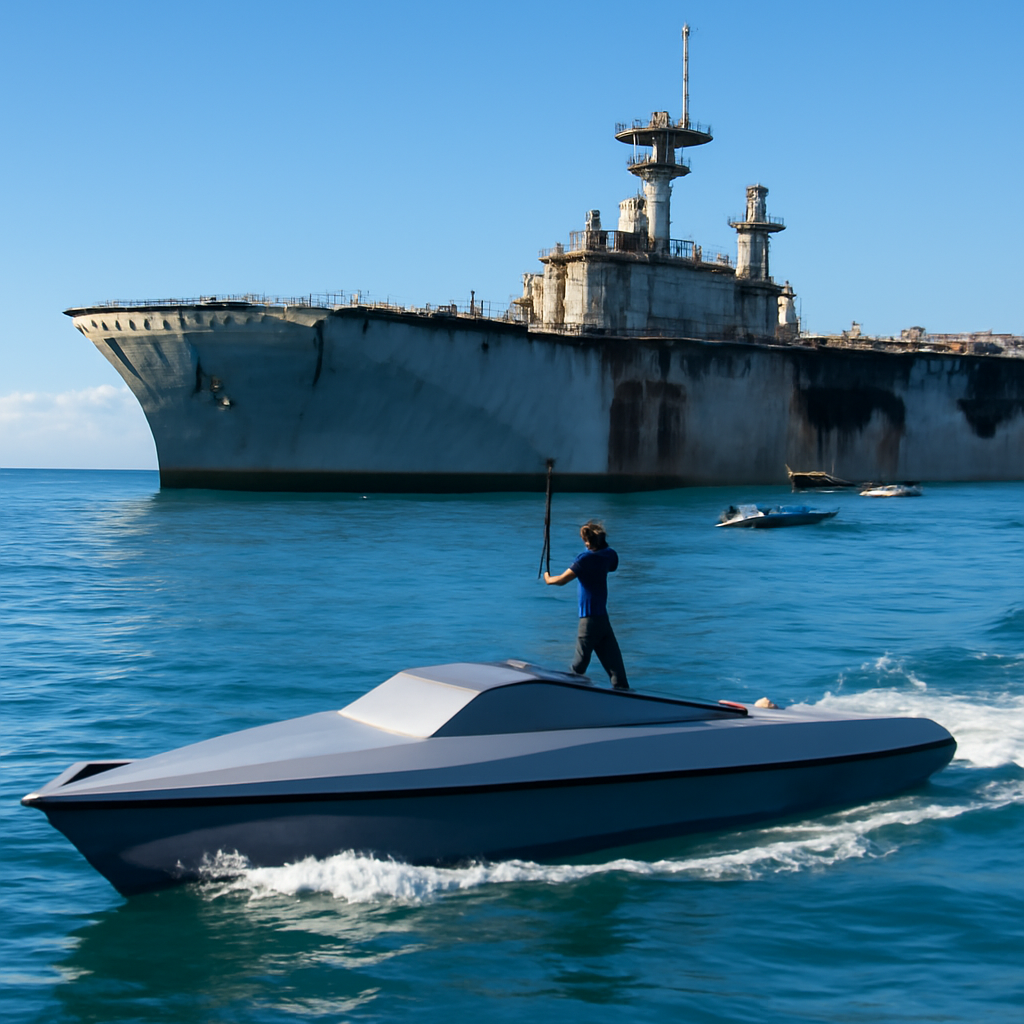
The U.S. Navy has confirmed that a Global Autonomous Reconnaissance Craft (GARC) uncrewed surface vessel took part in a live-fire sinking exercise (SINKEX) during RIMPAC 2026. The event unfolded on July 17 against the decommissioned Tarawa-class amphibious assault ship ex‑USS Peleliu. The Navy released video on July 24 showing USVs in the exercise; that footage, captured by a second drone boat, inspected damage inflicted on the assault ship.
GARC technical profile and the attack
Built by Baltimore-based BlackSea Technologies, the GARC is roughly 16 feet long, displaces about 4,800 pounds at full load, and has a stated range of 700 nautical miles at 22 knots. A source familiar with the SINKEX told TWZ that two GARCs were present but only one was used destructively in an end-to-end attack. That USV carried a 1,000-pound payload; the source said it is unclear how much of that weight was accounted for by the warhead. The released footage shows significant damage to the former USS Peleliu, especially around the waterline, with water already coming aboard.

Audit-ready is a season. It shouldn't be.
Evidence in spreadsheets, controls drifting between audits, frameworks multiplying on flat headcount. Nubivance runs continuous compliance on Rapid7 Cyber GRC - SOC 2, HIPAA, ISO 27001, PCI, CMMC.
End the scrambleAutonomy and Anduril’s Lattice
The destructive GARC in the SINKEX operated with a full autonomy package described in the reporting as Anduril’s Lattice. The use of a full autonomy stack in a live-fire, end-to-end attack represents a concrete example in which an uncrewed surface vessel executed sensors-to-effectors behavior without direct human control during the engagement, according to the source account.
Training, doctrine, and the rise of a new Navy specialty
USVDIV-32, established earlier this year, is tasked with maintaining and implementing unmanned vessels. The division regularly conducts exercises and training with multiple platforms, the Navy said, and took GARCs to Baltic Operations (BALTOPS) 2026 in June to provide realistic counter‑USV training to NATO allies while operating alongside the command-and-control ship USS Mount Whitney. The division also previously employed GARCs during UNITAS 2025 to test how unmanned and remotely operated vehicles and vessels could extend interconnected manned-platform sensors across a multinational force.
The division includes the new rate Robotics Warfare Specialist (RW). In a Navy release, Chief Robotics Warfare Specialist Christian Butler said: "I think most commands, if not all commands, are going to have some component of RWs. Just because there’s no going away from unmanned systems at this point, they’re only going to grow in scale, and you’re going to need RWs to carry that weight."
Operational precedent: CENTCOM strikes, Houthis, and the Magura family
The GARC live-fire at RIMPAC follows a rapid series of developments in the operational use of one‑way attack USVs. The U.S. military employed USVs as offensive strike weapons for the first time on July 12, according to U.S. Central Command, when Corsair USVs were used in strikes against “dozens” of Iranian targets, including an Iranian Ghadir-class diesel-electric midget submarine. CENTCOM also reported that three Corsair unmanned surface vessels hit the port at Bandar Abbas Naval Base. Earlier operational precedents cited in the reporting include explosive-laden Houthi drone boats striking a Saudi frigate in 2017, and Ukraine’s use of Magura-family drone boats against the Russian Black Sea Fleet.
What this means for RWs, NATO allies, and technologists
- Robotics Warfare Specialists (RWs): Units like USVDIV-32 that include RWs will likely be the hands-on operators and maintainers of GARC-class systems during both training and live operations; the Navy’s statements make RWs a planned, institutional role.
- NATO allies and regional partners: BALTOPS training showed USVDIV-32 providing counter‑USV training to NATO forces; allies will be watching both defensive and offensive lessons from the RIMPAC employment of GARCs.
- Technologists and autonomy developers: The use of Anduril’s Lattice in a full autonomy package for an end-to-end attack will draw attention to how autonomy stacks are integrated with weapons, sensor suites, and operational concepts for one-way USVs.
The RIMPAC GARC live-fire is concrete proof that the U.S. Navy is fielding one-way attack USVs in training and is prepared to exercise them in live-fire settings. Questions that remain in the public record include the precise composition of the 1,000-pound payload and further operational details; TWZ said it had reached out to RIMPAC officials for additional information. The broader arc in the reporting is clear: GARCs are moving from exercises into demonstrable, kinetic roles, and the Navy is organizing people and doctrine—through USVDIV-32 and the RW rate—to manage them.