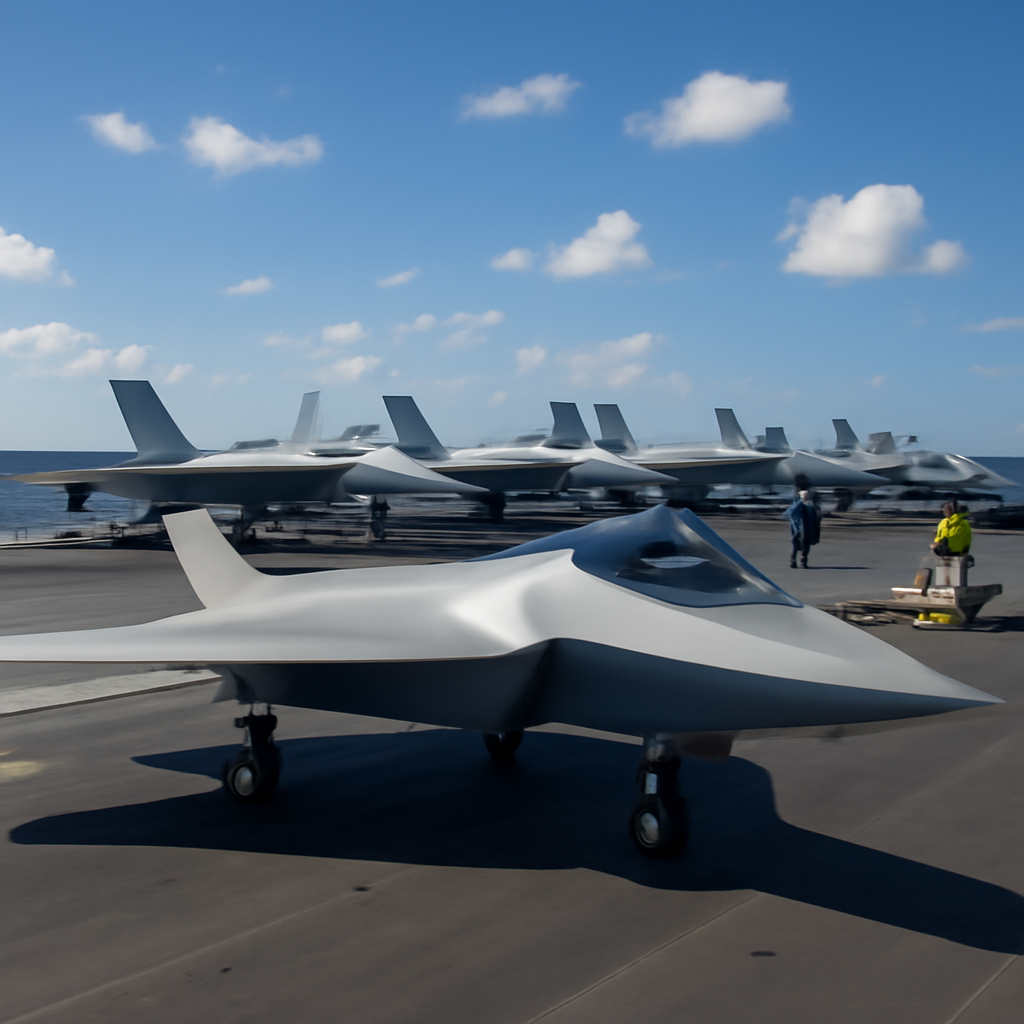
A six-paragraph news release at 5:01 pm on Tuesday was all that marked the launch of one of the biggest US Navy projects of the 21st century: the service had picked Boeing, over Northrop Grumman, to develop its future F/A-XX combat aircraft under a $20 billion contract.
The $20 billion F/A-XX award and the mission ahead
Under that contract, the F/A-XX is slated to begin replacing F/A-18 Hornet fighters and EA-18 Growler electronic attack aircraft from the mid-2030s. The navy will need a production cadence that the article puts at "30-plus fighters a year" to keep carrier air wings filled — a markedly different scale than the Air Force’s projected buy for the related F-47 Next Generation Air Dominance (NGAD) program, which may number between 200 and 300 aircraft.
Why Boeing — scale, prior wins, and shared technology
Boeing entered the navy contest with a recent win behind it: the company beat Lockheed Martin in March 2025 to build the Air Force’s F-47 NGAD. That advantage, together with the 18-month gap between the choice of contractors, meant Boeing "had the F-47 in the bag before making its final navy bid" and could offer to use F-47 program work to break ground and reduce risk for the F/A-XX — particularly on systems integration and software.
Boeing is developing the F-47 on a brand-new campus at St Louis with facilities and workforce it could share with the F/A-XX, including high-end simulation, and benefits from Midwest costs for labour, land and construction. The article also notes Boeing’s size: it is twice Northrop Grumman’s size and is "the largest US exporter," a factor the navy regards as helpful when seeking to protect program funding amid debates over naval force structure.

This site is the portfolio.
OSINTSights runs on Cloudflare Workers, D1, R2, and Vectorize, with an AI pipeline on Hetzner ARM. Nubivance designed, built, and operates it. We do the same for clients.
See what we buildBoeing’s recent record — hits and misses
The article is candid about Boeing Defense and Space’s mixed recent performance. Program trouble spots include the KC-46 Pegasus tanker, and a rocky pathway for the T-7 Red Hawk trainer; reviving the E-7 Wedgetail air-surveillance aircraft "seems to be harder than developing a new type." At the same time, the navy has relied successfully on Boeing: the Super Hornet and Growler "have kept the navy’s air wings credible" despite F-35C delays and deficiencies, and the Boeing P-8 Poseidon maritime patrol program "has gone smoothly." The navy historically prefers primes with navy experience — "and, sorry, the Grumman name, for fighters, is history."
Northrop Grumman’s Sunnyvale problem and industrial trust
Not all program judgments were technical. Tucked away at Northrop Grumman’s Sunnyvale plant is the production line for steam turbines for US nuclear submarines. In 2024 the navy disclosed that Sunnyvale issues were responsible for a 12 to 16 month delay in the completion of USS Columbia, the first boat of a new ballistic‑missile submarine class. Washington sources told the author the navy "wasn’t happy with the USAF-focused prime’s response." That industrial-capability concern appears to have weighed against Northrop Grumman in a competition the navy could not afford to see slip on unrelated platforms.
Program risks: dual programs, secrecy, and exports
The article raises three linked risks now that Boeing holds both the F-47 and F/A-XX competitions. First, there is the classic worry about concentration: giving one prime the lead on both major next-generation fighters risks the government being "no more able to control this double-headed monster of a fighter development effort than it has been for the F-35." Second, program health depends on a "powerful, professional project office" whose staff must be compensated to avoid moving to industry on retirement — an administrative challenge the author questions whether DoD leadership fully understands.
Third, there is a strategic export question. The F-47 and F/A-XX programs are reportedly so secret that they "really need to be as secret as they are," which would make them non-exportable. That leaves no obvious replacement for the main current exportable US type, the F-35. The author warns bluntly that if DoD leaders regard exportability as a distant problem — "that’s a 2050 matter" — they are mistaken: "Foreign F-35 operators will be looking for replacements well before then."
What this means for the US Navy, Boeing, Northrop Grumman, and foreign F-35 operators
- For the US Navy: the service gains a single industrial partner capable of large-scale production and shared program infrastructure, but it also accepts attendant risks around concentration of supply and program oversight.
- For Boeing: the dual wins validate a revived fighter organisation — aided by a new St Louis campus, simulation facilities and Midwest cost advantages — while placing heavy responsibility on sustaining delivery across two distinct, high‑risk programs.
- For Northrop Grumman: the Sunnyvale turbine delay and perceived USAF focus are cited as material negatives in the competition; the company remains a prime but lost this particular fighter contest.
- For foreign F-35 operators: the article signals an eventual gap in exportable next‑generation fighters if the F-47 and F/A-XX remain non-exportable, and suggests those operators will be seeking replacement options well before mid-century.
There is an extraordinary human element to the backstory: the article credits the late Alan Wiechman with keeping Boeing’s St Louis fighter team intact through decades of setbacks and shifting program fortunes, setting them "on a path to victory." That legacy, industrial realities at Sunnyvale, and the hard arithmetic of carrier air-wing production all converge in one fact: Washington has put two of its flagship future-fighter bets into Boeing’s hands. Whether that concentration of capability produces economies of scale or a single-point failure will be one of the Pentagon’s most consequential management challenges over the next decade.