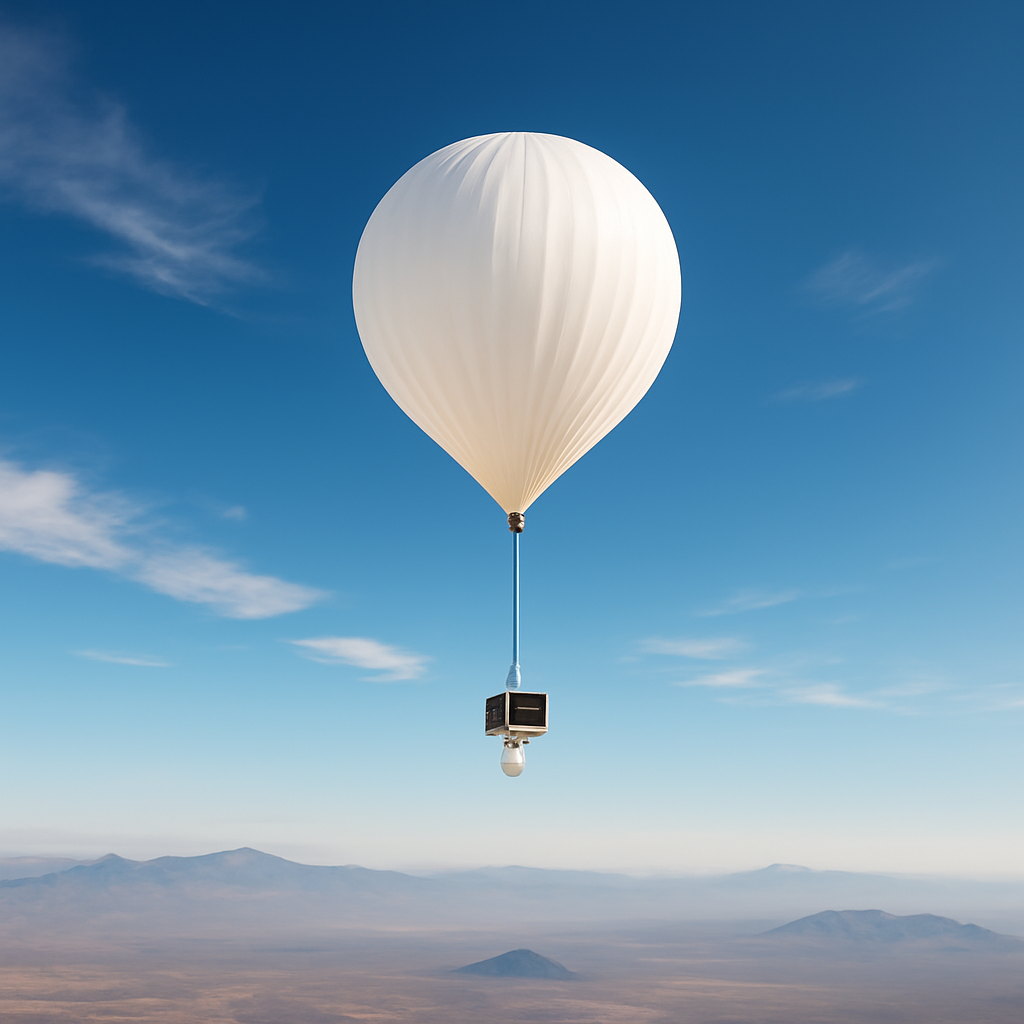
“We discovered along the way that the maturity of sensors to operate in the stratosphere was simply not there,” Andrew Evans said, summing up why the Army is about to fly a new prototype pairing small sensors with a high-altitude balloon.
Project Wallabee: an Army–J‑7 test in the coming days
The Army’s intelligence hub (the G‑2) and the Joint Staff’s J‑7 are set to test Project Wallabee — an autonomous target recognition sensor mounted on a stratospheric high‑altitude balloon — “in the coming days,” a senior Army official told Breaking Defense. The exercise marks the first time the military will field manufacturer Urban Sky’s high‑altitude balloon together with Applied Intuition’s small sensor, officials said.
Why the stratosphere is a hard place for sensors
Evans, director for the new Strategy & Transformation Office inside the G‑2, framed the test as a response to physical limits imposed by the stratosphere. The stratosphere begins at about 60,000 ft. above the Earth’s surface and presents “harsh physical limitations caused by extreme weather and thinning air,” he said. That environment favors very light platforms that contend with low air density; historically, installed payloads have been “much heavier and require much more power,” rendering them ineffective at those altitudes.
Wallabee aims to address those constraints by combining “advancements that are happening with stratospheric balloons with advancements happening in miniaturizing sensors that can operate [in] the stratosphere,” Evans said, stressing the need for systems that handle “vast temperature swings” while remaining lightweight.

This site is the portfolio.
OSINTSights runs on Cloudflare Workers, D1, R2, and Vectorize, with an AI pipeline on Hetzner ARM. Nubivance designed, built, and operates it. We do the same for clients.
See what we buildG‑2, J‑7 Warfighter Laboratory Incentive Fund, Urban Sky and Applied Intuition
The exercise pairs Army G‑2 efforts with the J‑7’s Warfighter Laboratory Incentive Fund program. The two vendors named in the test are Urban Sky (the balloon manufacturer) and Applied Intuition (the sensor provider). Evans positioned the test as experimental: the Army and J‑7 are “experimenting before heavily investing in a product or program,” he said, seeking early lessons so that the service does not make “enormous investments” and then regret repeated mistakes.
How Wallabee connects to a larger balloon swarm experiment
Officials described Wallabee as “complementary” to a larger balloon swarm exercise planned for later this year. That swarm was originally slated to take place in the Indo‑Pacific theater; Evans told Breaking Defense at an annual AAAA conference earlier this year that it would be held “some place else,” but did not disclose where. Results from Wallabee will inform those future experiments, providing lessons on what works — and what should not be repeated before larger commitments are made.
What this means for early entry forces and Army experimenters
- Early entry forces: The Army described the broader goal as creating a “multi‑layered, robust sensing ecosystem” that combines ground, airborne, stratosphere and space‑based sensors. Evans said the approach is intended to give early entry forces tools to “find” without relying on uncontested communications or “exquisite space‑based sensing systems.”
- Army experimenters and procurement leaders: Wallabee is explicitly an experiment to test miniaturized payloads in the stratosphere and to learn before committing large resources. Evans emphasized learning early from tests “that are things you don’t want to repeat” so those lessons come before “it’s too late.”
Evans cautioned that the test is not a declaration of mission success. “We’re not yet ready to declare, you know, mission success here. What we are ready to declare is that we know we need to do this. We must do this. It’s a domain we must exploit,” he said. The immediate next step is the Wallabee flight in the coming days; the results will shape how the Army and the Joint Staff proceed with balloon‑borne sensing and the larger swarm exercise later this year.