"The team successfully completed testing, meeting or exceeding its test execution objectives," the U.S. Air Force wrote in a release describing experiments conducted September 7–11, 2026.
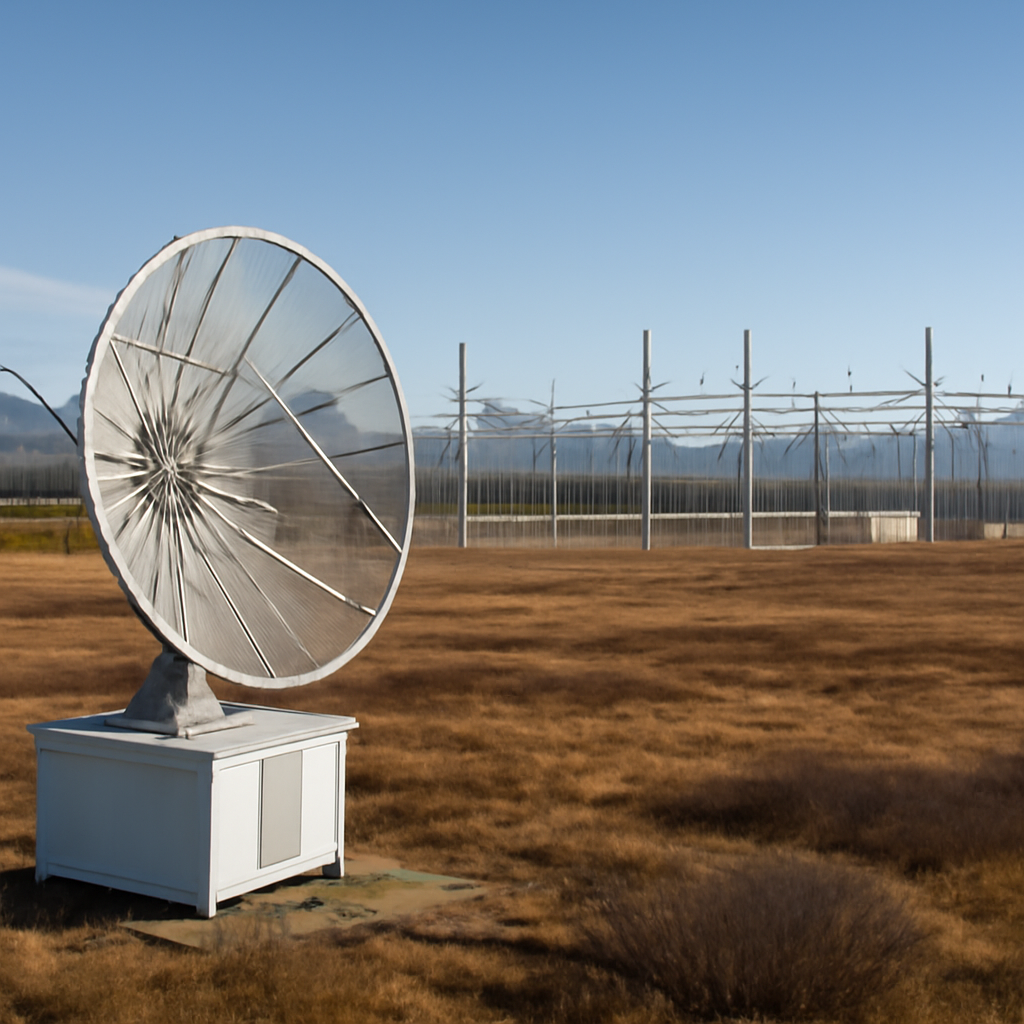
The exercises used the University of Alaska Fairbanks’ High Frequency Active Auroral Research Program (HAARP) facility as a high‑power “illuminator,” paired with a newly developed, low‑cost receiver array in Cold Bay, to test over‑the‑horizon (OTH) radar detection of aircraft across the Gulf of Alaska and Bering Sea. The tests mark a concrete step in efforts to plug persistent surveillance gaps in and around the Arctic, and they re‑open the practical question of whether HAARP — operated since 2015 by the University of Alaska Fairbanks after a prior Air Force decision to transfer the site — could play a role in a future operational OTH network.
September fielding: HAARP transmitter, MITRE 16‑element receiver, and cooperative aircraft
The final round of a three‑year “Arctic air domain awareness” experiment series ran September 7–11 and used HAARP to transmit signals toward the ionosphere while a receiver array in Cold Bay, developed by MITRE, collected returns. The release describes the Cold Bay system as a “newly developed, low‑cost [16‑element high‑frequency] receiver array.”
Researchers flew cooperative targets to provide known positions for correlation: Air Force E‑3 Sentry AWACS aircraft, HC‑130J Combat King II rescue planes, and KC‑135 aerial refueling tankers all participated. According to the Air Force release, initial results showed the experimental arrangement “was successfully able to achieve full skywave (beyond line of sight) detections of aircraft and correlation to truth flights,” while thorough data analysis remains ongoing.
HAARP’s capacity and provenance
The remote HAARP site was built in the 1990s as a joint U.S. Air Force and U.S. Navy effort that also involved the Defense Advanced Research Projects Agency. The central component of the 33‑acre facility is an array of 180 crossed‑dipole antennas, capable of transmitting up to 3.6 megawatts of radio‑frequency energy, according to the Air Force. Its primary mission was to provide researchers with a state‑of‑the‑art platform for ionospheric study; military work historically focused on long‑range surveillance and communications, including methods for communicating with submerged submarines.
In 2014 the U.S. Air Force announced it would shutter and dismantle HAARP, but the following year the facility was transferred to the University of Alaska Fairbanks and has been operated as a civilian research center since. During the September experiments, caption text accompanying the Air Force release stated HAARP “served as a high‑power illuminator, transmitting signals toward the ionosphere to support the detection of airborne targets over Alaska’s maritime approaches.”

This site is the portfolio.
OSINTSights runs on Cloudflare Workers, D1, R2, and Vectorize, with an AI pipeline on Hetzner ARM. Nubivance designed, built, and operates it. We do the same for clients.
See what we buildSkywave OTHR basics and why the Arctic is different
The tests used skywave or backscatter OTH techniques, the most common OTH form, in which an illuminator array bounces signals off the ionosphere at a specific angle so they return to a geographically separated receiver array. As the reporting explained, these systems trade fidelity for range: while they typically offer “much lower fidelity” than line‑of‑sight radars, they can cover “hundreds of miles to thousands of miles,” with 1,500 miles presented as a common range for powerful skywave systems.
Placement matters. The angle at which radio waves hit the ionosphere dictates range and requires the transmitter and receiver arrays to be sited with respect to the surveillance area. That condition — plus harsh Arctic weather, vast distances, and limited infrastructure — helps explain why the Air Force framed last month’s experiments as an effort to “improve awareness across a region where vast distances, harsh weather and limited infrastructure present challenges for air surveillance.”
What this means for the Royal Canadian Air Force, U.S. defense planners, and MITRE
- Royal Canadian Air Force (Maj. Gen. Chris McKenna): McKenna has said he “suffer[s] from an insufficiency of ISR in the Arctic on a daily basis” and framed OTH radar as “a really important capability.” Canada is building an Arctic Over The Horizon Radar (A‑OTHR) at an estimated cost of more than $4 billion, leveraging technology from Australia’s Jindalee Operational Radar Network (JORN).
- U.S. defense planners and NORAD/NORTHCOM (Lt. Gen. Joseph Jarrard): The U.S. military is tying OTH work into broader initiatives such as the Golden Dome air and missile defense effort. Jarrard warned that a range of new delivery systems — cruise, hypersonic, ballistic missiles, and fractional orbital bombardment systems — require new sensing layers and that some threats can “approach North America from the south” rather than the traditional northerly vector for which legacy radars were designed.
- MITRE and technologists: The September tests validated a low‑cost, 16‑element HF receiver array concept in a bistatic OTH geometry. For technical teams and procurement officers, the immediate prize is a potentially lower‑cost receiver that can be paired with high‑power illuminators to expand long‑range coverage without duplicating very large, expensive facilities.
OTH radars are not a panacea for every emerging threat — the Air Force release and participating officers explicitly tied the tests to filling coverage gaps rather than replacing other sensor layers — but the experiment series demonstrates practical progress on a capability many Arctic planners have long sought.
Whether HAARP itself will be repurposed for an operational OTH radar remains an open question: the Air Force release and accompanying captions describe HAARP’s experimental role, and outside reporting noted that “whether or not this is actually under consideration is still unclear.” Meanwhile, the release makes plain that rigorous data analysis is underway and that the exercise is part of a broader push — alongside projects like Palau’s Tactical Mobile OTH radar effort and Canada’s A‑OTHR — to deepen long‑range sensing in the High North.
Original reporting: https://www.twz.com/news-features/alaskas-haarp-site-now-being-used-to-test-new-air-force-over-the-horizon-radar-tech