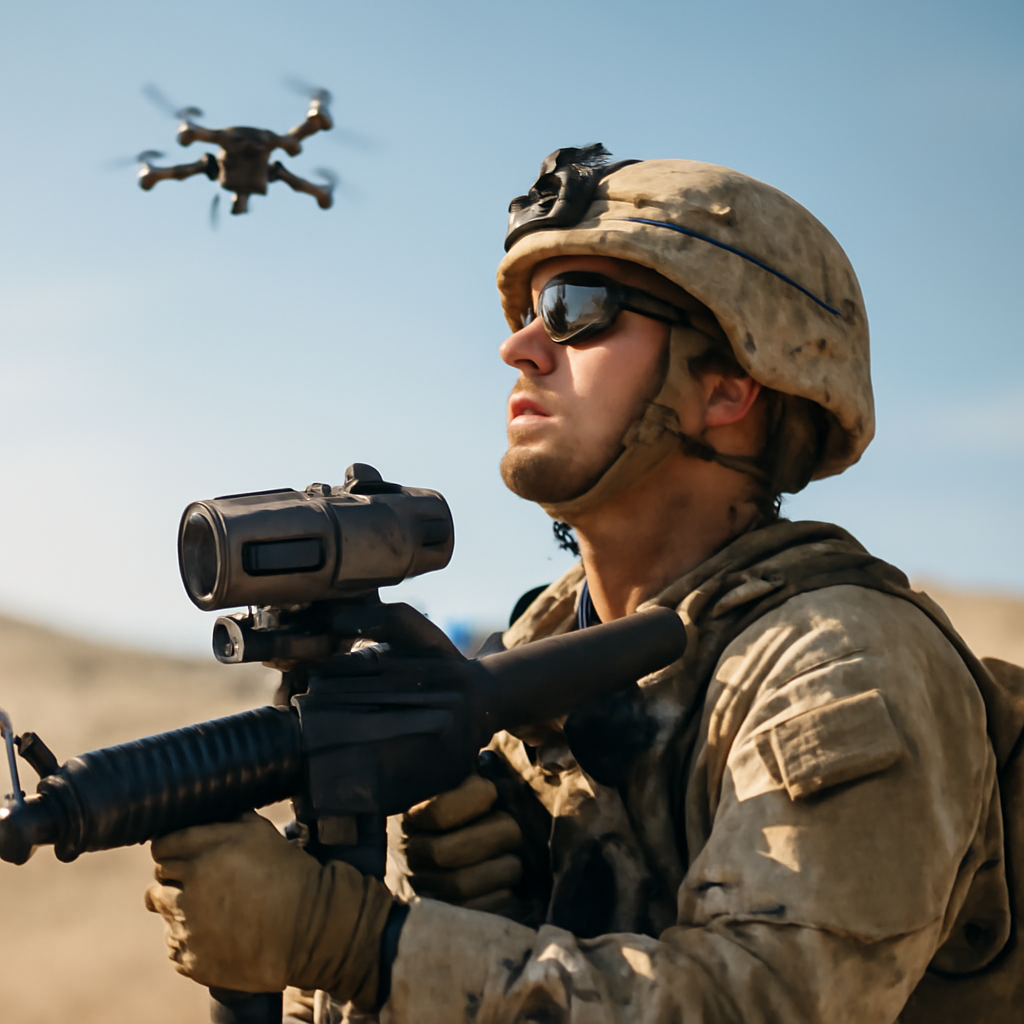
"The necessity for dismounted c-UAS has been a 'common denominator among all these awards we have received in the last six to eight months,'" Scott Thompson, Smart Shooter vice president and general manager for US operations, told Breaking Defense.
Smash 2000LE: a rifle-mounted fire-control built for small, fast targets
Smart Shooter manufactures a rifle-mounted fire control system called Smash 2000LE that the company says digitally identifies targets and "will release the round when [the system] thinks it has the highest probability" of a hit. The system's stated purpose is to increase per-round accuracy when soldiers engage small, fast-moving drones overhead — a technical challenge that the company pitches as a kinetic alternative when electronic countermeasures struggle.
Recent U.S. orders: Marines, Army, Navy, and Air Force-linked buys
The most recent follow-on contract with the US Marine Corps, signed June 9, was worth $3.4 million. That contract follows a string of awards to Smart Shooter across the US armed forces: a $10.7 million follow-on order from the US Army announced May 11, and the company's first US Navy contract, $1.8 million, announced June 1 with delivery expected later this year. In March the company reported it received its first order via the Joint Interagency Task Force 401 (JIATF); Thompson indicated one of those JIATF orders is intended for the Air Force’s Global Strike Command.

This site is the portfolio.
OSINTSights runs on Cloudflare Workers, D1, R2, and Vectorize, with an AI pipeline on Hetzner ARM. Nubivance designed, built, and operates it. We do the same for clients.
See what we buildJIATF 401 as a procurement 'marketplace' and synchronizer
Thompson likened availability via JIATF 401 to "a kind of military-version of an online marketplace like Amazon," saying the task force "filter[s] through capabilities and make[s] decisions now that makes sense and then users across the military can go to the marketplace and pick out equipment." The Department of Defense describes the task force as having "a global focus and [as] a multifaceted organization leading DoW C-sUAS activities at the nexus of OSW, the Joint Staff, Combatant Command, and the services," and notes protecting critical infrastructure is a key aspect of JIATF’s focus.
Operational history: from SOCOM evaluations to wider service adoption
Smart Shooter's systems have been used by US forces in the field since at least early 2020, when they were observed on rifles of US special forces at Tanaf Garrison in southern Syria. Thompson recounted that the technology was initially evaluated more than five years ago by what he called the Counter Terrorism Technical Support Group — now the Irregular Warfare Directorate IWTSD — which procured systems for SOCOM and sent them to different SOCOM commands. Thompson said that process "began the use of our technology into the US market" and that the system has since moved into the "big army," with interest from the Army Reserves as the company seeks to scale production and distribution.
Threat drivers and platform expansion: fiber-optic drones, Smash Hopper, and SMASH 3000
Thompson pointed to changes in the drone threat as a driver of kinetic solutions: the "increased use of fiber optic drones in Ukraine and in Lebanon," he said, reduces the effectiveness of jamming and other electronic measures and therefore increases demand for systems like Smash 2000LE. Smart Shooter is also pursuing other platforms beyond handheld rifles. The company makes a remote weapon station called Smash Hopper, which can be vehicle-mounted, and it said it is demonstrating that system to another Department of Defense office this month. The company additionally referenced its SMASH 3000 Fire Control System: in December 2025 Smart Shooter said it had received a contract for the Australian Defence Force project LAND 156 LOE 2 to evaluate the SMASH 3000.
What this means for Marine Expeditionary Units, Navy critical infrastructure teams, Air Force Global Strike Command, and SOCOM
- Marine Expeditionary Units: Thompson said the Marines may use the system with their Marine Expeditionary Units, suggesting deployments where dismounted troops face low-altitude drone threats could see broader distribution of Smash 2000LE.
- Navy critical infrastructure teams: The Navy’s $1.8 million contract is framed around protecting critical infrastructure, and the service expects deliveries later this year to meet that mission.
- Air Force Global Strike Command: Thompson indicated one JIATF-linked order is intended for Global Strike Command, reflecting the Air Force’s recent focus "more from an airbase and critical infrastructure [protection standpoint]."
- SOCOM: Special operations channels were the early adopters — the Counter Terrorism Technical Support Group/IWTSD procured and evaluated systems more than five years ago and pushed them into SOCOM commands — and SOCOM remains a relevant buyer and evaluator for dismounted c-UAS capabilities.
Smart Shooter reported international activity as well: on May 20 it said it signed an agreement with the Israeli Ministry of Defense to supply SMASH Hopper lightweight remote-controlled weapon stations and related services, worth around $2.2 million, and the company displayed systems at Eurosatory in France this month despite a dispute that resulted in panels hiding Israeli defense companies at the show. Thompson said there was "a lot of interest" despite the blockage, and that meaningful meetings took place.
For now, the pattern is clear in Smart Shooter's own account: multiple, modest contracts across services, early special-operations adoption followed by broader service uptake, and active efforts to place the company’s systems on more platforms. The near-term milestones in the record — delivery expectations for the Navy contract later this year, the June 9 Marine Corps signing, and a demonstration to a Department of Defense office this month — will test whether Smart Shooter can convert service-level interest into the scale Thompson says the company is aiming for.