"We must ensure resilience and freedom of action to protect our assets and the joint force from the evolving, pacing space-enabled threats," said Kurt Kuntzelman, Executive Strategic Account Manager – Space at Red Hat, summarizing why satellite operators are racing to make spacecraft software‑updatable in orbit.
Why Red Hat frames the problem as avoiding operational surprise
Kuntzelman told Breaking Defense that the imperative is to "dominate the ultimate high ground" by preventing operational surprise and countering adversarial moves with speed — a requirement he says has been emphasized by Gen. Salzman and Lt. Gen. Gagnon. Kuntzelman argued that open‑systems architectures are central to that effort because they let teams "integrate artificial intelligence, machine learning, and autonomy to create evolvable platforms where sensors and capabilities are constantly enhanced via secure, mission‑critical code."
High‑performance onboard computing and abstraction layers, in Red Hat's view
Travis Steele, Red Hat's Global Chief Architect, described a technical shift that he said enables in‑orbit software evolution. Historically, Steele said, space vehicles were constrained by limited compute and rigid, function‑specific designs driven by size, weight and power (SWaP) needs. "The game‑changer has been the evolution of high‑performance onboard computing and the ability to apply abstraction layers to that hardware," Steele told Breaking Defense, adding that abstraction lets operators "do more with less" and eliminates the need to launch a new vehicle every time capability requirements change.

Audit-ready is a season. It shouldn't be.
Evidence in spreadsheets, controls drifting between audits, frameworks multiplying on flat headcount. Nubivance runs continuous compliance on Rapid7 Cyber GRC - SOC 2, HIPAA, ISO 27001, PCI, CMMC.
End the scrambleDemonstrations on orbit: micro‑data centers and hybrid‑cloud regions
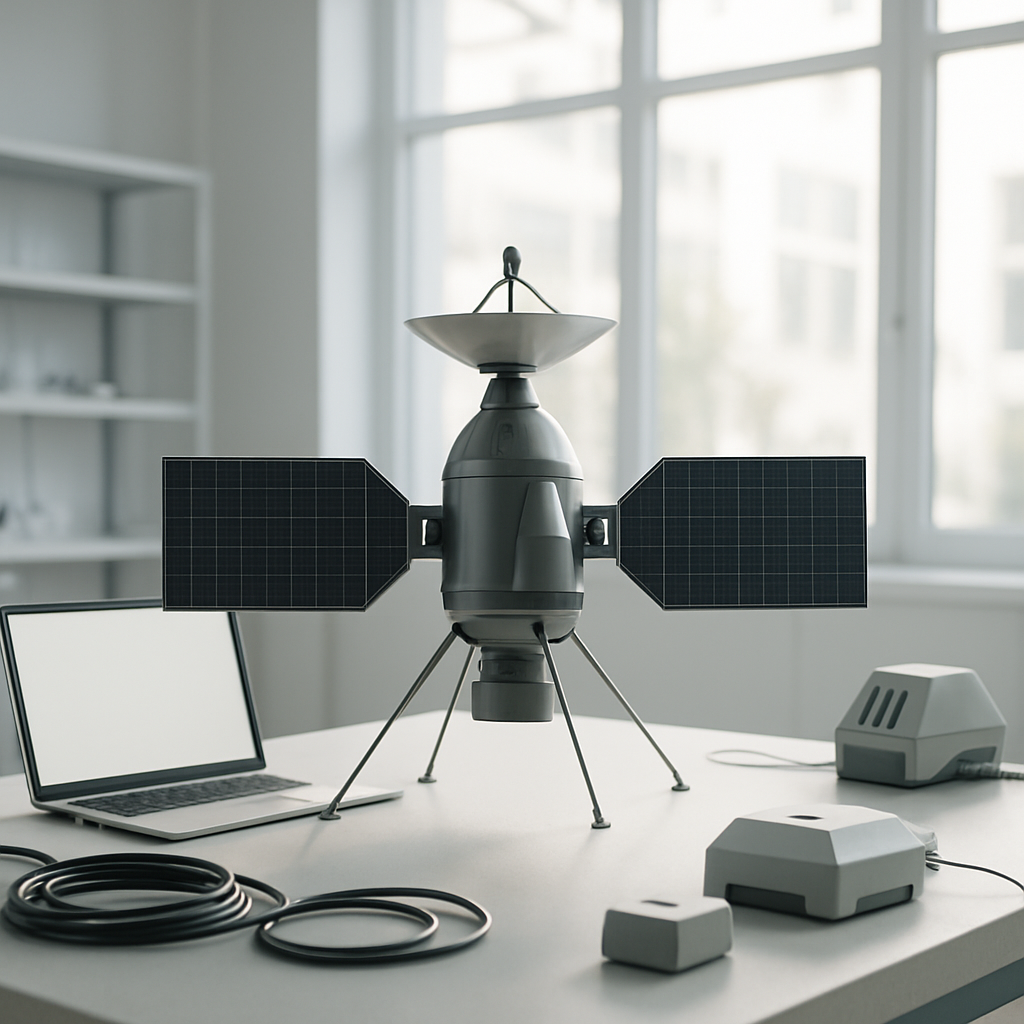
Steele asserted that this capability is already operational. "This is an operational reality today," he said, noting that last year Red Hat participated in missions that deployed the first orbital micro‑data centers and hybrid‑cloud regions to the International Space Station. Steele identified one prototype from Axiom Space and a microdata center multi‑cloud region from Voyager Technologies, and used those examples to argue that a Commercial Off‑The‑Shelf (COTS) approach to space technology "is not only possible but mature." He said these milestones prove the ability to execute "real‑time AI updates and maintain a continuous delivery pipeline for software in the harshest environments imaginable."
Kuntzelman emphasized why that on‑board processing matters operationally: the proliferation of assets and the volume of orbital data "necessitate low‑latency processing at the source." Providing mission capabilities at the edge, he said, lets satellites analyze data where it is collected and then act, reducing dependency on space‑to‑ground transport and closing the "OODA loop" in orbit.
Design philosophy: modular open systems, multi‑orbit meshes, and interoperability
Both executives framed the technical solution as more than software updates alone. Kuntzelman said the "true power" lies in modular, open‑systems designs created from the outset; with a standardized software foundation, "every sensor becomes a dynamic asset," he said, enabling satellites and sensors to continue contributing throughout their orbital life. Steele outlined an architecture that spans orbital layers: a "multi‑constellation, multi‑orbit mesh" that provides distributed communications and capabilities so a compromised node does not halt a mission. He warned that centralized targets on the ground have lessons for space, saying the layered approach must offer "backward and forward interoperability" and produce a resilient, "proliferated mesh."
What this means for U.S. and allied systems, major funded programs, and lunar operations
- U.S. and allied systems: Expect pushes for a unified, global software standard to enable seamless sharing of data and capabilities, as Kuntzelman linked such standards to joint and combined force mission success.
- Major funded programs and government planners: Steele reported "a massive push for urgency" and demand signals for speed, openness, and software‑driven agility — particularly to counter hypersonic threats and attempts to disrupt communications.
- Lunar operations and proliferated architectures: Steele identified expanding lunar activity (for example, building a base on the moon) as a driver of complexity that increases the need for real‑time onboard maneuver and autonomous responses.
Red Hat's account offers a concise through‑line: improved onboard compute and software abstraction make in‑orbit updates feasible; operational demonstrations on the ISS show commercial approaches can work; and modular, interoperable design is the declared path to resilience. The remaining, explicit decision point the company highlights is programmatic: systems must be designed with a "standardized software foundation on the front end" if satellites are to be dynamic assets throughout their life. Whether program managers and partners adopt that front‑loaded, open‑systems posture at scale will determine if the promise of software‑defined mission dominance becomes the norm — or remains a capability demonstrated on a few prototypes.