“The range of the Naval Strike Missile is 135 nautical miles,” a Marine Corps spokesperson recently confirmed to TWZ. “The Marine Corps is currently exploring opportunities to more than double the range of the NSM.”
The Marine Corps' target: more than double NSM range
The Marine Corps has set a clear goal: extend the Naval Strike Missile’s reach well beyond its current figure of 135 nautical miles. The service is explicitly exploring ways to “more than double the range,” which would push the weapon toward roughly 270 nautical miles or greater. The 135‑nautical‑mile figure already reflects a boost introduced with the Block 1A variant in the early 2020s; earlier NSM variants were described as having a range nearer to 100 nautical miles.
NMESIS and the ROGUE‑Fires launcher
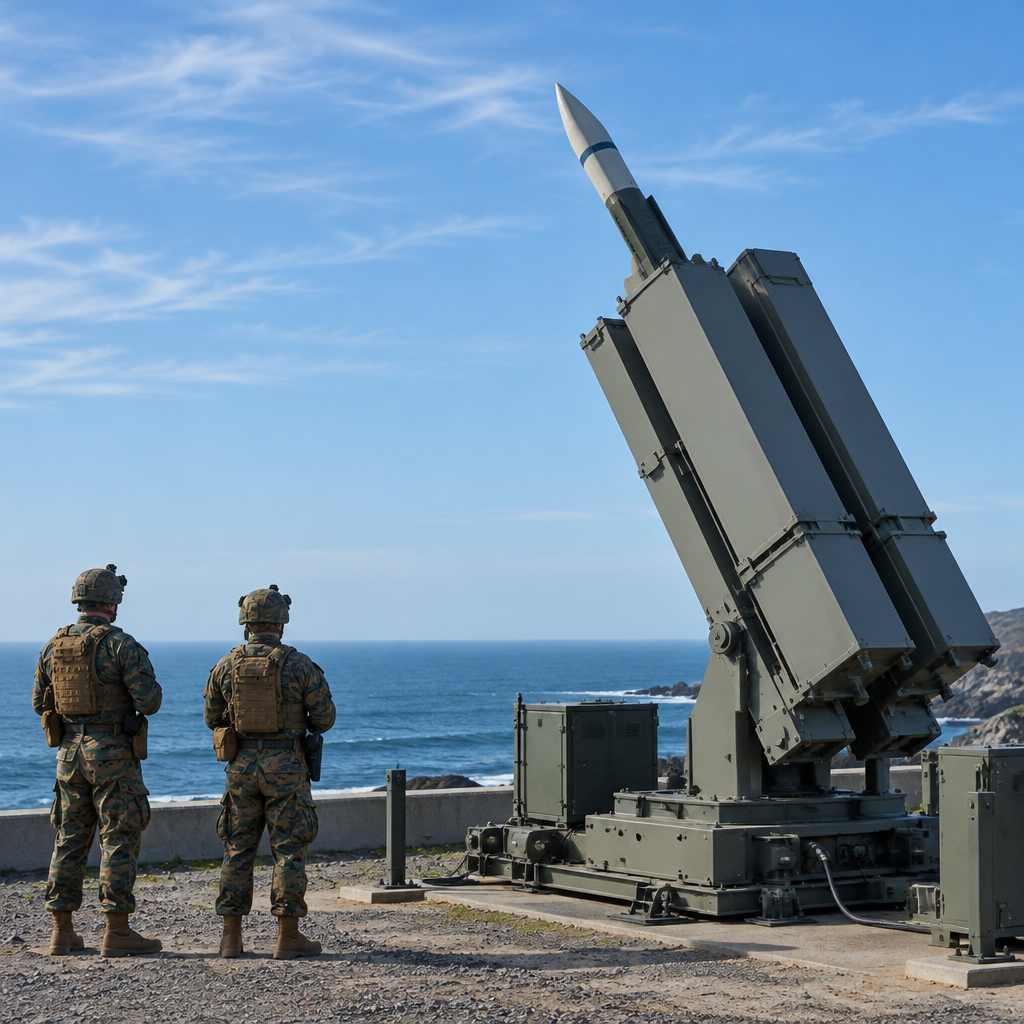
NSM is a central munition in the Navy‑Marine Expeditionary Ship Interdiction System (NMESIS). At NMESIS’ core is the Remotely Operated Ground Unit Expeditionary‑Fires (ROGUE‑Fires) platform — an uncrewed, 4×4 Joint Light Tactical Vehicle (JLTV)‑based launcher that can carry up to two ready‑to‑fire NSM canisters. The missile itself is a modern anti‑ship design with stealthy features, GPS‑assisted inertial navigation guidance to get into the target area, and a passive imaging infrared seeker for terminal homing that is described as immune to radio‑frequency jamming. It also performs high‑G evasive maneuvers in the terminal phase and retains a secondary land‑attack capability.

Audit-ready is a season. It shouldn't be.
Evidence in spreadsheets, controls drifting between audits, frameworks multiplying on flat headcount. Nubivance runs continuous compliance on Rapid7 Cyber GRC - SOC 2, HIPAA, ISO 27001, PCI, CMMC.
End the scrambleRange, area coverage, and island campaigns
Doubling NSM’s range would produce a nonlinear increase in the area a single launcher can threaten. With the current 135‑nautical‑mile reach, a single ROGUE‑Fires launcher can hold targets at risk inside roughly 57,255 square nautical miles. Extending that range to about 270 nautical miles would increase the threatened zone to approximately 229,022 square nautical miles — roughly four times larger. The Marines see that larger footprint as especially useful in expeditionary, distributed operations and island‑hopping campaigns, where widely dispersed launchers can create maritime choke points from remote outposts.
Force organization: MMSL sections, batteries, and the new battalion
The Marine Corps is organizing NMESIS around Medium Missile (MMSL) units. The basic MMSL section contains three ROGUE‑Fires launchers plus two JLTVs (one carrying the NMESIS command‑and‑control system and one for general utility). An MMSL battery comprises two platoons of three sections each, yielding 18 launchers and supporting assets. In October the Corps stood up its first MMSL battalion — 1st Battalion, 10th Marine Regiment — which is intended to field multiple batteries.
Alternatives, trade‑offs, and regional context
What technical route the Marines will take to extend NSM range is not specified. The source notes possible approaches such as lowering gross weight (including a smaller warhead), or increasing fuel efficiency or capacity. Even with doubled range, NSM would not match Tomahawk’s roughly 1,000‑mile reach; the Corps previously canceled plans to field ROGUE‑Fires armed with Tomahawk, leaving gaps that longer‑range NSM could partially address.
The Marines are also considering other long‑range surface‑to‑surface options. Precision Strike Missile (PrSM) short‑range ballistic missiles can be launched from the Corps’ 6×6 M142 HIMARS, and an anti‑ship variant of PrSM that can hit moving targets is described as in development. The Corps has discussed configuring ROGUE‑Fires to fire the podded munitions used on the M142 HIMARS — the MLRS Family of Munitions (MFOM) pods that also fit the tracked M270 MLRS — including 227mm guided rockets.
These capability choices come as regional deployments of NMESIS have increased. The Marines have demonstrated NMESIS deployments to remote Japanese and Filipino islands near Taiwan, including exercises that placed launchers in the Batanes Islands to threaten the Luzon Strait and a late‑October deployment of NMESIS elements to Japan’s Yonaguni Island during the Keen Sword exercise (Oct. 19–29), an island only about 65 nautical miles east of Taiwan. A tweet cited during the October movement noted Yonaguni as about 110 km from Taiwan and referenced a reported NSM range figure of about 185 km.
China’s People’s Liberation Army Navy is specifically named in the source as expanding surface fleets and island outposts; the Marines view NMESIS as a tool for providing sea control from island positions that may be in or near an opponent’s weapons engagement zone.
Whether the Corps pursues lighter warheads, larger fuel stores, improved propulsion, or hybrid solutions, the immediate choices are tangible: extend NSM reach to multiply coverage from dispersed launchers, accept associated trade‑offs in weight or lethality, or pair shorter‑range NSM with other long‑reach systems such as Tomahawk alternatives or PrSM. The next concrete milestone will be which technical path the Marines select to “more than double the range” and how rapidly the new configuration can be fielded across MMSL units.