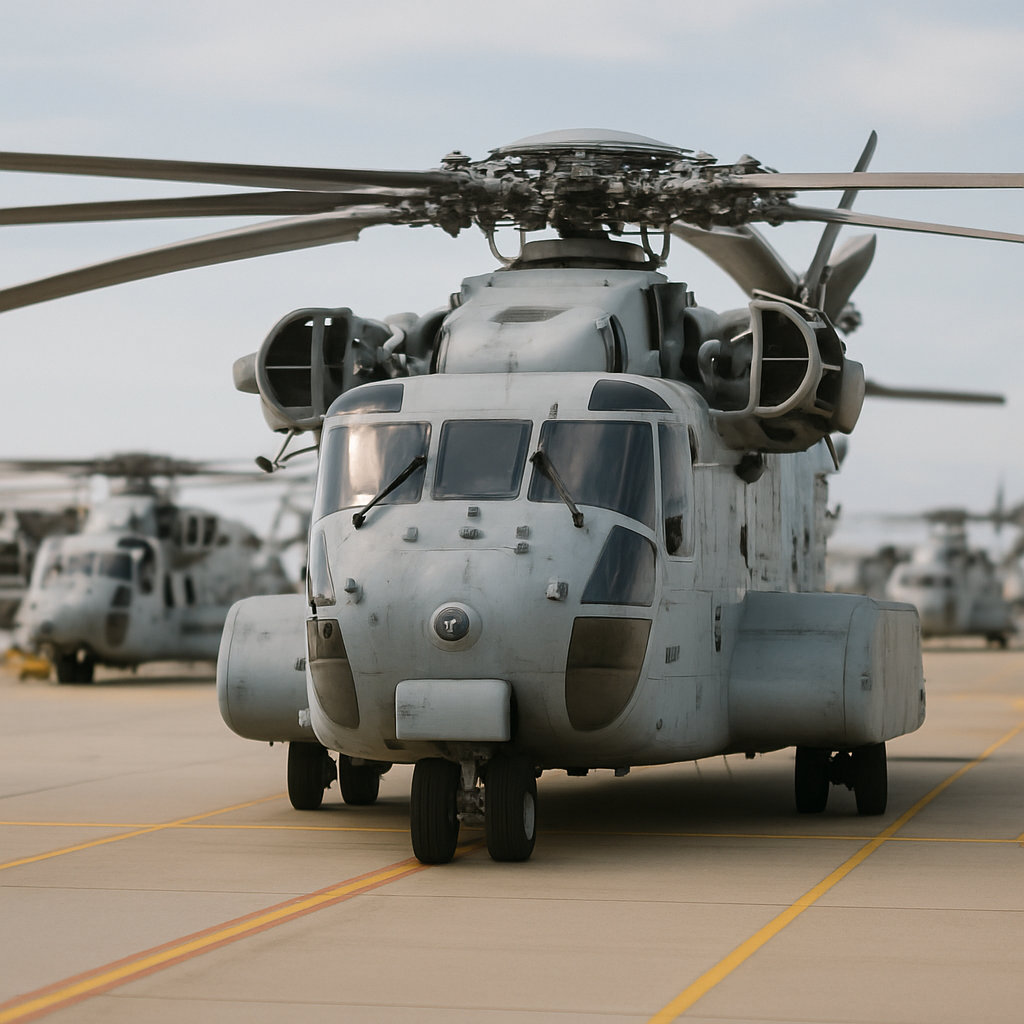
“extremely happy with how the aircraft is performing,” Col. Kate Fleeger said, summarizing the Marine Corps’ assessment of the CH-53K King Stallion as it nears its first operational deployment.
Delivery pace, production milestones, and the program of record
The Marine Corps has begun to ramp up deliveries of the CH-53K. The 25th CH-53K rolled off the Sikorsky production line in Stratford, Connecticut, earlier this week, and the service expects to add another eight aircraft for the remainder of the year. The program of record remains 200 aircraft. There are currently 12 CH-53Ks on the Sikorsky line in various phases of completion.
Sikorsky’s target is to reach 16 production aircraft per year, a milestone now expected in Fiscal Year 2029. The service expects the production line to be “getting up there” toward full-rate at the end of Fiscal Year 2028, with FY29 the year the 16-per-year mark will be achieved. Reaching that rate will trigger the formal transition of CH-53K ownership from East Coast squadrons to West Coast units as the service completes the fleetwide switch from CH-53E to CH-53K.
Squadrons, training units, and flight hours
Four Marine Corps squadrons already include CH-53Ks in their organizations. Marine Heavy Helicopter Squadron 461 (HMH-461), the first fleet CH-53K squadron, is fully outfitted with Kilos. The training squadron HMHT-302 has received multiple CH-53Ks and will remain a dual type/model series training squadron during transition. Developmental test work is underway with HX-21 at Patuxent River, and operational testing is being conducted by VMX-1 in Yuma, Arizona.
The fleet recently hit 10,000 flight hours across only 25 aircraft, a milestone the Marine Corps highlighted as significant given the small size of the fleet to date. HMH-461 has conducted detachments to the Weapons and Tactics Instructor (WTI) school in Yuma and exercise deployments out of Twentynine Palms as part of “every clime and place in CONUS” testing.

Audit-ready is a season. It shouldn't be.
Evidence in spreadsheets, controls drifting between audits, frameworks multiplying on flat headcount. Nubivance runs continuous compliance on Rapid7 Cyber GRC - SOC 2, HIPAA, ISO 27001, PCI, CMMC.
End the scrambleOperational testing, mission expansion, and in-flight experiments
Operational and developmental testing continues to expand the CH-53K’s baseline envelope. One recent test lifted a CH-53K by another CH-53K to explore Tactical Recovery of Aircraft and Personnel (TRAP) options; the aircraft lifted had gearboxes and engines removed for the test. The sling-load test involved a lifted weight of about 28,000 pounds — below the CH-53K’s 36,000-pound maximum external load — and documented flight characteristics and rigging procedures.
Other mission-expansion trials have included aviation ground fuel delivery, where a CH-53K landed with fuel and then provided that fuel to a V-22 tiltrotor parked next to it. The service is using these tests to broaden how the CH-53K can be employed in operational settings.
Training devices and maintenance approaches
The CH-53K transition is supported by new training systems. Four Containerized Flight Training Devices (CFTDs) have been delivered; these are mobile simulators that emphasize high-fidelity visual databases and haptic cueing over large motion platforms. An Advanced Aviation Training Device (AATD) has been fielded near New River for familiarization and refresher training, offering see-through virtual-reality goggle sets and lower-fidelity interactive cockpit environments for tactics and procedure development.
Maintenance is being modernized as well. The CH-53K uses a condition-based maintenance model for some components, with the service able to monitor vibratory and temperature signatures on gearboxes to predict end-of-life and schedule replacements around operational commitments and parts availability rather than reactively replacing components.
Mine countermeasures, the MH-53E withdrawal, and allied sales
The CH-53E is slated for retirement in 2032, and the Navy’s MH-53E Sea Dragon is scheduled to be withdrawn in 2027. The source notes the Navy is beefing up MH-60 Seahawk mine countermeasures capabilities to offset the MH-53E’s impending departure, but the heavy sled-towing capability and the heaviest organic vertical-lift capacity the MH-53E provided will be lost when it leaves the inventory.
Col. Fleeger said there have not yet been conversations about the Navy procuring the CH-53K or producing a minesweeping variant, but she added the Marine Corps is “certainly open to that in the future, should that need arise.” Separately, Israel has procured 12 CH-53Ks and is “in conversations” about potential additional aircraft.
What this means for the 26th Marine Expeditionary Unit, the Navy, and Sikorsky
- 26th Marine Expeditionary Unit: The 26th MEU is slated to receive the CH-53K on the first operational deployment in Fiscal Year 2027, making its readiness and the completion of shipboard and expeditionary training a priority for that unit.
- The Navy: With the MH-53E withdrawal scheduled for 2027 and the CH-53E retirement set for 2032, the Navy will be managing capability shifts in airborne mine countermeasures and heavy lift — including reliance on MH-60 enhancements while the heavier legacy capability phases out.
- Sikorsky: Meeting the 16-aircraft-per-year production milestone and sustaining the 12-aircraft pipeline on the Stratford line will determine the timing for the East-to-West transition and the broader fleet conversion the Marine Corps has planned.
The CH-53K is moving from a developmental focus into operational reality: deliveries are increasing, testing continues to expand its mission set, and training and maintenance systems are being fielded to support the fleet. The near-term schedule now points to a first operational deployment in Fiscal Year 2027 and a production ramp milestone in Fiscal Year 2029 — and an open question remains whether the type will take on the Navy’s heavy airborne mine-countermeasures gap in future service conversations.