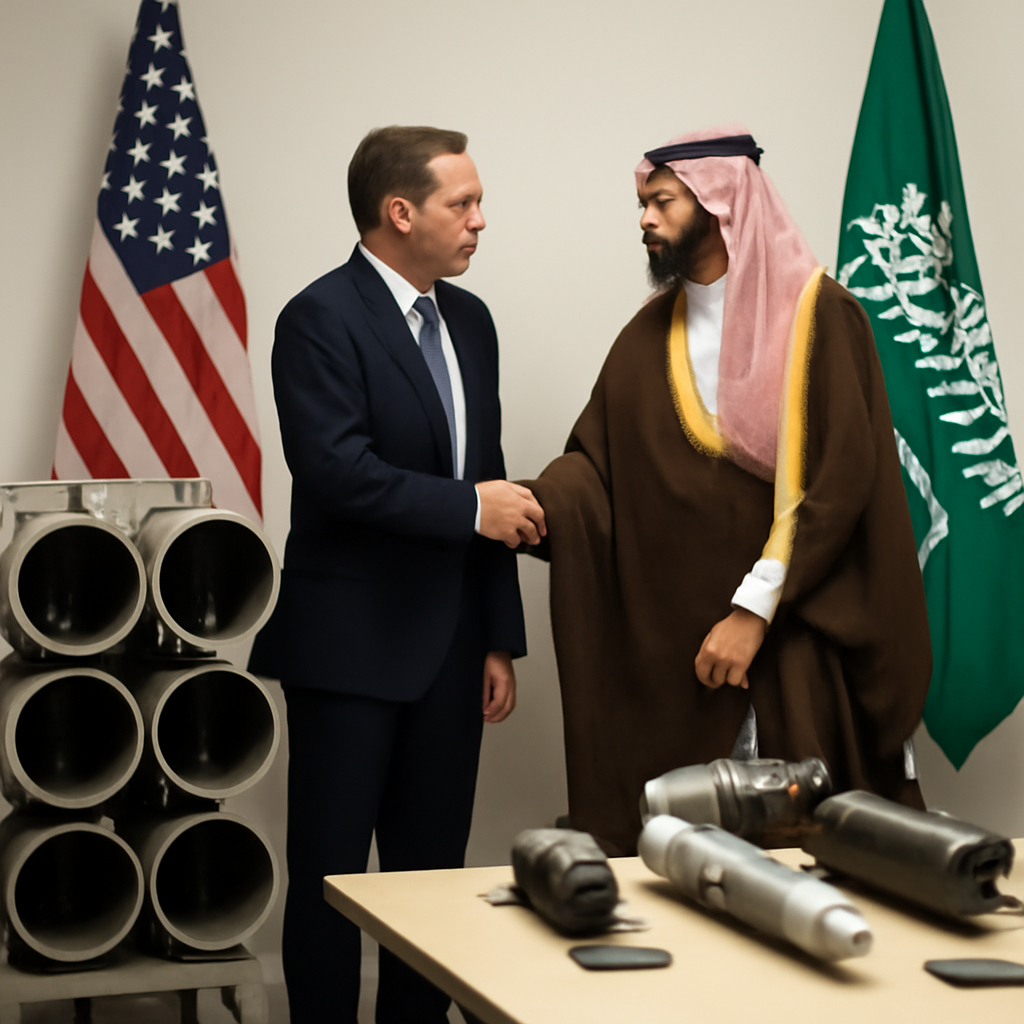
Up to 20,000 Advanced Precision Kill Weapon System (APKWS II) laser guidance kits — a possible $2 billion package — have been approved for sale to the Kingdom of Saudi Arabia by the State Department, the agency said in a formal notice announcing the proposed transfer.
What the State Department approved and why
The State Department cleared the potential sale of up to 10,000 APKWS II air-to-air guidance sections and up to 10,000 air-to-ground guidance sections, with associated LAU-131/A seven-shot 70mm rocket pods, Mk66 rocket motors, Mk-152 high explosive warheads and proximity fuzes, although the deal “does not include the rockets themselves,” the notice says. The department explained the package “will improve Saudi Arabia’s capability to deter current and future threats by strengthening its homeland defense, and improving interoperability with U.S. forces, and other regional and NATO forces.” The release added that “The Kingdom of Saudi Arabia will have no difficulty absorbing this equipment and services into its armed forces.”
APKWS II: modular kit, multiple roles
All APKWS versions are built from three components: a laser guidance section inserted between a warhead and a standard 70mm rocket motor. The system’s modularity supports both air-to-ground and an air-to-air optimized variant designated the AGR-20F — also referred to as the Fixed Wing, Air Launched, Counter-Unmanned Aircraft Systems Ordnance (FALCO) — which includes a proximity fuze and adjustments to guidance and sensing algorithms.
The air-to-air variant has been described as a “critical cost effective weapon to shoot down large numbers of long-range one way attack drones and lower-end cruise missiles,” while the air-to-ground configuration “provides extremely precise low-collateral strike capabilities against a wide variety of targets,” according to the reporting.

This site is the portfolio.
OSINTSights runs on Cloudflare Workers, D1, R2, and Vectorize, with an AI pipeline on Hetzner ARM. Nubivance designed, built, and operates it. We do the same for clients.
See what we buildPlatforms, precedent, and regional context
The State Department notice does not specify which Royal Saudi Air Force (RSAF) aircraft will carry these munitions, but the reporting says they “will most likely be loaded onto the RSAF’s Eurofighter Typhoon and F-15SA fighter jets.” In U.S. service, APKWS II has been cleared on multiple platforms: the U.S. Air Force’s F-15E Strike Eagle, F-16C Viper and A-10 Warthog, the U.S. Marine Corps’ legacy F/A-18 Hornets, and recently the Eurofighter Typhoon. The U.S. Navy’s F/A-18E/F Super Hornet “will likely receive the munitions too,” the source adds.
Usage precedent is already driving operational demand: U.S. forces and allied operators have used APKWS as a lower-cost option for downing Houthi-launched drones, and the reporting notes Ukrainian F-16s are employing APKWS against Russian drones. The proposed Saudi purchase comes amid “Iran increasing attacks on nations hosting U.S. troops in the Middle East” and renewed exchanges between Saudi Arabia and the Houthi movement, including airstrikes that hit Sanaa International Airport and Houthi accusations the kingdom launched those strikes.
Costs, economics, and force-multiplication
The APKWS II guidance section is reported to cost between $15,000 and $20,000 per unit, with the rocket motor and warhead adding a few thousand dollars more to the full weapon price. The reporting contrasts that with current-generation air-to-air missiles: roughly $1 million apiece for the AIM-120 and about $450,000 for the AIM-9X. U.S. Air Force Lt. Gen. Derek France, head of Air Forces Central, was quoted saying, “It’s our primary weapon against a drone,” and observers in the sourced reporting note APKWS has become the primary U.S. fighter weapon for shooting down Iran’s long-range one-way attack munitions at a small fraction of the cost of standard air-to-air missiles.
For a fighter fleet facing massed or lower-cost unmanned aerial threats, the appeal is clear in the numbers: APKWS significantly lowers the per-engagement expense and, because of its modularity and apparent “plug-and-play” readiness for aircraft like the F-15SA and Typhoon, enables rapid increases in the sortie-level capacity to contest incoming drones or cruise threats.
What this means for the Royal Saudi Air Force, Air Forces Central, and the Houthi-Iranian axis
- Royal Saudi Air Force: The RSAF is positioning to field a high volume of precision laser-guided rockets on tactical fighters, preparing to “shoot down a lot of drones far more cheaply than in the past,” per the reporting. The likely platforms named are the Eurofighter Typhoon and F-15SA.
- Air Forces Central (AFCENT) and U.S. partners: AFCENT leadership has publicly endorsed APKWS as a primary counter-drone weapon. Increased Saudi capability with the same system will, by the department’s account, “improve interoperability with U.S. forces.”
- Houthi forces and Iran-aligned actors: The deployment of thousands of guidance kits, plus associated launchers and fuzed warheads, expands the defensive capacity of a state actively engaged in strikes and counter-strikes with the Houthis and facing regional missile and drone activity attributed to Iran.
The State Department framed the sale as serving U.S. foreign policy and national security objectives by bolstering a Major non-NATO Ally in the Gulf. Practically, the approved transfer — absent the rockets themselves and with unspecified pod counts and platform confirmations — sets the conditions for a rapid proliferation of an inexpensive, laser-guided means to defeat unmanned and lower-end missile threats across the region.
Source: TWZ — Saudis Cleared To Buy A Whopping 20,000 Laser-Guided Rockets



