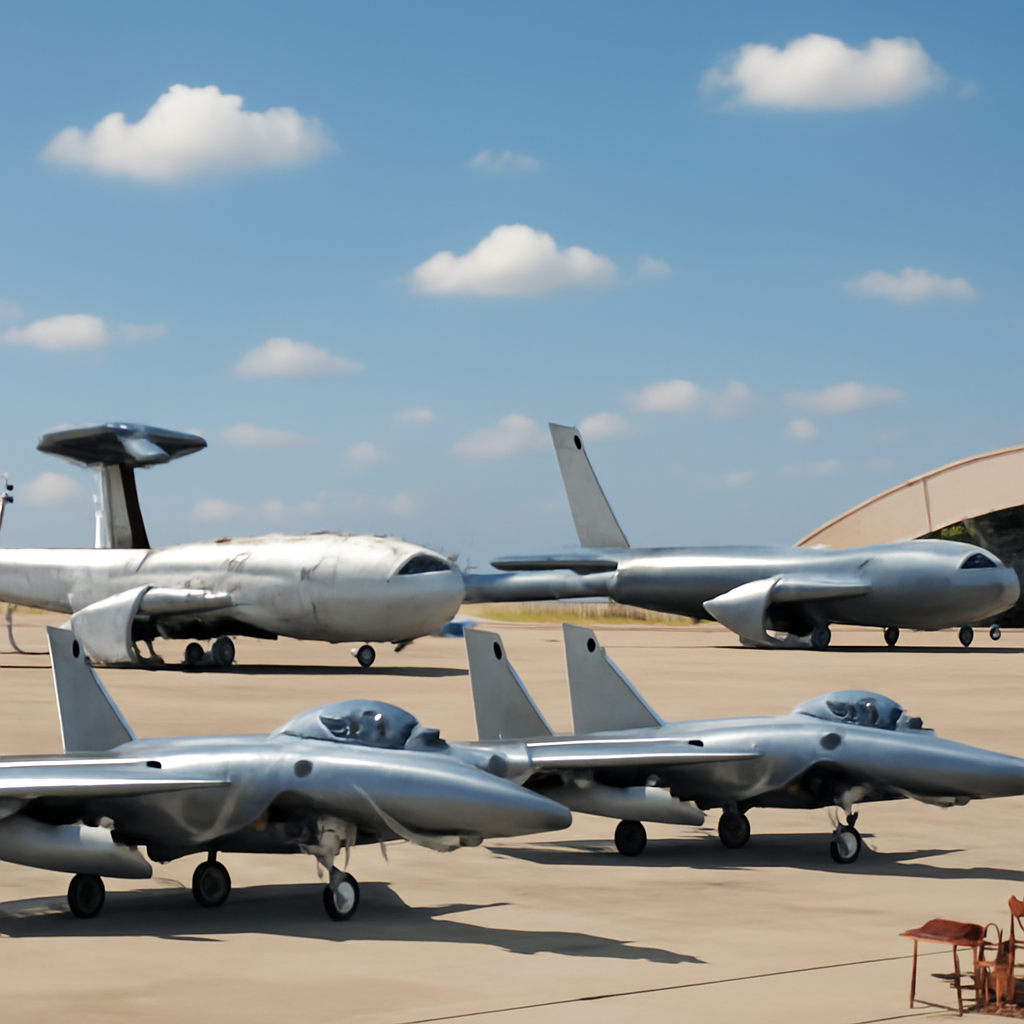
The Air Force is planning to purchase 187 F-47s, whereas the PLAAF has at least 300 J-20s — a gap that, by the math Greg Malandrino lays out, could leave U.S. fighters outnumbered in a long-range aerial fight unless the service changes how it protects its high-value airborne assets.
Air Force force structure and the firepower–protection paradox
Malandrino, a senior fellow at the Center for Strategic and Budgetary Assessments and a retired naval aviator, frames a central problem: contemporary air-to-air combat depends not only on fighters and long-range missiles but on high-value airborne assets (HVAA) — airborne early warning (AEW) and aerial refueling aircraft — that enable first-look, first-shot advantages and extend fighter reach. Those HVAA are vulnerable, highly visible, and lightly defended.
Using the International Institute for Strategic Studies 2026 Military Balance figures — 1,780 U.S. fighters and 1,650 Chinese fighters — the author sketches a crude but stark model. If the Air Force commits two-thirds of its fighters to the fight and runs 100 HVAA protection (HVAAP) orbits with four fighters apiece, the HVAAP “tax” is roughly 400 fighters, leaving about 787 fighters for other missions. Applying a similar protection burden to the PLAAF leaves it with about 1,305 fighters — a near 2:1 numerical advantage in fighters available for offensive counterair missions under these assumptions.
The consequence, Malandrino writes, is that dedicating fighters to protect HVAA reduces offensive strike capacity and the attrition rate inflicted on the PLAAF. Conversely, prioritizing offensive missions risks catastrophic loss of AEW and tanker aircraft and the long-range kill chains they enable.
HVAA vulnerability and the PLAAF’s targeting strategy
HVAA are large, conspicuous platforms that “rely on outmoded self-defense systems,” the source says. The PLAAF has devoted considerable effort to targeting and destroying U.S. HVAA using extended-range air-to-air missiles such as the PL-17. Destroying AEW and tankers would hand the PLAAF decisive first-look and range advantages and could collapse U.S. long-range air-to-air kill chains.

This site is the portfolio.
OSINTSights runs on Cloudflare Workers, D1, R2, and Vectorize, with an AI pipeline on Hetzner ARM. Nubivance designed, built, and operates it. We do the same for clients.
See what we buildCCA Increment Two: design trade-offs for protection-first missions
Malandrino proposes a reoriented Collaborative Combat Aircraft (CCA) Increment Two: not a manned sixth-generation fighter replacement, but a larger, endurance-focused unmanned or optionally manned platform optimized to protect HVAA. Key attributes he outlines include a substantial missile payload, resilient datalinks, and semi-autonomous engagement capability — trading speed and extreme signature reduction for endurance and ordnance capacity.
The missile count per aircraft is central. Increment One CCAs appear likely to carry two AIM‑120s; by contrast, a protection-focused CCA could carry smaller missiles externally to increase rails. Malandrino models a force of 150 such CCAs, each with four-to-six missiles, as adding 600–900 missile rails for long-range air-to-air engagements. Assuming two missiles are expended per target, that translates into as many as 450 successful engagements — a force-multiplier that could reduce the fighter protection tax and restore near-quantitative parity.
There are trade-offs: increasing size and missile load will raise unit cost and weight, and Malandrino explicitly suggests “investing less in signature reduction and aircraft speed” to constrain per-aircraft costs while maximizing payload and range.
What this means for the Air Force, the PLAAF, and DoD procurement leaders
- Air Force: Reprioritize CCA Increment Two toward HVAA protection to free manned fighters for offensive counterair; accept design trade-offs (endurance and payload over speed and stealth) and plan for higher per-unit costs in exchange for increased missile capacity and mission endurance.
- PLAAF: Continued emphasis on long-range strike weapons such as the PL‑17 will keep HVAA as high-value targets; sustaining a quantitative fighter advantage amplifies the leverage of systems-destruction warfare against U.S. kill chains.
- DoD procurement and policymakers: Consider whether to fund a protection-centric CCA variant (Malandrino sketches a 150-aircraft force) and to invest in smaller missiles, semi-autonomy, resilient datalinks, and active terminal defenses that could counter both long-range air-to-air missiles and long-range SAMs like the HQ-9.
Active terminal defense and broader operational effects
Malandrino argues that a CCA with an active counter-missile capability — able to engage inbound long-range air-to-air missiles and possibly long-range surface-to-air missiles — could change the operational calculus. Such a platform might create limited protection “bubbles,” enabling AEW, refuelers, electronic attack, strike, and airlift aircraft to operate closer to contested areas and reducing billions spent on traditional counter-HVAA kill chains.
In his account, a protection-oriented CCA force could both negate a core PLAAF objective under systems destruction warfare and unlock increased offensive attrition by U.S. fighters once they are freed from persistent HQAA escort duties.
Greg Malandrino’s prescription is concrete and numeric: shift Increment Two to defense of HVAA with endurance and ordnance over speed and stealth, field hundreds of missiles on hundreds of unmanned platforms, and pair that force with active terminal defenses. The proposal offers a clear trade: higher per-unit costs and different engineering priorities in exchange for restoring the long-range kill chains the Air Force needs to contest the PLAAF at scale.