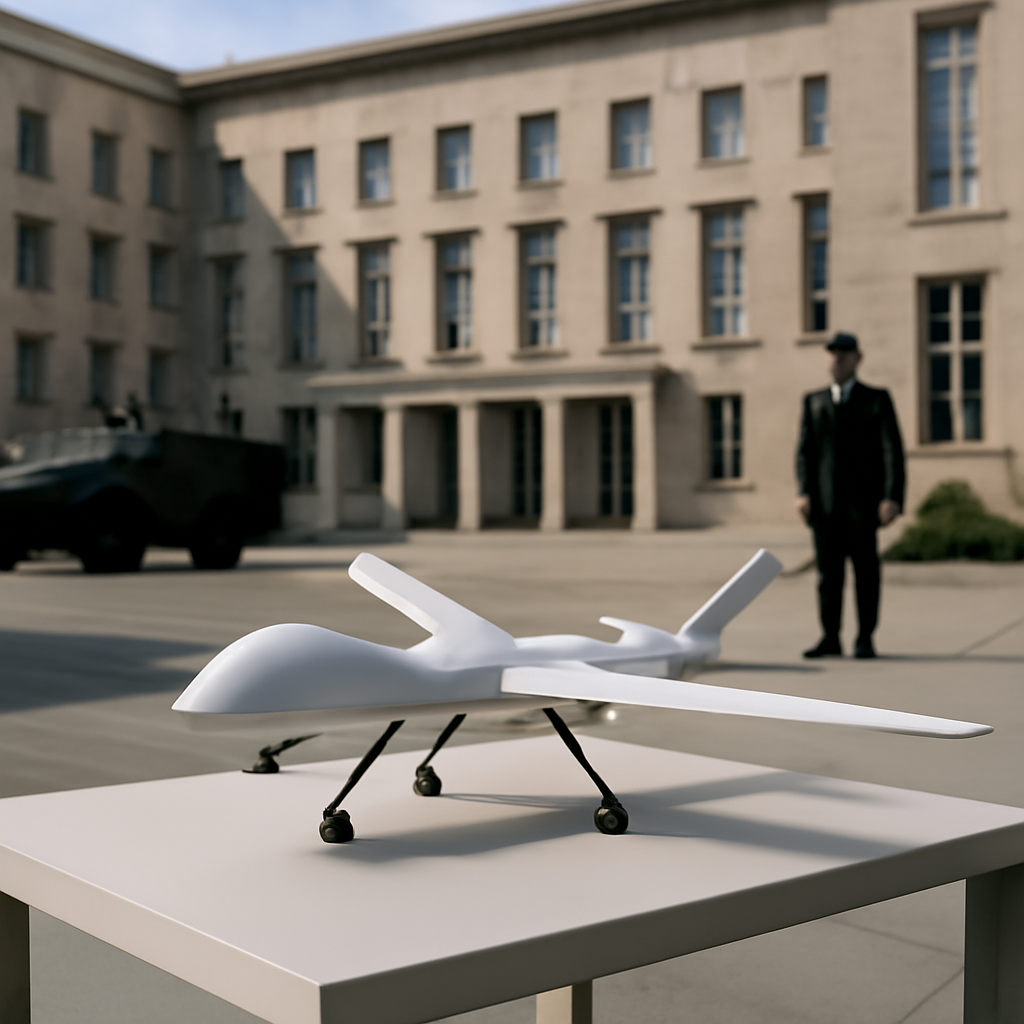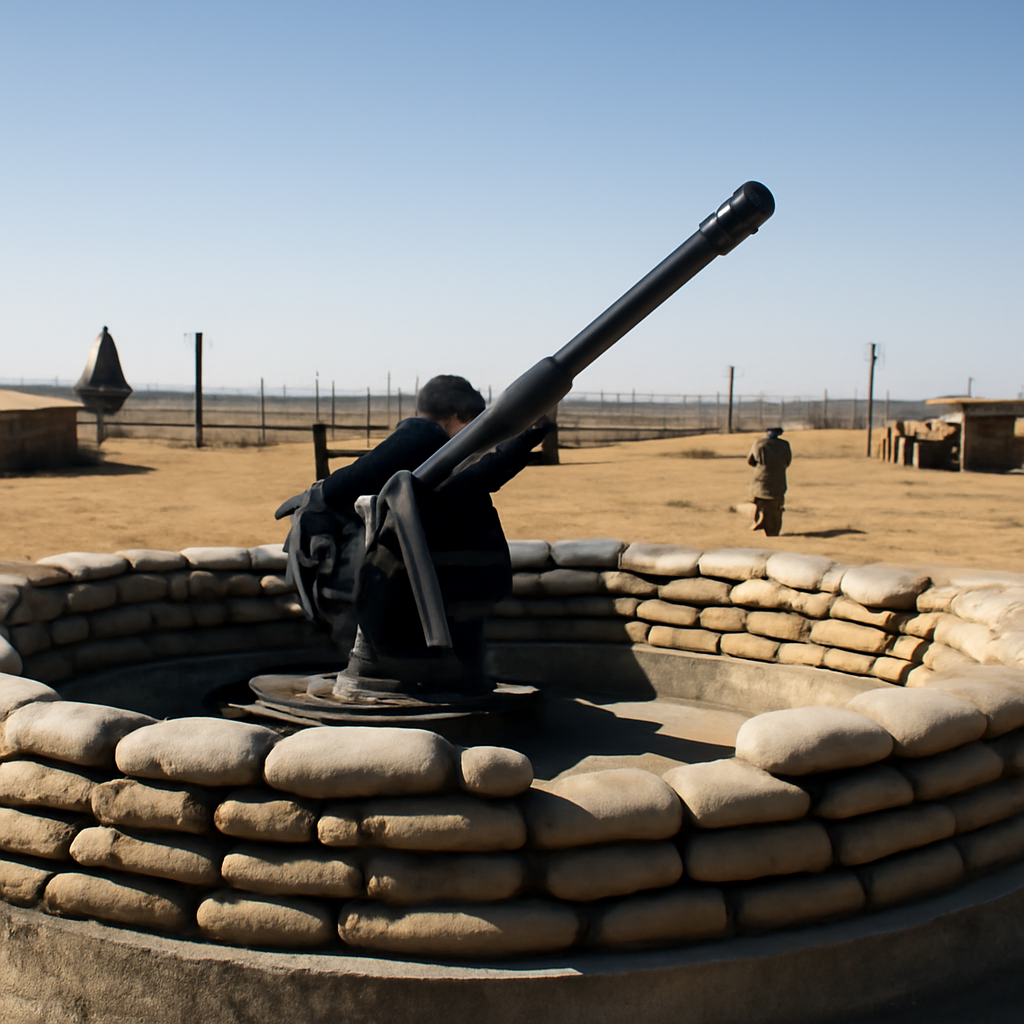
"The Government is conducting market research to identify potential industry sources capable of providing solutions for a Ground-Based, Medium-Caliber Gun Weapon System that fires affordable munitions, enables defense against air and missile threats with an initial focus on subsonic cruise missiles (CM) and Unmanned Aircraft Systems (UAS) to provide persistent defense in support of [the] United States Air Force," the Air Force Request for Information states.
What the RFI asks for and how performance will be judged
The Air Force’s Request for Information seeks a ground-based, medium-caliber gun weapon system designed to defeat subsonic cruise missiles and Group 1–5 unmanned aircraft systems. The RFI highlights 15 baseline operational and technical parameters that “must be analyzed in unison,” beginning with a system’s Salvo Probability of Kill (Pk) evaluated against both cruise missiles and UAS Groups 1–5 at maximum range and altitude. The service also specifies integration of a mix of radar, electro-optical, infrared, or radio‑frequency sensors to ensure reliable target acquisition and tracking across varying weather conditions, environments, and countermeasure scenarios.
Deployability and transport constraints: C-130, C-17, C-5 and more
The Air Force wants a system that is "rapidly deployable, maintaining a lightweight, modular, and transportable footprint" suitable for austere theaters. The RFI does not prescribe transport modes, but the service currently relies on C-130 Hercules, C-17 Globemaster III and C-5 Galaxy aircraft to move equipment. The source notes that the size and weight of any chosen system will determine which aircraft can carry it, and that trucks, ships or self-propelled movement remain alternatives that can slow delivery and complicate rapid global deployments.

The cyber insurance questionnaire just landed. Now what?
SOC 2, HIPAA, insurance renewals - someone has to own security strategy. Nubivance provides fractional CISO leadership without the full-time salary.
Get a security leadCost trade-offs: munitions price, interceptors, and magazine depth
Cost-per-engagement is a central evaluation criterion. The RFI directs vendors to maximize shell velocity and terminal effects “without driving the cost-per-engagement to unsustainable levels or exceeding the physical constraints of the host platform.” The reporting contrasts this requirement with recent operational lessons: a mass-produced Iranian Shahed-136 reportedly costs about $35,000 to $50,000, while a Patriot PAC-3 interceptor can run about $5 million. The Army’s Centurion C-RAM — a ground variant of the Phalanx CIWS with a six-barrel 20mm Vulcan firing M940 rounds — lists M940 rounds at $80.70 each in the Army’s Fiscal Year 2025 budget request; a two‑second Centurion burst at 4,500 rounds per minute would cost just over $12,100. The RFI frames gun-based systems as a cheaper, inner-layer fallback when higher‑end interceptors must be conserved.
Existing gun-based options: U.S. and foreign systems on the market
The Air Force’s move comes while the U.S. already fields several gun-based short-range air defense (SHORAD) systems. Those include the Centurion C-RAM, the Army’s SGT STOUT Stryker A1 M‑SHORAD (with a 30mm XM914 automatic cannon and optional Stinger or Hellfire launchers), and the Marine Air Defense Integrated System (MADIS) armed with 30mm cannons and M240C coaxial machine guns. The Army has recently sought 50mm gun systems and Northrop Grumman introduced a Raid Hunter 50mm GBAD system in August 2026, calling it designed to defeat mixed aerial raids with precision‑guided 50mm ammunition.
Foreign offerings are also in the market. Rheinmetall’s Skyranger 35 — a turreted 35mm system using AHEAD airburst technology — began deliveries to Ukraine in January, and Rheinmetall’s Skyshield represents a fixed-placement cousin used by several nations. Videos and reporting cited in the source show Gepard SPAAGs — twin 35mm cannons on a Leopard 1 chassis — shooting down loitering munitions, and the success of Gepards in Ukraine is credited with renewing global interest in SPAAGs.
What this means for the Air Force, the Army, and the defense industry
- For the Air Force: The RFI marks an expansion of the service’s role in air base defense, a capability historically carried out by the Army. The service requested about $1.4 billion for a missile-defense variant of the Air Base Air Defense Systems (ABADS) in its Fiscal Year 2027 budget request and sought $51.8 million in procurement for Small Unmanned Air Defense Systems (SUADS) in FY2026.
- For the Army: Army gun-based and SHORAD capabilities remain relevant as the Air Force pursues organic options; the RFI and parallel Army requests for 50mm solutions suggest complementary, not identical, approaches to base defense.
- For the defense industry: The Air Force set a submission deadline — parties have until 5 p.m. Oct. 9 to respond — and the RFI’s mix of range, lethality, sensor integration, transportability and munitions-cost constraints creates a defined engineering and business case for vendors offering new or adapted gun‑based GBAD systems.
The Air Force is moving to close a gap exposed by the wars the source cites — the war against Iran and the Ukraine war — and to build a lower‑cost, last‑line capability that can preserve magazine depth and protect bases against drones and cruise missiles. The RFI frames the task narrowly: medium-caliber guns, cost-effective munitions, integrated sensors, and rapid deployability. With submissions due Oct. 9, the next visible step will be what vendors propose and whether the Air Force’s requirements push the service toward domestically developed systems, foreign buys, or a hybrid solution.
Source: TWZ — U.S. Air Force Seeks Anti-Aircraft Guns To Protect Its Overseas Bases