"I gotta keep modernizing the tanker force," Air Force Lt. Gen. Rebecca Sonkiss told reporters at the Air & Space Forces Association’s warfare symposium in February.
RAF Mildenhall sighting and photographic evidence
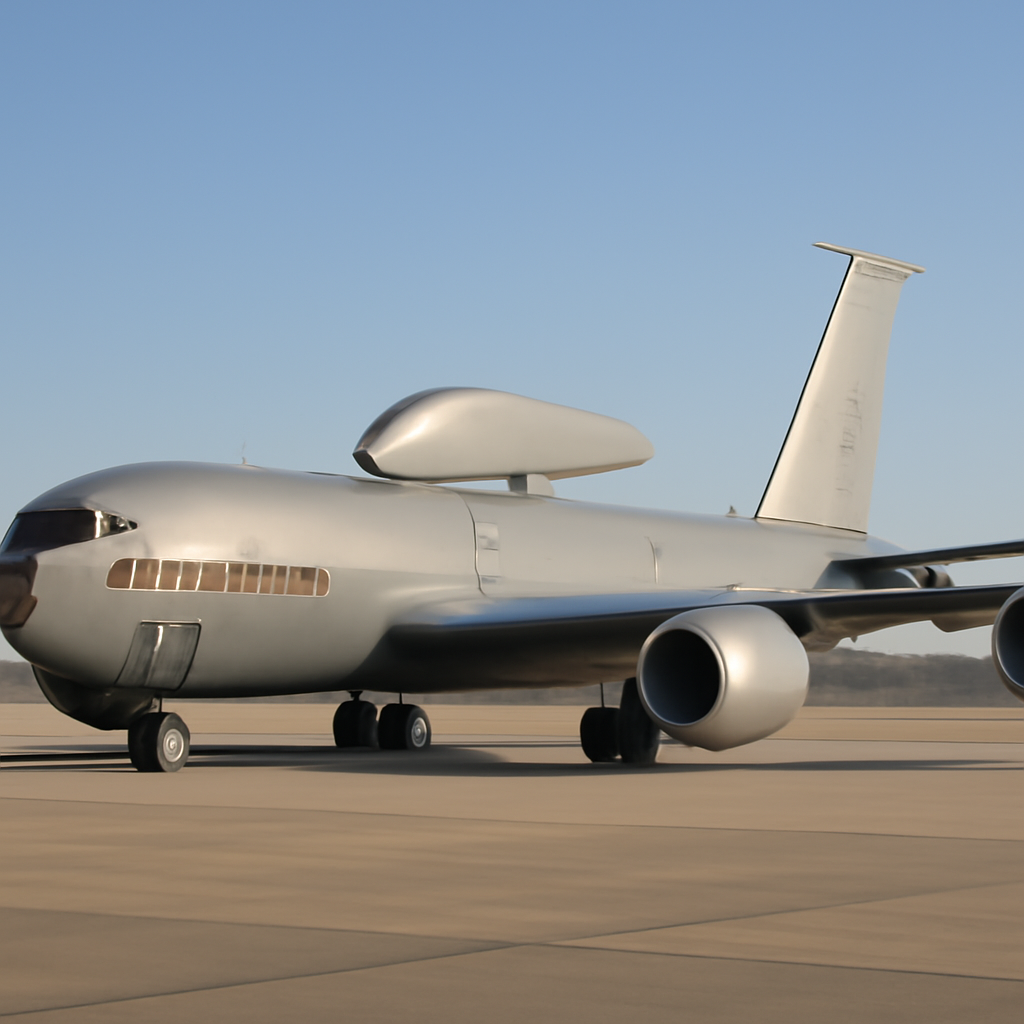
A U.S. Air Force KC-135 tanker was photographed at RAF Mildenhall over the weekend with a new dorsal antenna mounted atop the rear fuselage, according to aviation photographer Alessandro Ledda (Aerographist on Instagram) and reporting by The War Zone (TWZ). Ledda told TWZ that online flight-tracking data lists the airframe as serial number 63-7976, though he cautioned that this may not be correct because the plane is largely devoid of markings. RAF Mildenhall, home to the 100th Air Refueling Wing, is a frequent staging point for U.S. tanker operations and was noted in the reporting as having supported recent operations against Iran.
Antenna shape, placement, and immediate clues
The new fairing has a roughly trapezoidal profile with a mostly flat top and a small blade protruding at the rear. TWZ’s imagery shows it mounted directly behind a smaller, platter-shaped antenna typically used for ultra-high-frequency (UHF) SATCOM. The size and shape of the dorsal installation are broadly consistent with “hump” style antennas associated with high-bandwidth satellite communications suites seen on large military and commercial aircraft, and TWZ notes the form is in line with commercial Starlink antennas used on airliners.

Audit-ready is a season. It shouldn't be.
Evidence in spreadsheets, controls drifting between audits, frameworks multiplying on flat headcount. Nubivance runs continuous compliance on Rapid7 Cyber GRC - SOC 2, HIPAA, ISO 27001, PCI, CMMC.
End the scrambleATOMS, MAF NEXUS, and Starshield connections
Reporting links the installation to broader Air Mobility Command (AMC) efforts to field beyond-line-of-sight (BLOS) SATCOM on mobility aircraft. Aviation Week’s Brian Everstine, on X, described Airlift/Tanker Open Mission Systems (ATOMS) as “a Starshield-based BLOS satcom system SNC has been installing on a handful of [KC]-135s, [C]-17s, [KC]-46s, [C]-130s,” and added that “ATOMS is now transforming to Air Mobility Commands [sic] ‘MAF Nexus.’” TWZ reproduces these public observations and notes that Starshield is a government-focused offshoot of SpaceX’s Starlink.
Sierra Nevada Corporation (SNC) described ATOMS in an August 2025 press release as a Quick Reaction Capability that “delivers enhanced situational awareness through multidomain networking and datalink.” SNC said that ATOMS provides a Common Operating Picture and that it “played a pivotal role” during the Mobility Guardian 2025 exercise by demonstrating data management and communications across C-17, KC-135, KC-46 and C-130 platforms and numerous ground nodes.
Budget lines, program timelines, and other upgrade paths
The Air Force’s Fiscal Year 2027 budget documents highlighted related projects that could match the hardware seen on the KC-135. One is a “Hybrid SATCOM capability” involving “Multi-Band, Multi-Orbit SATCOM terminals” able to switch between government and commercial constellations. Another is MAF Connectivity, described as developing “a path forward as the tanker needs to be able to connect to the Joint fight to close kill chains and logistics chains,” with “possible capabilities” including intelligent gateways, antennas, radios, software updates, crew displays, and multiple aperture array housings.
TWZ further notes that an “increment 1 first prototype installation” was scheduled to be completed in the second quarter of Fiscal Year 2026 (January 1–March 31). The report also observes other fielded or experimental approaches to tanker communications, including roll-on/roll-off suites and an Air National Guard demonstration that packages a comms/data-sharing node inside a heavily modified underwing Multipoint Refueling System (MPRS) pod.
How AMC and aircrews, Sierra Nevada Corporation, and Congress/defense planners will respond
- AMC and aircrews: Leaders and former commanders quoted in the reporting emphasize connectivity as central to survivability and operational effectiveness. Lt. Gen. Rebecca Sonkiss tied modernization to connectivity and survivability; retired Gen. Michael Minihan argued that “real-world updates, real-time updates” are essential. The visible installation signals tangible progress toward that objective.
- Sierra Nevada Corporation and industry integrators: SNC’s prior QRC work on ATOMS and public claims of fielding elements across multiple airframes suggest contractors will be tasked with scaling prototype installations into more widespread fleet modifications if the installations prove operationally valuable.
- Congress and defense planners: The report cites a recent hearing where Lt. Gen. David Tabor told members of Congress, “Over the course of about the next six years, you’ll see the full fleet of KC-135s fully connected.” Budget lines in the FY2027 request tie directly to Hybrid SATCOM and MAF Connectivity work that planners and appropriators will likely track as prototype installations proceed.
The KC-135 sighting at Mildenhall is a visual marker of work already underway: experimental SATCOM gear, program-level budget lines, exercise demonstrations, and public advocacy from mobility leaders. It also arrives amid operational pressure—the report notes two KC-135s collided over Iraq in March during the opening weeks of Operation Epic Fury against Iran, with one aircraft lost and six fatalities—and amid explicit timelines for wider fleet connection. Whether this dorsal fairing is a one-off trial, a step toward Starshield-enabled BLOS connectivity, or an early MAF Nexus node remains to be confirmed by the Air Force; for now, the photograph offers a clear, inspectable sign of a program moving from lab and exercise to aircraft skin and flightline.