"Right now, we're massively starting to implement this," said Davyd Aloian, deputy secretary of the National Security and Defence Council of Ukraine, describing a shift toward robot-forward infantry concepts that Ukrainian forces began developing more than a year ago.
Davyd Aloian and the rise of robot-forward infantry
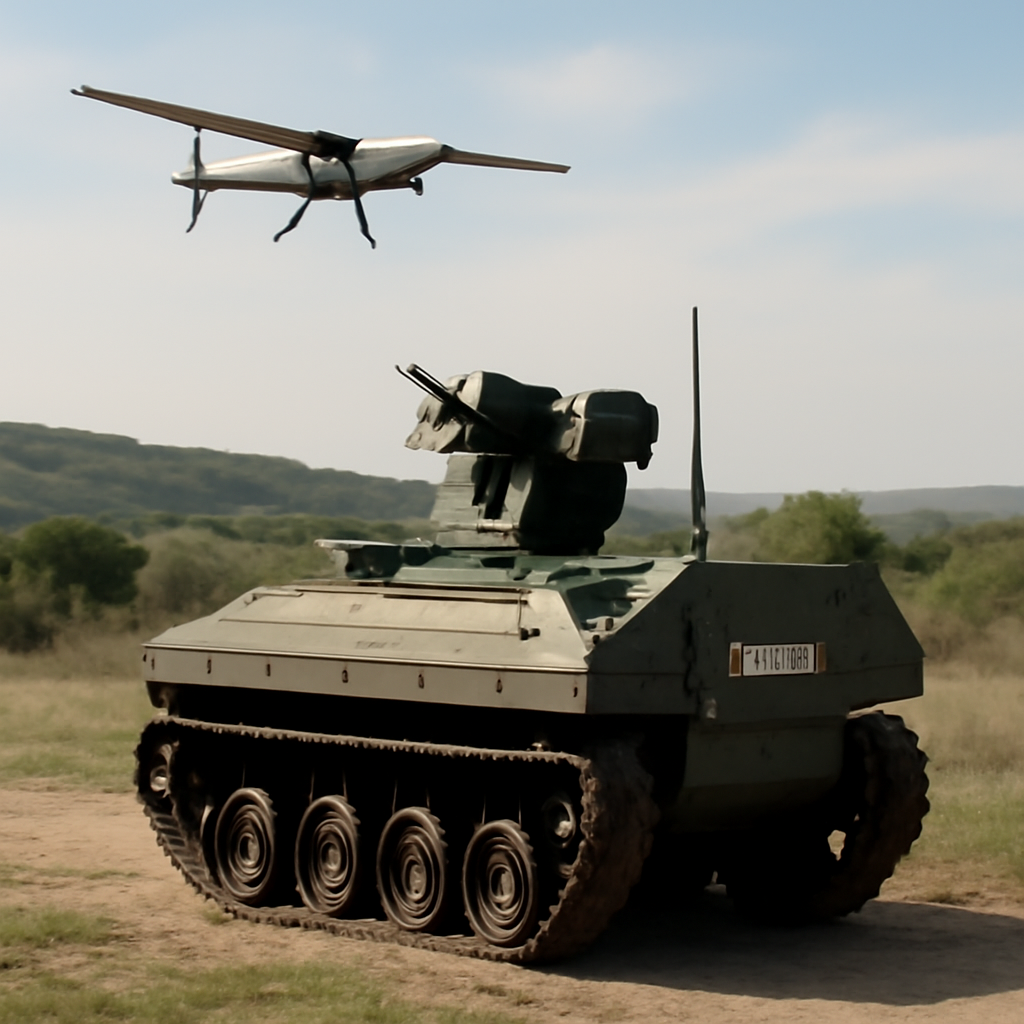
Aloian told conference audiences that Ukrainian forces were granted "unusual latitude to experiment" and that the results have been rapid and concrete. He described combined-arms attacks that pair airborne and ground robotic systems and said those concepts, incubated more than a year ago, are now moving into broad implementation. Aloian also said command and control is decentralizing and digitizing: "Everything can be controlled from Kyiv, Lviv, from cities in other countries," and human controllers will be dispersed as systems automate routine decisions.
TFL-1, autonomy, and layered drone defenses
One named technology cited as emblematic of the change is the TFL-1 guidance module from a Ukrainian firm called The Fourth Law. The company says the TFL-1 permits a one-way drone to operate autonomously after a human selects the target, reducing vulnerability to jamming; The Fourth Law claims TFL-1 makes a drone four times more likely to hit its target. That mix of human selection and onboard autonomy is mirrored in Ukraine's emerging air-defence concepts: ISR sensors and AI are being linked to detect and identify enemy drones faster and with more certainty, and interceptor drones are being positioned across a distributed network to be activated as needed. Aloian described a future in which roughly 10 people might be responsible only for approving interceptions, while automated systems carry out the engagement.

Audit-ready is a season. It shouldn't be.
Evidence in spreadsheets, controls drifting between audits, frameworks multiplying on flat headcount. Nubivance runs continuous compliance on Rapid7 Cyber GRC - SOC 2, HIPAA, ISO 27001, PCI, CMMC.
End the scrambleStrike drones and operational leverage against Russian forces
Analysts and industry figures at GLOBSEC traced a chain of effects from Ukraine's strike-drone campaigns. The Institute for the Study of War wrote that "Ukraine's successful mid-range and frontline drone strike campaigns are limiting Russia's ability to transport personnel to the frontline and to supply and sustain frontline positions." The article quoted expatriate economist Vladislav Inozemtsev describing Russian mobilization incentives as "deathonomics," and noted that human-wave advantages erode if drones "kill soldiers faster than they can be replaced at the front."
The effect is not confined to frontline logistics. The piece reported that Ukrainian deep-strike capabilities now reach oil infrastructure inside Russian territory, constraining export revenues. Those strikes also shaped domestic political theater: Estonian foreign minister Margus Tsahkna said Russia's annual Victory Day parade this month occurred "without Soviet-esque ranks of tanks and missiles" and framed that change as an erosion of a public-facing posture. The article also noted a recent large Russian barrage of drones and missiles in which "some 90 percent were intercepted," a statistic editors flagged as a measure of evolving Ukrainian defenses.
Industry, investment, and an ecosystem built since 2022
Aloian and industry leaders stressed that battlefield successes are underpinned by an evolving Ukrainian defense industrial base. Aloian said, "We have evolved since 2022, the industry has and our defense has as well. Right now we are able to provide not only [large quantities of drone] assets but everything what is needed to build out the ecosystem," including parts, production, training, and modification. Swarmer CEO Serhii Kupriienko warned European audiences that the surprising speed of Ukrainian gains should be a wake-up call: having climbed a capability curve that "just two years ago seemed insurmountable," Ukraine's experience shows middling militaries can quickly field precise, long-range systems if they integrate AI and adapt procurement and doctrine.
What this means for European policymakers, the Ukrainian defense industry, and the Russian military
- European policymakers: Expect intensifying interest in aligning acquisition and doctrine with autonomous and AI-enabled systems. Kupriienko argued that "the answer is always AI solutions and integrating the AI into even the daily routine work within the bureaucracy," and speakers at GLOBSEC urged governments to avoid falling behind.
- Ukrainian defense industry: The sector is positioned both to supply wartime needs and to attract foreign investment; Aloian framed the current moment as a maturation since 2022 toward an ecosystem that spans production, parts, and training.
- Russian military and political leadership: Observers tied drone pressure to operational constraints on troop movements and to symbolic blows such as the altered Victory Day parade; Aloian said that any ceasefire would require harsh conditions so the invading country "can't re‑arm" as it did after 2014, and that even regime change alone would be "insufficient" without internal transformation.
The through-line in the reporting is direct: the confluence of AI-enabled guidance modules like the TFL-1, distributed sensor-to-shooter networks, and a defense-industrial effort retooled since 2022 has shifted battlefield dynamics. Ukrainian leaders and industry figures framed those shifts not as incremental but as structural—changes to doctrine, procurement, and command that can turn robots and autonomy into strategic leverage. As Aloian put it, if victory ever arrives, "much of the credit will go to the makers and operators of Ukraine's drones."