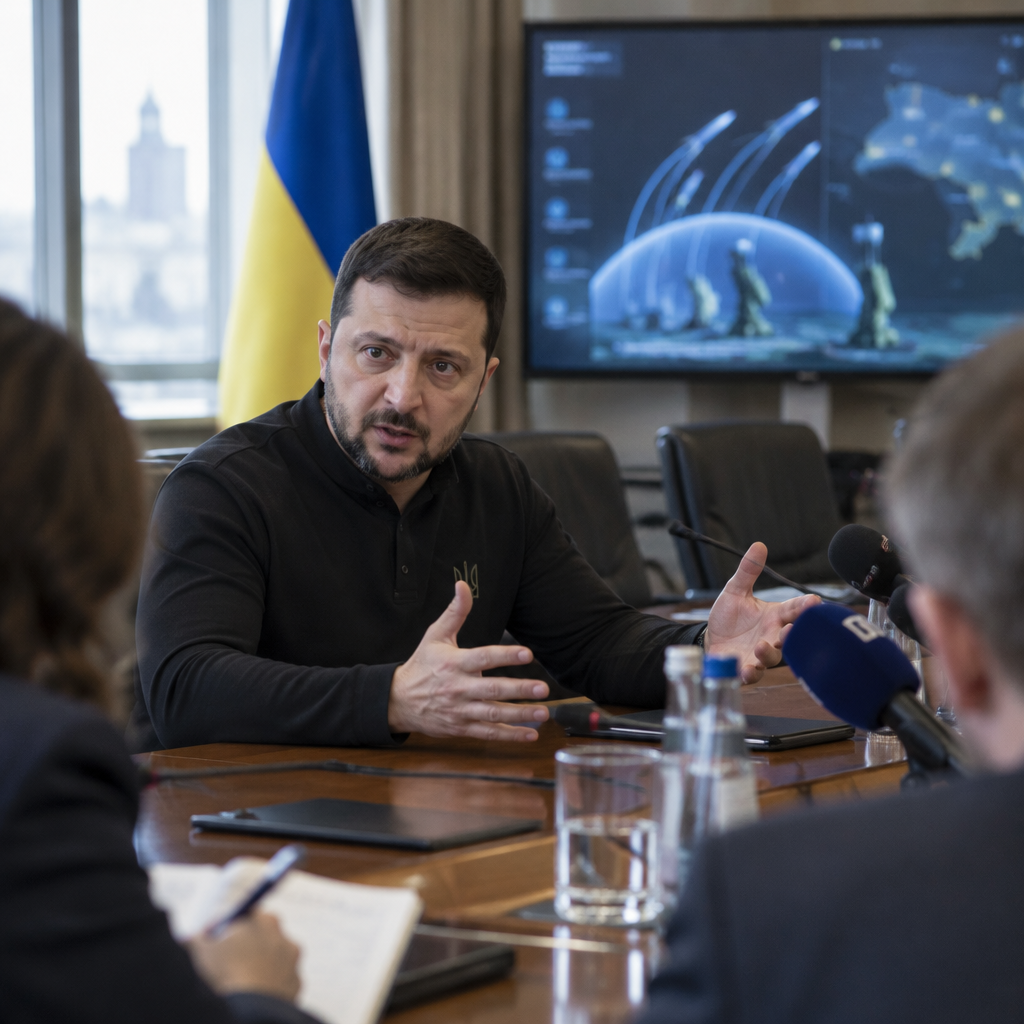
“Ukraine has done what it needed to do,” Ukrainian President Volodymyr Zelensky said on 26 October, urging the 10 partner countries behind the Freyja anti‑ballistic missile shield to accelerate work that he described as urgent and time‑sensitive.
Zelensky presses partners and names Norway and France
Zelensky told reporters that the partners’ work “needs to move faster,” and that he had discussed the program with French President Emmanuel Macron. He singled out Norway as “one of the key development partners,” framing the project’s urgency in terms of time: such systems typically take decades to develop and “Ukraine wants to move very quickly because there is no time.”
How Freyja is structured: open architecture and partner roles
Freyja took shape through a 13 July declaration signed by Denmark, France, Germany, Italy, the Netherlands, Norway, Spain, Sweden and the United Kingdom with Ukraine. The program uses an open architecture in which Ukraine supplies the launcher and interceptor while partners contribute radars, sensors and funding. Each partner brings its own financing to the shield, alongside the radars and sensors it contributes. Ukraine is responsible for system integration, with data exchange planned over Link 16 under STANAG 5516.

This site is the portfolio.
OSINTSights runs on Cloudflare Workers, D1, R2, and Vectorize, with an AI pipeline on Hetzner ARM. Nubivance designed, built, and operates it. We do the same for clients.
See what we buildIndustry roster and the technical backbone
Fire Point is listed as the lead industrial partner and the full industrial list named by Zelensky after the July declaration includes Fire Point, Thales, HENSOLDT, Diehl, Saab, Kongsberg, Weibel, Leonardo, MBDA, Eurosam, Safran and Destinus. Radar is the main partner contribution, and the Saab Giraffe, Thales Ground Master 400 and HENSOLDT TRML‑4D are cited among the options.
Fire Point signed a memorandum with HENSOLDT in June, a month before the July declaration; the two companies now have an agreement covering HENSOLDT radar for the system. The source notes that HENSOLDT’s TRML‑4D can track up to 1,500 targets.
Fire Point’s FP‑7.X interceptor: testing, timelines and costs
The Ukrainian missile at the centre of the shield is Fire Point’s FP‑7.X interceptor, unveiled the same day as the July declaration. Fire Point co‑owner Denys Shtilerman said a test reached an altitude of 25 km, and Fire Point said in July that testing of the FP‑7.x was complete and integration into the system was under way.
Shtilerman framed cost as central to Ukraine’s pitch, putting the FP‑7.x at about $700,000 per interceptor, compared with $3.8 million for a Patriot PAC‑3 interceptor. Fire Point Chief Executive Officer Iryna Terekh has set the first ballistic interception with the FP‑7.x for the end of 2027, calling it “an extremely ambitious goal.” Terekh has said Fire Point is trying to compress a 20–30 year missile program into two to three years, with Freyja’s operators keeping full control of the system, while Patriot carries a remote kill switch.
Timeline pressure: 12 months, a 2027 prototype, and interim reliance on Patriots
Zelensky had set a 12‑month deadline for the program when it was launched in July. Within that window, a system prototype is targeted for the first half of 2027. Fire Point also plans to deploy FP‑7.x interceptors on the battlefield in mid‑2027.
Until that prototype and subsequent testing are complete, Ukraine’s defence against ballistic missiles will continue to rely on Patriot interceptors supplied by partners. The source reports that Ukraine is receiving 12 Patriot missiles a month from the United States but used 35 this month, “drawing down its stock faster than deliveries replace it.”
What this means for Norway, France, and the United States
- Norway: Zelensky named Norway “one of the key development partners,” highlighting Norway’s role in financing, technology contribution or coordination among the radar and sensor suppliers that form Freyja’s backbone.
- France: Zelensky discussed the program with French President Emmanuel Macron; France is one of the signatories to the July declaration and is listed among partner countries expected to provide funding, sensors or radars.
- United States: While Freyja is a European‑led effort with Ukraine supplying the launcher and interceptor, the United States remains a near‑term source of Patriot interceptors — the interim defence underpinning Ukraine’s ballistic‑missile protection as Freyja is developed. The reported consumption rate (35 Patriots used this month against 12 monthly deliveries) underlines the urgency Zelensky described.
The program’s public facts lay out a tight and explicit gamble: compress decades of weapons development and multinational integration into a two‑to‑three‑year sprint, field a prototype in the first half of 2027, and attempt a first operational interception by the end of 2027. The named industrial partners, radar options and Link 16 integration plan provide a technical roadmap — but the calendar and the reported Patriot drawdown are the clearest measures of why Zelensky is pressing partners to “move very quickly because there is no time.”