“to enable remote control of the vehicle from a distance of up to 1,000 km.” — Col. Vladyslav Voloshyn
Col. Vladyslav Voloshyn and the Central Innovation Activities Directorate
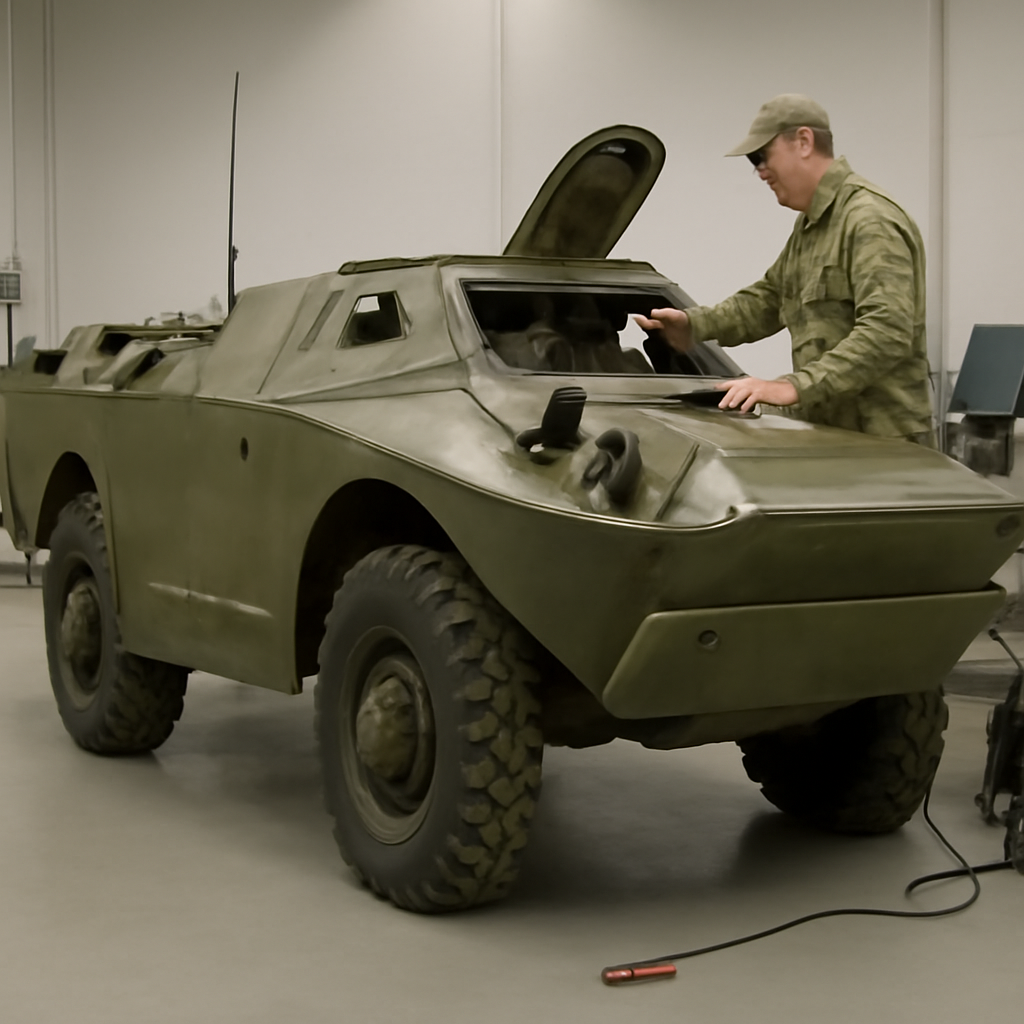
Col. Vladyslav Voloshyn, head of the Central Innovation Activities Directorate of the Ukrainian Armed Forces, told the Ukrinform news outlet that his unit is converting Soviet-era BRDM-2 armored reconnaissance vehicles into remotely controlled robotic platforms. Voloshyn framed the effort as part of a broader push to field robotic systems that “will help preserve the lives of service members,” and said the directorate is preparing the BRDM-2M for future frontline use without providing firm timelines.
BRDM-2M modernization: key technical changes under development
The modernization package described by Voloshyn contains multiple concrete changes to the legacy BRDM-2 design. Planned upgrades include:
- Remote-control capability intended to operate “from a distance of up to 1,000 km.”
- Replacement of the Soviet-made GAZ gasoline engine with a “powerful foreign-made diesel engine,” with General Motors and Mercedes engines among those being considered, plus an automatic transmission.
- Day and night cameras and protected data links to enable beyond-line-of-sight guidance, with the platform sized to “more easily accommodate robust satellite links.”
- Additional survivability additions: increased mine protection for the hull bottom, anti-fragmentation protection, tubeless high-mobility tires, and a backup remote-control system located inside the hull.
- Ability to integrate a remotely controlled combat module “equipped with an automatic weapon of at least 12.7 mm caliber.”

This site is the portfolio.
OSINTSights runs on Cloudflare Workers, D1, R2, and Vectorize, with an AI pipeline on Hetzner ARM. Nubivance designed, built, and operates it. We do the same for clients.
See what we buildHow Ukraine is using UGVs on the battlefield
The report places this BRDM-2 conversion in the context of a larger UGV (uncrewed ground vehicle) effort across Ukraine. Voloshyn said Ukraine is using UGVs mainly for logistics and casualty evacuation, although they are “also increasingly engaging in ground combat as well air defense.” The directorate anticipates employing upgraded BRDM-2Ms either to “assault front line Russian positions where troops can’t go on foot” or as remote assets to “provide fire control and support” in areas where frontline defenses are porous.
Converting stored BRDM-2s is presented as a resource-efficient alternative to designing a wholly new vehicle: Ukraine has “a large supply of BRDM-2s…in storage,” Voloshyn noted. ArmSpetsTekhnolohiya previously unveiled a BRDM-2M at a Defense Builder Accelerator Demo Day in June; the directorate is now preparing this system for deployment if it proves viable.
Andrii Hrytseniuk, Brave1, and the Delta command-and-control link
Brave1 CEO Andrii Hrytseniuk provided complementary technical context on how combat UGVs are operating in Ukraine. Hrytseniuk said that “combat UGVs without artificial intelligence do not work at appropriate effectiveness,” and that combat turrets in use “have elements of artificial intelligence” to perform machine vision tasks — “object recognition, identification, classification, tracking and providing recommendations for the operator on what to do.”
Hrytseniuk also tied these systems to Ukraine’s Delta command and control system, saying the UGVs “communicate through Ukraine’s Delta command and control system” and that “without the Delta system, ‘all these advanced technologies on the battlefield will not be working.’” He described Delta as “number one in the world” and “absolutely crucial” for drones and multi-domain operations.
What this means for the Ukrainian Armed Forces, Brave1, and Russian forces
- Ukrainian Armed Forces: The conversion program aims to expand remote strike and support options while reducing personnel exposure. Remote-control range, satellite-capable links, and added protection suggest planners intend these platforms for higher-risk tasks on contested front lines.
- Brave1 and UGV developers: The directorate’s push aligns with Brave1’s emphasis on AI-enabled machine vision and integration with Delta; developers will be watching interoperability, protected data links, and how recommendations from onboard AI feed operator decisions.
- Russian forces and frontline defenders: Voloshyn’s description signals that these platforms could be used for direct assaults on positions Ukrainian troops cannot safely enter and for remote fire control—roles that, if realized, would change force-multiplication dynamics along static or contested sectors of the front.
The BRDM-2M effort arrives alongside other battlefield trends documented in the same reporting: both sides continue to press forward in small, localized actions while front lines remain largely static; UGVs and aerial drones are becoming pervasive; and related logistical and strategic developments—range-extending strikes, North Korean missile and troop transfers to Russia reported by the Institute for the Study of War and Ukraine’s Main Military Intelligence Directorate (GUR), and Ukraine’s interest in using Starlink-equipped drones—add operational context to Kyiv’s push for remotely controlled combat vehicles.
Voloshyn’s description gives a clear engineering outline for what Kyiv seeks to field: extended-range remote control, heavier diesel powerplants, added protection, and at least a 12.7 mm remotely operated weapon. The remaining questions are operational: how the platforms will be exercised, the timelines for fielding, and whether the upgraded BRDM-2Ms will meet the survivability and control expectations Voloshyn has cited. Those answers, the colonel acknowledged, remain to be provided.