"The Defense Forces of Ukraine conducted a unique special operation targeting two Russian military assets near the Libyan port of Benghazi,” the Security Service of Ukraine (SBU) reported on its website.
The SBU’s claim: a mothership launched seven USVs
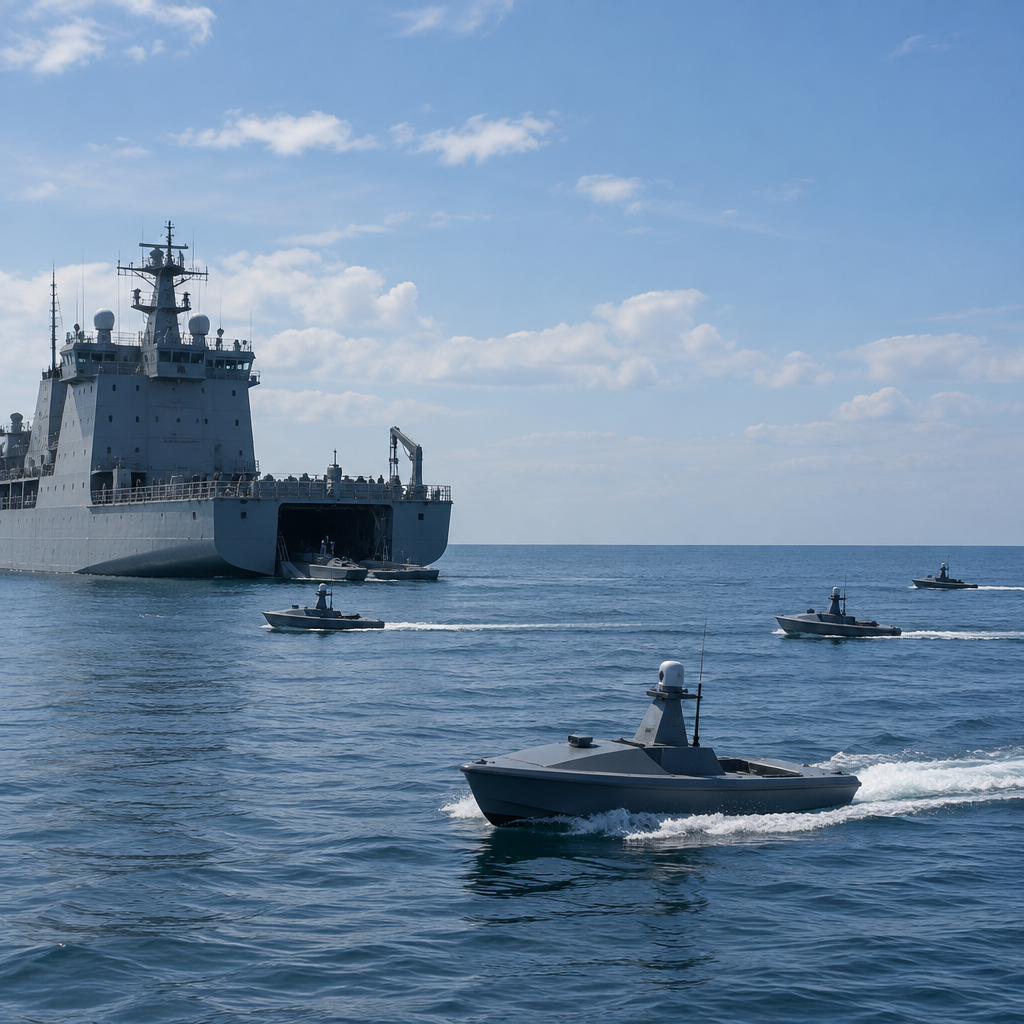
The SBU’s Monday statement said seven Ukrainian-made uncrewed surface vessels (USVs) were “transported to the designated location and launched from a ‘mothership.’” According to the agency, the mission struck two vessels: the Project 20380 corvette Merkury (hull number 734) and the dry-cargo vessel MV Angara (IMO 9179842). The SBU called both vessels “legitimate military targets” because they “directly supported the Russian Federation’s military capabilities.”
The SBU did not identify the mothership’s location or its type. It also released video clips showing sea-drone footage of explosions aboard the corvette and an attack on a cargo ship; the footage includes close approaches and a distant view of a ship engulfed in flames.
Competing origin stories: Libya, Albania, and earlier reporting
The SBU statement is the first official confirmation we have of Ukraine claiming to use a vessel to deliver USVs for an attack. It conflicts with other contemporaneous accounts. The Associated Press reported initial investigation findings that the USVs were “launched at the ship from a base run by Ukrainian forces in western Libya.” Meanwhile, the Clash Report asserted the USVs came from Albania—an allegation Albanian officials “categorically reject[ed],” the Albanian Ministry for Europe and Foreign Affairs said on X, calling the reports “inaccurate” and “without verifiable evidence.”
TWZ noted that the differing accounts leave the launch point disputed: the SBU’s mothership claim, a Libyan land base, and an Albanian origin have all been asserted and contested in public statements.

The cyber insurance questionnaire just landed. Now what?
SOC 2, HIPAA, insurance renewals - someone has to own security strategy. Nubivance provides fractional CISO leadership without the full-time salary.
Get a security leadThe strikes and their visible aftermath
TWZ reported that the Merkury sank after being struck while moored at a dock in Benghazi and that a cargo ship was also struck in waters outside the port. Satellite imagery collected by Vantor showed the Merkury rolled over on its side at a Benghazi pier and the cargo ship—identified by the SBU as MV Angara—moored in port with visible damage and firefighting vehicles nearby. TWZ also noted earlier reporting that the struck cargo ship had been identified in some accounts as the Ascalon, which “looks similar to the Angara.”
Following the attack, Libya closed off the harbor section where the ships lay by lining up roughly two dozen small boats to block the approach from inside the harbor, according to a Vantor satellite image cited by TWZ.
USV model and observable features
Naval analyst H.I. Sutton identified the USV used in imagery of the raid as a variant of the Sargan 3000; TWZ previously described the Sargan 3000 as 6.9 meters long, 2.2 meters wide, with an operational radius of up to 1,600 km and a payload capacity of 450 kg. TWZ also noted that in the SBU video a USV attacking the cargo ship was fitted with “at least two tubes on either side of the hull,” though TWZ cautioned it was unclear whether those tubes were weapons or countermeasures such as smoke dispersal.
Libyan politics and regional reactions
TWZ summarized Libya’s fractured governance: the internationally recognized Government of National Unity (GNU) governs the northwest while the Libyan National Army (LNA), led by Khalifa Haftar, controls most of eastern Libya. TWZ reported Haftar is backed by Russia. The LNA accused the attacks of violating Libyan sovereignty and called for an international investigation into “reports regarding the presence of Ukrainian personnel, experts, or military units in western Libya,” citing AFP. Local reports cited by the LNA suggested “similar special forces” might be operating near Tripoli and other western locations.
What this means for the Libyan National Army, the Government of National Unity, and Albania
- The Libyan National Army (LNA): The LNA has publicly asserted a sovereignty violation and requested an international probe, which could increase pressure on its backers and raise questions about port security in LNA-controlled areas.
- The Government of National Unity (GNU): If USVs or personnel operated from western Libya—as some reports suggest—the GNU would face heightened scrutiny and domestic political fallout tied to foreign operations conducted from its territory.
- Albania and its foreign ministry: Albania’s Ministry for Europe and Foreign Affairs issued a categorical denial that its territory was used for the attack, signaling a desire to prevent diplomatic escalation and to correct public record when allegations arise.
TWZ placed the SBU’s mothership assertion in the context of past USV operations and maritime defenses: earlier Ukrainian USV raids prompted layered harbor defenses elsewhere, and TWZ highlighted the relative absence of such passive force protection around the Merkury in Benghazi. TWZ also noted a practical point: launching USVs from Ukrainian shores to Benghazi would require traversing roughly 1,300 miles and multiple seas, making a nearby launch—by ship or land—far more plausible than a direct shore-launched mission from Ukraine.
The SBU’s statement, video, satellite imagery, and multiple competing accounts together establish the broad facts: two Russian-affiliated vessels were struck near Benghazi, the SBU claims a mothership-launched USV operation, Libya’s eastern authorities decried a sovereignty breach, and Albania denied involvement. The SBU’s disclosure that the platform was a “mothership” is consequential because, if accurate, it marks an explicit admission that Ukraine used a vessel to deliver USVs in this operation—yet the agency provided no identifying details about the launcher. That omission leaves concrete questions about where and how the USVs were staged, even as the visible damage and claims on all sides shape the immediate political and security fallout.