How the Ukrainian Navy and the GUR described the engagement
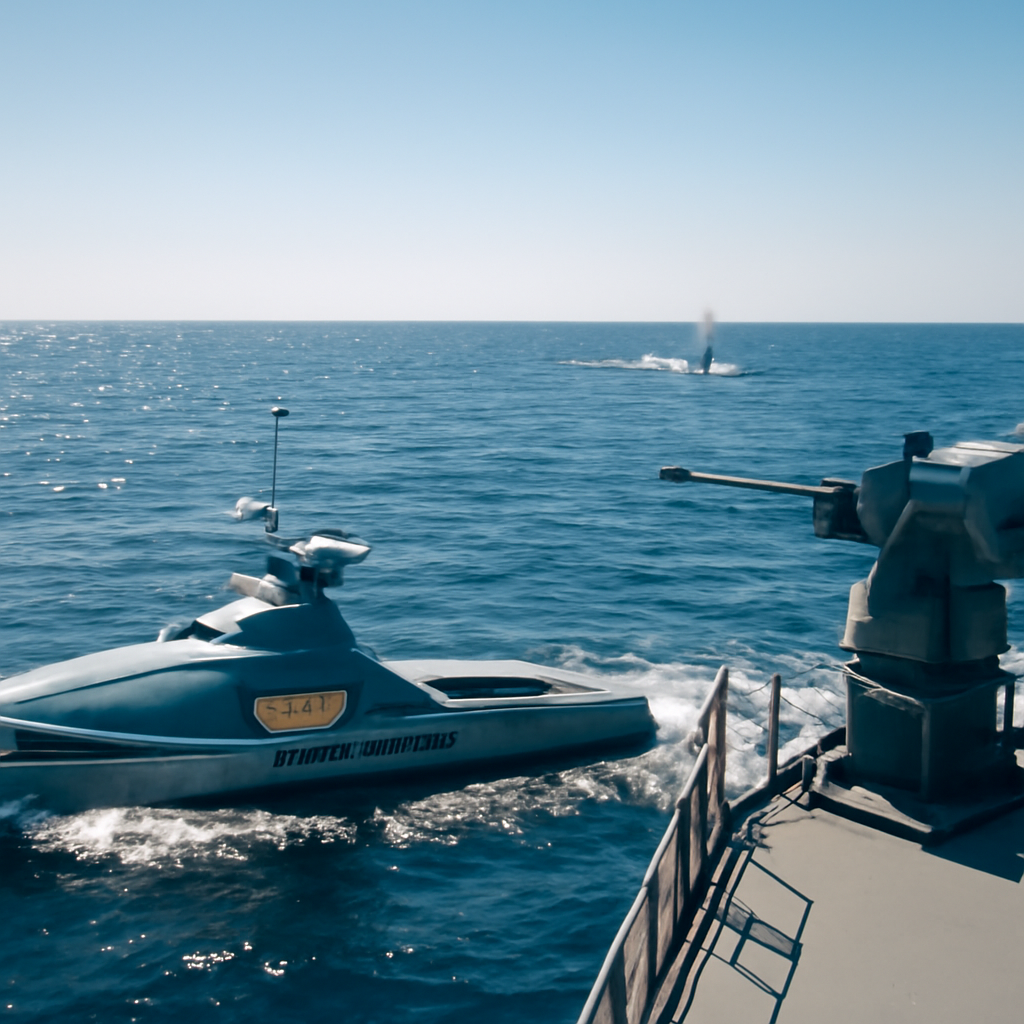
The Ukrainian Navy said units of the Main Intelligence Directorate (GUR) “detected the target” and that the Sargan 3000, “equipped with a remotely operated weapon station (RWS) Protector 12.7 mm, successfully destroyed it.” The service provided an 81‑second video showing the Sargan’s onboard camera acquiring and engaging the Russian USV and a closer view of the Protector firing until the target apparently sank stern first. The Ukrainian Navy did not provide an exact time or precise location for the incident, and TWZ notes it “cannot independently verify this claim.” The Russian drone boat was not identified in the release and “did not appear to be armed,” according to the same reporting.
The Sargan 3000: platform profile and variants (AmalNews reporting)
The Sargan 3000 — its name translated in the coverage as “needlefish” — was introduced publicly in April by President Volodymyr Zelensky as a “multi-purpose platform that has undergone testing and entered service with the Ukrainian Navy. These uncrewed vessels are highly maneuverable and capable of carrying out strike missions.” Reporting by the Russian AmalNews outlet supplied detailed specifications: a length of 6.9 meters, beam of 2.2 meters, an operational radius of up to 1,600 km, a 450 kg payload capacity, and estimated speeds of 40–55 knots. AmalNews also described a low‑profile hull, water‑jet propulsion (presumed diesel or hybrid), and a suite of systems including an inertial and optical navigation backup for GPS jamming, electronic countermeasures (ECM), redundant satellite communications, and “multi-channel control capabilities.”

Audit-ready is a season. It shouldn't be.
Evidence in spreadsheets, controls drifting between audits, frameworks multiplying on flat headcount. Nubivance runs continuous compliance on Rapid7 Cyber GRC - SOC 2, HIPAA, ISO 27001, PCI, CMMC.
End the scrambleKongsberg’s Protector RWS and the video record
The Ukrainian Navy’s account names the Sargan 3000’s weapon as a Protector remote weapon station chambered in 12.7 mm, a system the report attributes to Kongsberg. The released footage begins with the Sargan’s onboard camera, cuts to a closer view of the Protector firing, and later shows an aerial feed — unclear in the clip whether the aerial platform was piloted or an unmanned aircraft. The video shows the Sargan’s machine‑gun rounds striking the target until visible fragments detach and the vessel appears to sink stern first.
Referenced precedents: Izumrud, Romania, Houthis and CENTCOM
The report places the claimed event in a broader recent history of surface USV operations. It recalls an earlier Ukrainian Navy statement that a Sargan-3000 “destroyed the Russian Federation’s FSB border guard ship Izumrud” near Novorossiysk, a July engagement that the Navy said caused deaths and injuries among the ship’s crew. The Sargan has also been linked in coverage to an FPV‑carrier variant that washed ashore and detonated near Romania’s Constanța port in early June.
The story notes that Houthi forces pioneered operational kamikaze USVs years earlier and that Iran had developed crude versions that later reached Houthi proxies. It adds that Russia developed its own drone boats and mounted an attack on a Ukrainian vessel in August 2025. The United States’ first announced use of drone boats as one‑way attack systems was cited in a July CENTCOM post: “Yesterday, using multiple one‑way attack surface drones, CENTCOM forces successfully struck a submarine and ship maintenance facility in Iran,” the command wrote on X, adding that three Corsair unmanned surface vessels hit a port at Bandar Abbas Naval Base.
What this means for the Ukrainian Navy, Russian naval forces, and maritime security planners
- Ukrainian Navy: The claim — if borne out — would demonstrate an ability to pair GUR detection with a remote‑weapon USV to prosecute and neutralize small surface threats at sea, expanding the Sargan’s reported roles beyond kamikaze strikes to include hunt‑and‑engage missions.
- Russian naval forces: An unarmed or lightly armed USV that can be located and engaged by another USV presents a vulnerability for unescorted or unprotected autonomous craft; the reported loss of an unnamed Russian USV underscores a potential need for hardened comms, escorts, armament, or tactics to defend similar systems.
- Maritime security planners and port authorities: The clip underlines that USVs can operate not only as one‑way weapons but also as persistent assets capable of hunting other unmanned craft, complicating defensive posture and harbor protection schemes that previously considered USVs primarily as attacking swarms or stand‑off threats.
This account, presented by the Ukrainian Navy and illustrated by an 81‑second video, is being framed as a milestone: a sea drone hunting and sinking another sea drone. TWZ reports it cannot independently verify the claim and notes no prior evidence of a drone boat killing another. The engagement, the platform details reported by AmalNews, and the wider examples cited — Izumrud, the Constanța incident, Houthi and CENTCOM use of USVs — together underscore how quickly roles for maritime drones are evolving and suggest the next phase could be armed duels between fully capable combat USVs.