"control the ‘cost of attack’ and ‘price of defence.’" — Quwa
MSPO 34 and the El Alamein airshow: an offensive-heavy signal
The 34th International Defence Industry Exhibition (MSPO) and the 2nd El Alamein International Airshow revealed a convergent trend across Europe, the Middle East, and Africa: a preference for low-cost strike — piston- and electrically-powered loitering munitions, low-cost subsonic cruise missiles (LCCMs) — and scalable kinetic air-defence solutions. Quwa’s review of both events notes a clear industry objective: make long-range munitions cheap (well under $1 million per unit) while ensuring a defensive munition or round is available at sub-$1M to protect high-value assets. For Pakistan, the exhibitions underline that its defence industry has made visible progress on offensive systems but lags on the defensive side.
Low-cost cruise missiles and loitering weapons: NESCOM, private firms, and practical design choices
Pakistan’s long-range strike portfolio, centered on NESCOM and firms such as Woot‑Tech and the National Aerospace and Science Technology Park (NASTP), has numerous LCCM and loitering-munition programs. Core programs like Sarfarosh and KaGeM V3 date to 2024, before the 2025 conflict with India, and Pakistan has pursued measures to break production bottlenecks — standardizing a miniature turbojet, repurposing munitions (for example, reworking Fatah 2 into an anti-ship ballistic missile via SMASH), and simplifying platform designs (a shift from Babur to Fatah‑4).
International vendors at MSPO and El Alamein — WB Group’s Gladius 2/Warmate 30, MBDA’s Deluge and Crossbow, and Russia’s S‑71M/S‑71K — provide templates Pakistan appears to be emulating. The shared design intent visible across recent weapons is consolidation: airframes composed of few large pieces, low external fastener counts, and sizing to a 500‑lb rack envelope to simplify manufacture and logistics.

Audit-ready is a season. It shouldn't be.
Evidence in spreadsheets, controls drifting between audits, frameworks multiplying on flat headcount. Nubivance runs continuous compliance on Rapid7 Cyber GRC - SOC 2, HIPAA, ISO 27001, PCI, CMMC.
End the scrambleAdditive manufacturing versus brake-formed simplicity: RAACM-ER, the Rasoob 250, and PIAM3D
Western and Chinese OEMs are increasingly using additive manufacturing to accelerate iteration and reduce tooling costs. CoAspire’s Rapidly Adaptable Affordable Cruise Missile (RAACM) shows this model in action: Divergent Technologies printed fuselages, wings, and fins, delivering first hardware in week 10, integrated rounds in ground testing by week 14, and a flight test by week 16. Vendors such as Anduril, CoAspire, WB Group, and CASIC are fabricating sub-assemblies via 3D printing rather than conventional tooling.
Pakistan has nascent additive capacity. The Pakistan Institute of Additive Manufacturing (PIAM3D) at the National Centre for Physics operates two metal printers covering Ti6Al4V, AlSi10Mg, and IN718, alongside industrial polymer machines and precision electropolishing to under one micron, and lists aerospace and defence among its target sectors. Whether that capacity has been applied to guided munitions remains unknown; no Pakistani SOE has publicly stated it has done so.
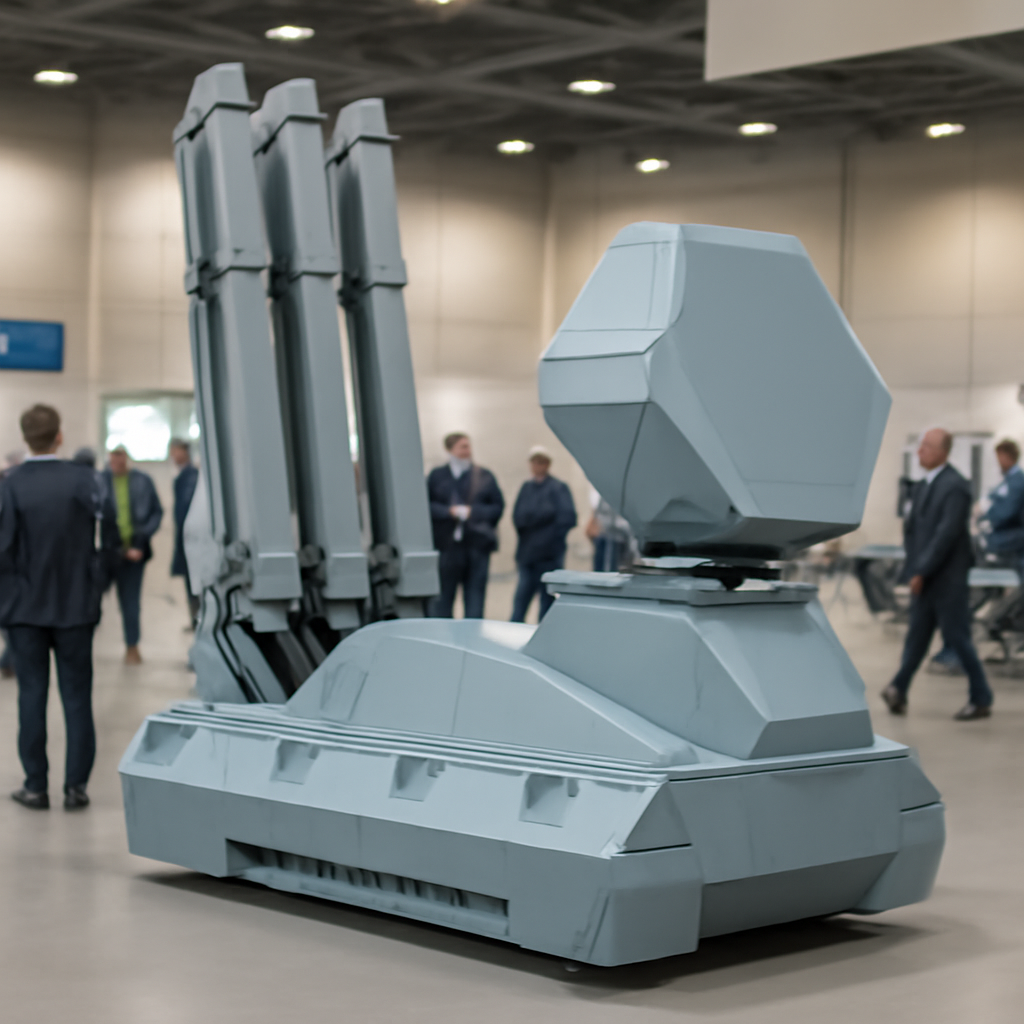
The GIDS Rasoob 250 mock-up illustrates an alternate approach: a near-constant trapezoidal section with flat-sided panels and few fasteners—shapes ideal for brake-formed metal or bonded flat composite panels. That profile appears designed for inexpensive, high-volume fabrication rather than being optimized for current large-format additive processes. The contrast between RAACM-ER’s printed compound-curved shell and the Rasoob’s flat-panel prism highlights two routes to the same end: low-cost, rapidly-produced LCCMs.
Kinetic air defence, NESCOM’s gap, and the dual-pulse motor problem
By contrast with strike, Pakistan’s domestic kinetic air-defence production is limited. Today the bulk of domestic scalable air-defence work centers on passive soft-kill counter‑UAS systems targeting communications links; there is no widely produced Pakistani kinetic effector for C‑UAS or general anti-air warfare. The Pakistan Air Force has supplemented its SHORAD layer with Chinese and Turkish systems to defend against subsonic LCCMs, loitering munitions, and small drones.
NESCOM is pursuing a short‑to‑medium‑range AAW layer — the Lance IR (possibly a licensed QW‑19), FAAZ‑SL (35 km range, 12 km altitude), and LoMADS (100 km range) — but Pakistan lacks indigenous development experience in larger solid‑fuel rocket motors needed for medium‑ and long‑range SAMs, particularly dual‑pulse motors. Quwa points to Poland and MBDA’s approach — dual‑pulse motor SAMs such as CAMM‑MR and complementary point‑defence systems like the Counter Mass Interceptor (CMI) — as a model for building layered, scalable air defences. NESCOM could pursue partnerships (the article cites Türkiye or Ukraine as possibilities) to close the dual‑pulse gap and standardize a scalable SAM/AAM ecosystem.
What this means for the Pakistan Air Force, NESCOM, and the private sector
- Pakistan Air Force: continue fielding foreign short-range solutions while awaiting domestic kinetic options; current networked ISTAR investments (radars, passive ESM, China-supplied imaging satellites, and data links) strengthen targeting for strike systems but leave kinetic cover thin.
- NESCOM: show-cases of strike strength underline a need to prioritize dual‑pulse motor development and consider additive-manufacturing procurement (large-format powder-bed or directed‑energy deposition systems, a Pakistani qualification standard for printed flight hardware, and hiring for design‑for‑additive roles were flagged as tells to watch).
- Private sector and foreign OEMs: an “Indus Dome”‑style wide requirement could invite private‑foreign partnerships; the article argues licensing and offsets from vendors such as MBDA Italy, Aselsan, Roketsan, and others are plausible routes to build indigenous kinetic capability.
Pakistan’s defence industry has made deliberate choices to scale strike cheaply and quickly; the question the exhibitions leave hanging is whether the country will match that urgency on the defensive side. The technical levers are visible — additive manufacturing, partner-driven dual‑pulse motors, and private‑sector engagement — but the next concrete steps will determine whether Pakistan can translate strike‑centred momentum into a balanced, layered air‑defence ecosystem.