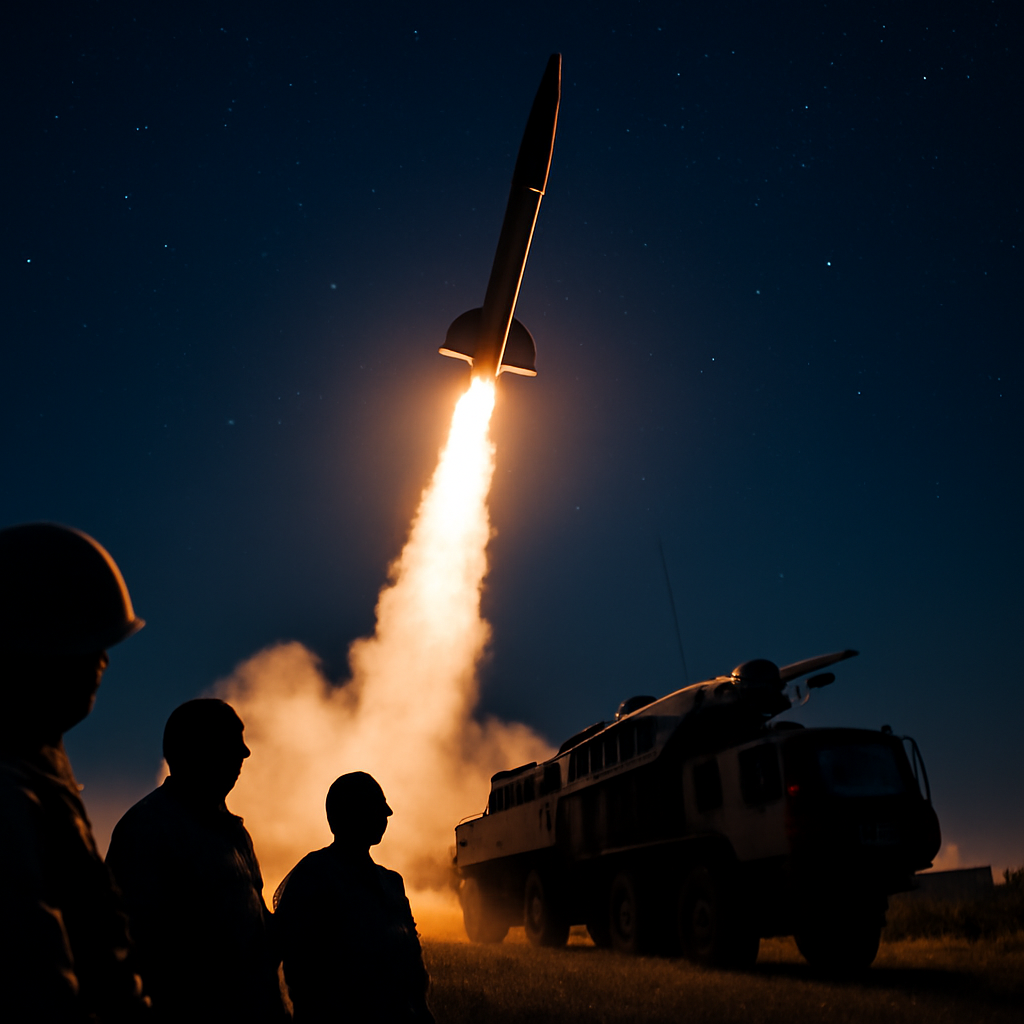
"Ukrainian tactical ballistic missile. FP-7. First combat use. Thank you for the result. Next up: production. Glory to Ukraine!" — Volodymyr Zelenskyy, October 1, 2026.
Zelensky’s announcement and what Kyiv disclosed
President Volodymyr Zelensky announced on October 1, 2026 that Ukraine had conducted the first combat use of the domestically developed FP-7 tactical ballistic missile and said production would follow. Ukrainian authorities did not disclose the strike’s target, location, the number of missiles involved, or other operational details. A video has been published that shows what is said to be a nighttime launch of the FP-7, but the claim has not been independently verified.
Fire Point’s rapid move from drones to ballistic missiles
The FP-7 is produced by Fire Point, a Ukrainian defense company that expanded from drones into long-range strike missiles and ballistic missile technology after Russia’s full-scale invasion. Fire Point’s earlier systems include the FP-1 and FP-2 long-range strike drones and the FP-5 Flamingo cruise missile. Fire Point CEO Iryna Terekh has described the company’s development and manufacturing model as aiming to rapidly scale production while maintaining a dispersed industrial base inside Ukraine.

Audit-ready is a season. It shouldn't be.
Evidence in spreadsheets, controls drifting between audits, frameworks multiplying on flat headcount. Nubivance runs continuous compliance on Rapid7 Cyber GRC - SOC 2, HIPAA, ISO 27001, PCI, CMMC.
End the scrambleFP-7: reported specifications and intended target set
According to Ukrainian and company-released information, the FP-7 has a reported range of approximately 250 kilometers (155 miles) and a reported warhead weight of around 150 kilograms (331 pounds). Other published figures place its velocity at roughly 1,500 meters per second (about 3,350 miles per hour). The missile is described as optimized for objectives such as logistics hubs, air-defense sites, and drone bases — a shorter-range complement to the U.S.-supplied Army Tactical Missile System (ATACMS) rather than a direct replacement. Those performance figures are reported by Ukraine and Fire Point and have not been independently verified; actual range, payload and accuracy can vary by configuration and mission profile.
FP-7.X interceptor, Project Freyja, and broader ambitions
Fire Point is reusing the FP-7’s basic missile architecture to develop the FP-7.X, an anti-ballistic missile interceptor. The company says commonality in propulsion, airframe, guidance and production processes can shorten development and yield manufacturing efficiencies. The FP-7.X is part of Project Freyja, a European effort to create a comparatively inexpensive, potentially numerous ballistic-missile-defense interceptor. Fire Point has described an initial interceptor that uses a blast‑fragmentation approach and envisions more sophisticated hit‑to‑kill capability for later versions; the company also said it is working with European and Ukrainian partners on the interceptor’s seeker.
Fire Point has discussed an eventual production rate measured in the thousands of interceptors annually, but those figures represent company ambitions rather than demonstrated output. The company is also developing a larger missile, the FP-9, which Fire Point has described as having a planned range of approximately 850 kilometers (528 miles) and which has driven new industrial work to manufacture large solid-rocket motors. Separately, Diehl Defense confirmed plans to launch production of the Flamingo cruise missile in Germany after signing a technology agreement with Fire Point, a development that could create pathways for European production of related systems.
What this means for Fire Point, Diehl Defense, and Ukrainian defense planners
- Fire Point: a claimed combat debut marks a shift from testing toward operational employment and places the company’s ability to industrialize and sustain production at the center of its near-term challenge.
- Diehl Defense and European partners: production agreements such as the one for the Flamingo could create industrial pathways for Fire Point technology in Europe and shape procurement options for NATO members seeking long-range fires.
- Ukrainian defense planners: the FP-7’s short flight time and reported warhead make it useful against hardened, time‑sensitive targets within its range, but planners will need production scale, targeting procedures, and launch discipline to move from symbolic first use to routine operational employment.
The operational significance of the FP-7 hinges on two linked transitions: whether the weapon moves from a claimed combat debut into sustained production, and whether Ukraine can field it at scale with the logistics, targeting and command arrangements needed for repeatable use. Fire Point’s ambitions — from interceptors under Project Freyja to the larger FP-9 and cooperation with Diehl Defense — map onto broader Ukrainian aims to build indigenous long‑range strike and defensive capabilities. For now, the announcement is a milestone in words and imagery; the next measure will be production and demonstrated operational service as Kyiv heads into a winter season when long‑range strikes against energy, industrial and military infrastructure typically intensify.
Source: TWZ — Ukraine Claims First Combat Use Of FP-7 Ballistic Missile