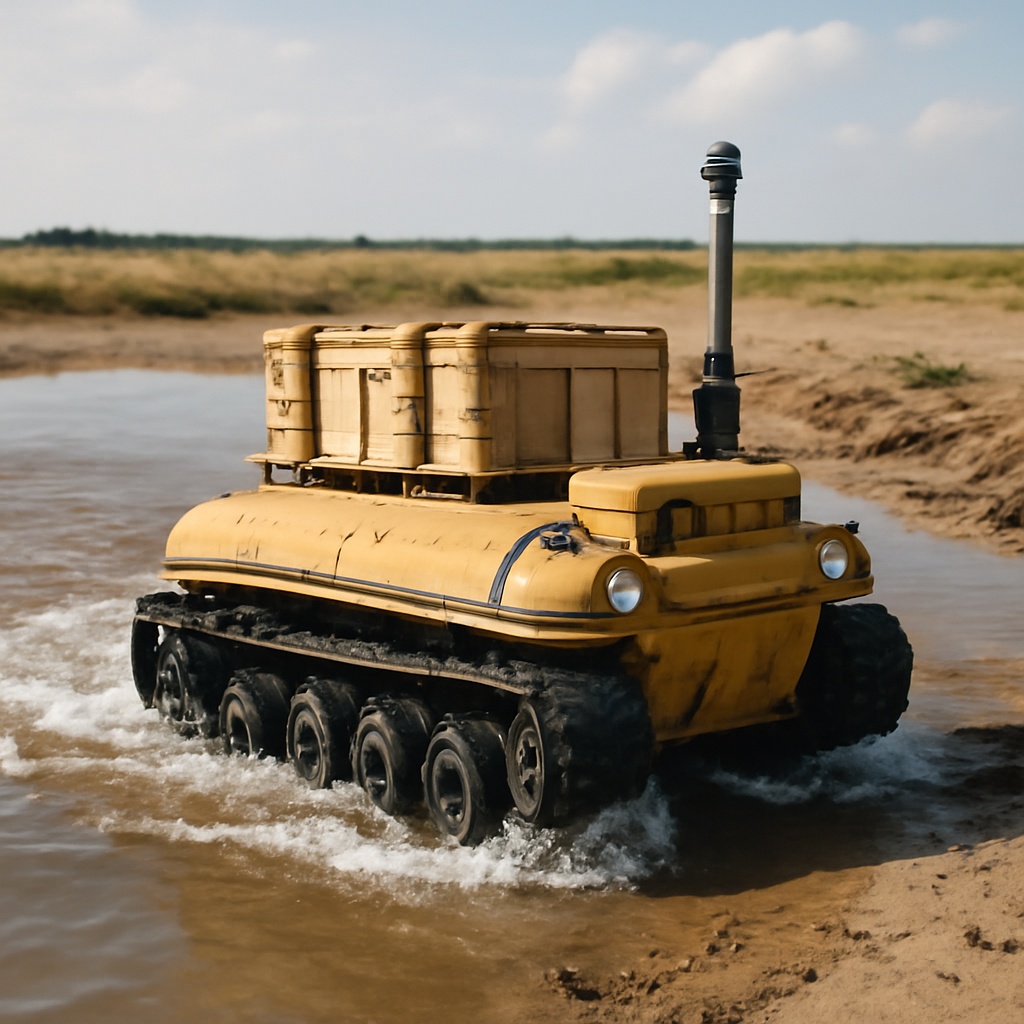
The uncrewed ground vehicle (UGV) traveled 40 kilometers one way, then returned — roughly 70 kilometers in total — carrying food and other supplies across mixed land and water terrain, and survived coming under Russian fire.
Why the 93rd Separate Mechanized Brigade’s “Alter Ego” unit took on amphibious UGVs
The brigade’s UGV detachment — the Alter Ego unit — developed the amphibious capability after “one of the departments of the Ministry of Defense asked for our help to solve this problem,” according to the unit’s commander, who uses the call sign “Electric.” Large stretches of Ukraine’s front line are bisected by rivers, wetlands and small waterways that impede logistics. Alter Ego was asked to act because, Electric said, the unit “are one of the most experienced units in terms of UGVs” and had prior firsts on evacuation and strike missions.
From concept to combat in less than three months
Electric told TWZ that “the whole process from development to battle deployment took less than three months.” The unit pursued two parallel approaches: modify a Triton variant and convert a standard ground UGV into an amphibious vehicle. The brigade’s forward workshops performed substantial engineering work near the front, a capability Electric contrasts with manufacturers who, he said, “don’t understand what’s needed on the battlefield.”

Audit-ready is a season. It shouldn't be.
Evidence in spreadsheets, controls drifting between audits, frameworks multiplying on flat headcount. Nubivance runs continuous compliance on Rapid7 Cyber GRC - SOC 2, HIPAA, ISO 27001, PCI, CMMC.
End the scrambleWhat Alter Ego changed — and what they kept
For the UGV that started as an amphibious market solution, Alter Ego “changed almost everything that that UGV had, starting from electronics, the software, the waterproofing, the communications — we basically changed everything.” For the ground UGV variant, the unit retained the elements that made it effective on land and “added waterproofing and specific mechanics” so it could operate in water. The vehicle switches between two separate control systems — one for water and one for land — and at present the operator drives the system manually.
Communications, autonomy and battlefield realities
Communications were a critical limitation of the manufacturer-supplied systems. Electric said the original communications “was not sufficient at all” and that Alter Ego installed its own communications stack. Satellite navigation is part of the UGV’s navigation and communication suite, but Electric declined to discuss “in detail about the other part of the communication system.” He also confirmed the mission did not use AI: “We didn’t use AI.”
First mission: logistics under fire, one failed attempt, and iteration
The unit would not disclose the precise time or place of the operation, saying only that it took place in a sector with water obstacles. The amphibious UGV was tasked with delivering food and other supplies; Electric said the system “went 40 kilometers one way, and then it returned. So probably around 70 kilometers in total.” The mission did not succeed on the first try — the unit reported one failed attempt caused by “a certain technical problem” — but after analysis and fixes the mission succeeded. Electric confirmed the UGV “came under Russian fire” and “survived.”
Brave1, scaling, and possible future roles
A representative of Brave1, Ukraine’s weapons technology accelerator, spoke to developing these systems “at scale.” Electric also said the amphibious platform “can be used in different ways in the future,” including logistics and potential strike roles, though he did not provide specifics. He confirmed there have been other amphibious UGV missions but declined to disclose numbers or payload details.
What this means for operators, manufacturers, and front-line units
- Operators: Training requirements broadened — Electric said operators “had to learn how to move them in the water,” not just on land, and tactics had to be developed alongside the hardware.
- Manufacturers and engineers: Systems that work on testing grounds “are not ready for the reality on the front line,” Electric argued; forward workshops and iterative, battle-driven engineering were decisive to success.
- Front-line units and logistics planners: Amphibious UGVs offer a new option where rivers, wetlands, and marshes obstruct conventional resupply and where aerial delivery or standard UGVs cannot fully satisfy needs.
The Alter Ego unit’s deployment demonstrates rapid, front-line adaptation: combining off-the-shelf amphibious designs with deep field engineering, replacing or upgrading communications, and training operators to manage two-mode controls. The immediate result was a logistics delivery that travelled tens of kilometers over mixed terrain and endured enemy fire after one iterative failure; the next questions are operational scale and whether the platform’s future roles will expand beyond resupply. Read the original TWZ report here: https://www.twz.com/land/inside-ukraines-first-combat-deployment-of-robotic-amphibious-vehicles