"The lack of fire and forget missiles is the greatest problem for us." — Andrii Pilshchykov, TWZ, 2022.
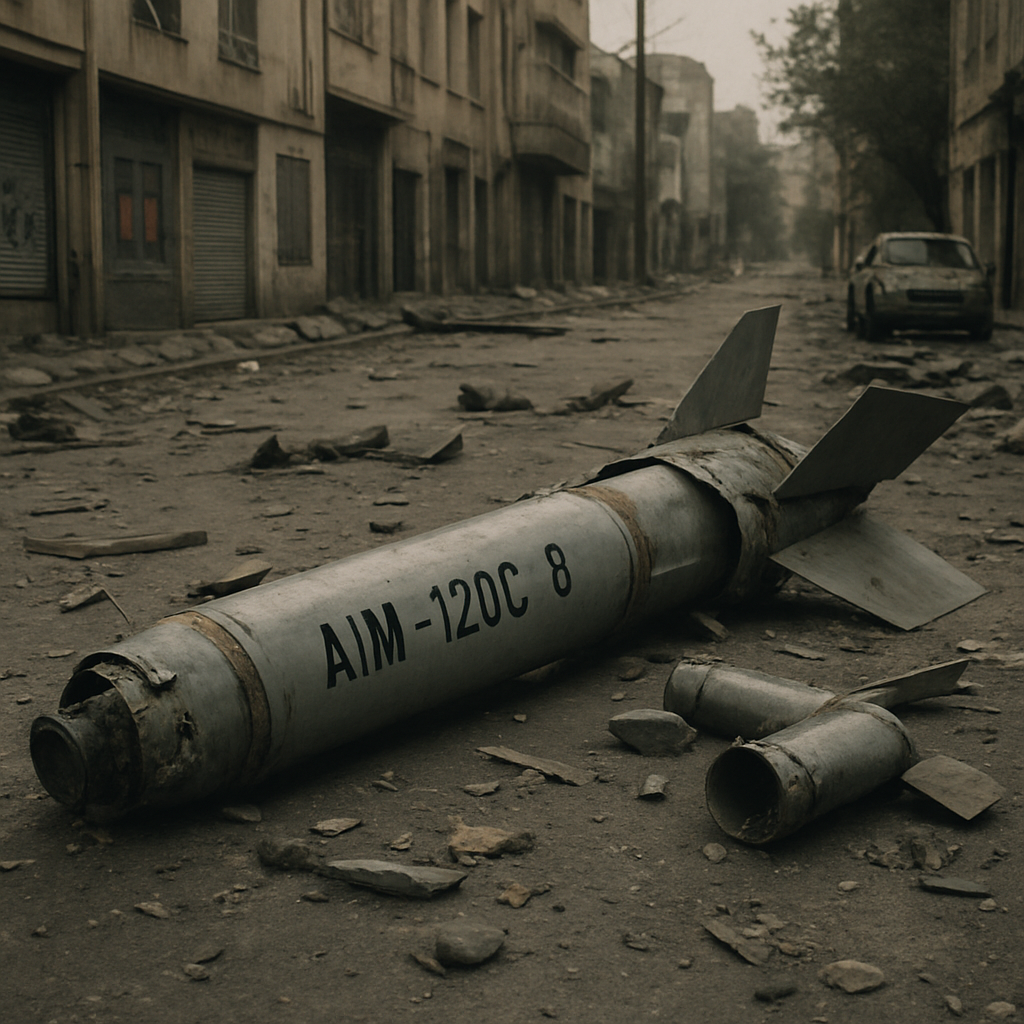
Wreckage recovered after Russian air attack on Dnipro
A photograph of missile wreckage marked AIM-120C-8 began circulating online after what available accounts say was a Russian air attack on Dnipro in central Ukraine. The image shows part of an AMRAAM missile body clearly labeled AIM-120C-8; according to those accounts, the wreckage was found in the aftermath of the strike while the Ukrainian Armed Forces were active in the city's defense.
What the AIM-120C-8 designation signifies
The AIM-120C family — commonly called "Charlie" — represents an evolution over earlier AIM-120A/B models, with upgrades in range, guidance, resistance to countermeasures and related areas. Successive C-series improvements described in available material include a WDU-41/B warhead (AIM-120C-4), a WPU-16/B propulsion section and ECCM upgrades (AIM-120C-5), and an updated proximity fuze (AIM-120C-6). The C-7 added further ECCM improvements, an upgraded seeker, and longer range.
The precise technical differences between the AIM-120C-8 and the AIM-120D are unclear in the public record cited, but the D-model has been associated with two-way datalink and third-party targeting capabilities and was used in what the U.S. Air Force described as the "longest known" air-to-air missile shot in tests near Eglin Air Force Base in fall 2024. The D-model may also include an AESA seeker, while the C-8 retains a mechanically scanned antenna.
Performance figures for the AIM-120C-8 are officially classified, but public reporting cited here assumes engagement ranges of roughly 75 to 100 miles under favorable conditions. The AIM-120C-8 is expected to remain in production for international customers long beyond 2030.

This site is the portfolio.
OSINTSights runs on Cloudflare Workers, D1, R2, and Vectorize, with an AI pipeline on Hetzner ARM. Nubivance designed, built, and operates it. We do the same for clients.
See what we buildLaunch platforms: F-16 fighters and NASAMS ground launchers
Ukraine can employ AMRAAMs from two principal platforms identified in the record: F-16 fighters and the ground-based National Advanced Surface-to-Air Missile System (NASAMS). Previous imagery confirmed Ukrainian F-16s carrying some version of the AIM-120C — identifiable by cropped fins used for internal carriage on certain U.S. fighters — and a social-media post from OSINTtechnical dated February 11, 2025, showed a Ukrainian F-16 with clipped fins consistent with a C-series AMRAAM.
NASAMS uses the same AMRAAM family in a ground-launched role and does not require a special variant to fire AMRAAMs. Ukrainian NASAMS, which had its first two batteries expedited following large-scale attacks on population centers in late 2022, can also fire AMRAAM-ER (a hybrid of AIM-120 and RIM-162 ESSM), AIM-9X Sidewinder, and IRIS-T missiles. At this stage it is not known whether the Dnipro wreckage was air-launched from an F-16 or ground-launched from NASAMS.
Operational trade-offs, costs, and munitions supply
AMRAAMs are high-capability but high-cost weapons: each AMRAAM costs around one million dollars, according to the reporting. That price and relative scarcity have operational consequences. Earlier reporting cited here said Ukrainian F-16s were left late last year with only "a handful" of U.S.-made AIM-9 Sidewinder short-range missiles, forcing pilots to rely more on AMRAAMs and onboard 20mm M61 Vulcan guns for air-to-air engagements. AMRAAMs can engage drones and cruise missiles but are more expensive than Sidewinders.
To conserve expensive air-to-air missiles against long-range or numerous drone and cruise-missile threats, Ukrainian F-16s began using laser‑guided 70mm APKWS II rockets in combat last year; these provide a lower-cost option for engaging long-range kamikaze drones and subsonic cruise missiles.
The appearance of AIM-120C-8 wreckage may also reflect changing inventories: one possible explanation cited is that stocks of older AIM-120A/B and earlier C variants have been drawn down, prompting issue of higher-end C variants. That dynamic, the record notes, would increase pressure on foreign partners supplying missiles — a pressure likely to be aggravated by competing demands on global munitions inventories, including strains tied to the conflict in Iran and reported delays in deliveries as customers are deprioritized while the U.S. replenishes its own stocks.
What this means for the Ukrainian Air Force, foreign suppliers, and Russian air forces
- Ukrainian Air Force: Having AIM-120C-8s in the inventory would give Ukraine a longer-range, active-radar-guided "fire-and-forget" capability it long sought, improving options against crewed aircraft, cruise missiles and larger or higher-value aerial targets.
- Foreign suppliers and partners: If older AIM-120 stocks are depleted and higher-end C-8 variants are being supplied, procurement and production schedules matter. The C-8 family is expected to remain in production beyond 2030, and the U.S. AMRAAM program has a separate F3R refresh and a Lot 33 production milestone that began to field F3R-capable missiles to the U.S. Air Force starting early 2023 — but it is not clear whether Ukrainian C-8s include F3R upgrades.
- Russian air forces: The C-8’s assumed range—roughly 75–100 miles—narrows some of the engagement-range gap with long-range Russian effectors; by manufacturer claims, Russia’s R-37M can reach up to 124 miles against some targets in export descriptions, though those figures have caveats and target-dependence.
The appearance of an AIM-120C-8 wreckage in Dnipro is a concrete data point: it confirms Ukraine is using an advanced AMRAAM variant available to most international customers but generally withheld from all but the closest U.S. allies. That fact carries immediate operational implications in the combat zone and real logistical questions for partners supplying these munitions as inventory pressures grow.