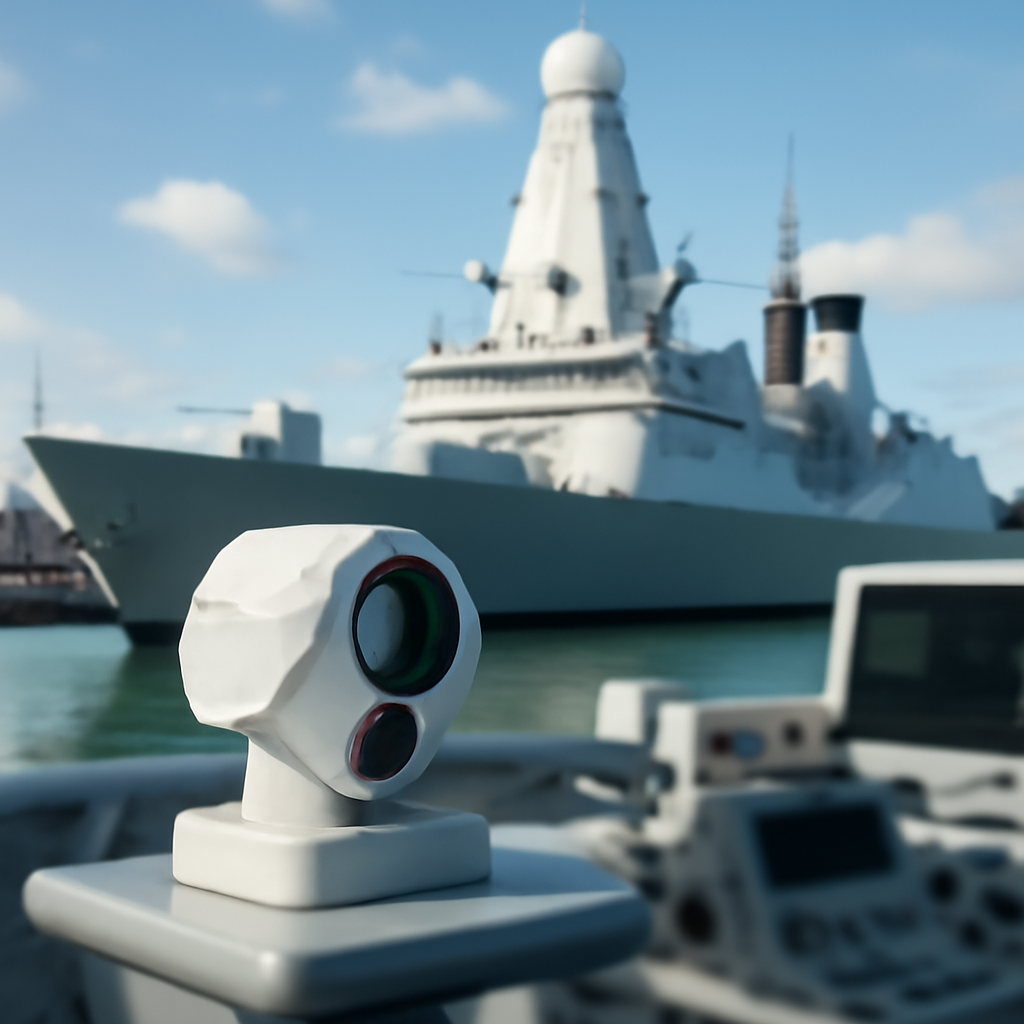
"The target of installing DragonFire on a Type 45 ship before the end of 2027 remains 'on track,'" James Anderson, Royal Navy account lead at QinetiQ, told trade media during a NATO Industrial Advisory Group industry day in Portsmouth.
QinetiQ, MBDA and Leonardo: miniaturizing the DragonFire beam
A three-way British industry collaboration is pushing to shrink the hardware that produces and directs the DragonFire high energy laser. QinetiQ, together with the UK divisions of MBDA and Leonardo, are running test and evaluation activities aimed at reducing the overall size of the laser system and understanding its through-life support, James Anderson said. Anderson described QinetiQ's work as exploring "the overall manufacture of the [laser] beam, trying to reduce the size further of the whole system … [and] understanding the through-life support of a system like this."
Leonardo's Graeme McNaught, campaign manager for EO, infrared and laser directed energy, said industry has not set a specific target for how small the beam director should be. McNaught emphasised that, for now, "Our main thrust right now is just to … get the weapon onto the Type 45," and that the programme has focused on securing ingress to protect the system from the high seas rather than on collapsing modularity.
Type 45 destroyer: deployment timeline and operational firsts
Industry officials reiterated a still-ambitious schedule: installing DragonFire on a Royal Navy Type 45 destroyer before the end of 2027. If achieved, the UK would become the first European NATO nation to deploy novel laser-directed energy technology operationally, the sources said. The remarks were made in the context of a NIAG industry day attended by the companies sharing progress and near-term priorities.

Audit-ready is a season. It shouldn't be.
Evidence in spreadsheets, controls drifting between audits, frameworks multiplying on flat headcount. Nubivance runs continuous compliance on Rapid7 Cyber GRC - SOC 2, HIPAA, ISO 27001, PCI, CMMC.
End the scrambleCost per shot, tactical envelope, and intended role against drones
DragonFire is being positioned as a short-range, line-of-sight counter-drone weapon. The system is explicitly designed to intercept Class 1 and Class 2 drones and, based on what industry calls its "pinpoint accuracy," could provide more precise targeting than kinetic weapons while reducing expenditure on conventional munitions.
Industry estimates place the cost at less than £10 per shot (noted as $13 in the reporting), framing the laser as an economical alternative to "fairly exquisite missiles" when countering swarms or multiple small incoming targets. McNaught described the weapon as a way to "deepen the reservoir" of a ship’s kinetic weapons inventory: by using directed energy more often, "the ship can stay and patrol for longer, because it’s not using up the stockpile [of other munitions] as fast," while DragonFire remains "part of a layered defense."
Engineering priorities: ingress protection, spiralling software, and deployability
With a tight schedule, industry has prioritised what McNaught called "minimum deployable decisions." That has included work to secure ingress—for example, protecting the beam director from the high seas—and progress on DragonFire's "spiralling" software, a term he used to describe software development staged in progressive capability releases. These steps were described as practical trade-offs: there is only so much that can be done in a tight timescale, so the immediate push is toward a deployable, protected system rather than maximal modularity or size reduction.
What this means for technologists, procurement leaders, and the Royal Navy
- Technologists and security teams should watch for engineering outcomes tied to miniaturisation and through-life support: QinetiQ is explicitly focused on how the beam is manufactured and supported over time, and Leonardo has signalled no fixed size goal for the beam director while prioritising sea-worthiness.
- Procurement leaders and programme managers will need to manage deployability trade-offs: industry has emphasised "minimum deployable decisions" and spiral software delivery as practical approaches to meet the 2027 installation target while balancing capability breadth and schedule.
- The Royal Navy, as the intended end user, will evaluate operational utility against logistical and environmental questions: Anderson noted that Western navies will want confidence in fielding such systems and better understanding of laser performance in "severe weather conditions."
Industry forecasts of broader demand for laser weapons remain conditional. Anderson said he expects demand to spike in the long term but noted that "we haven’t seen signs of it yet, because … no one’s actually demonstrated they can effectively field this in the battle space." That sentence frames the immediate challenge: converting controlled tests and protected, shipborne installations into the operational confidence that naval commanders will require.
For now, the programme is moving on a clear, public timetable: miniaturise where possible, harden the system for the sea, deliver spiralled software, and put DragonFire aboard a Type 45 before the end of 2027. Achieving those milestones will determine whether the UK becomes the first European NATO operator of this class of weapon and whether the modest per-shot cost can translate into meaningful force-multiplied endurance at sea.