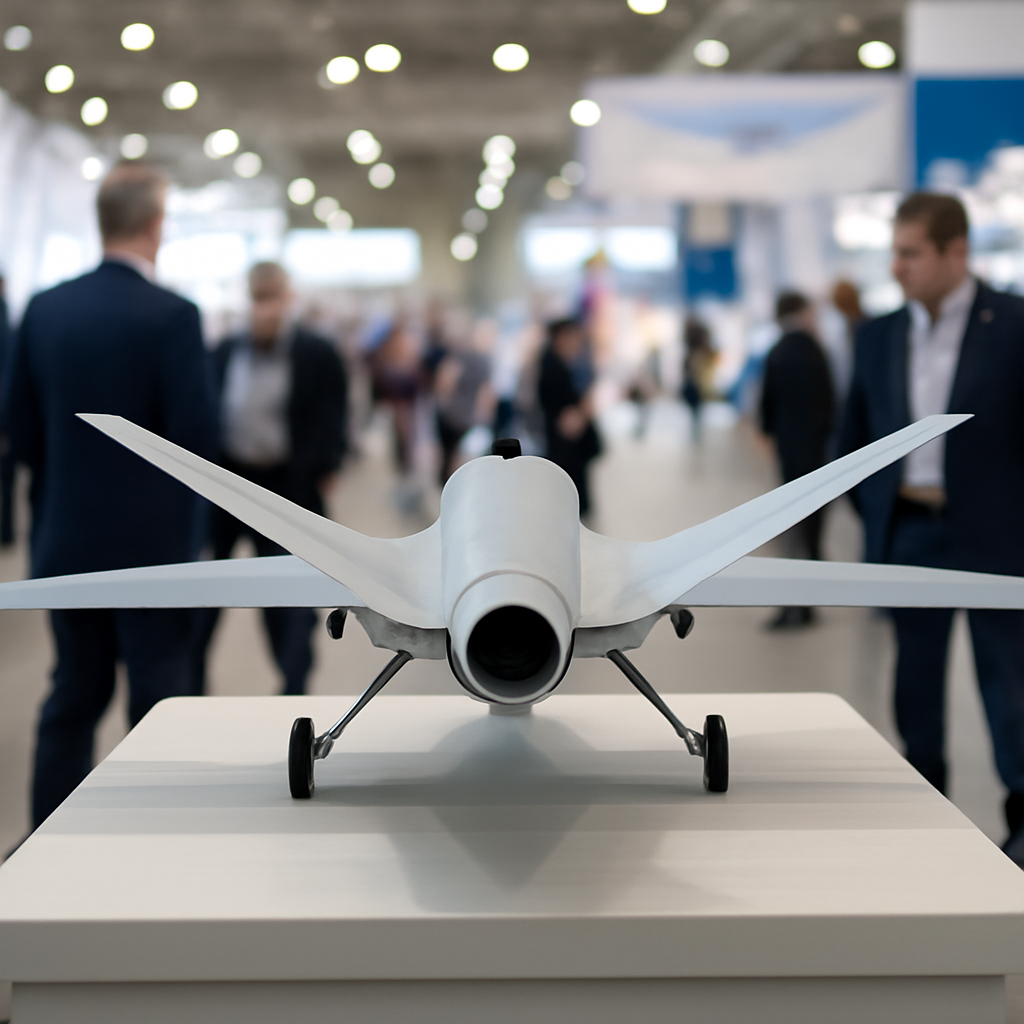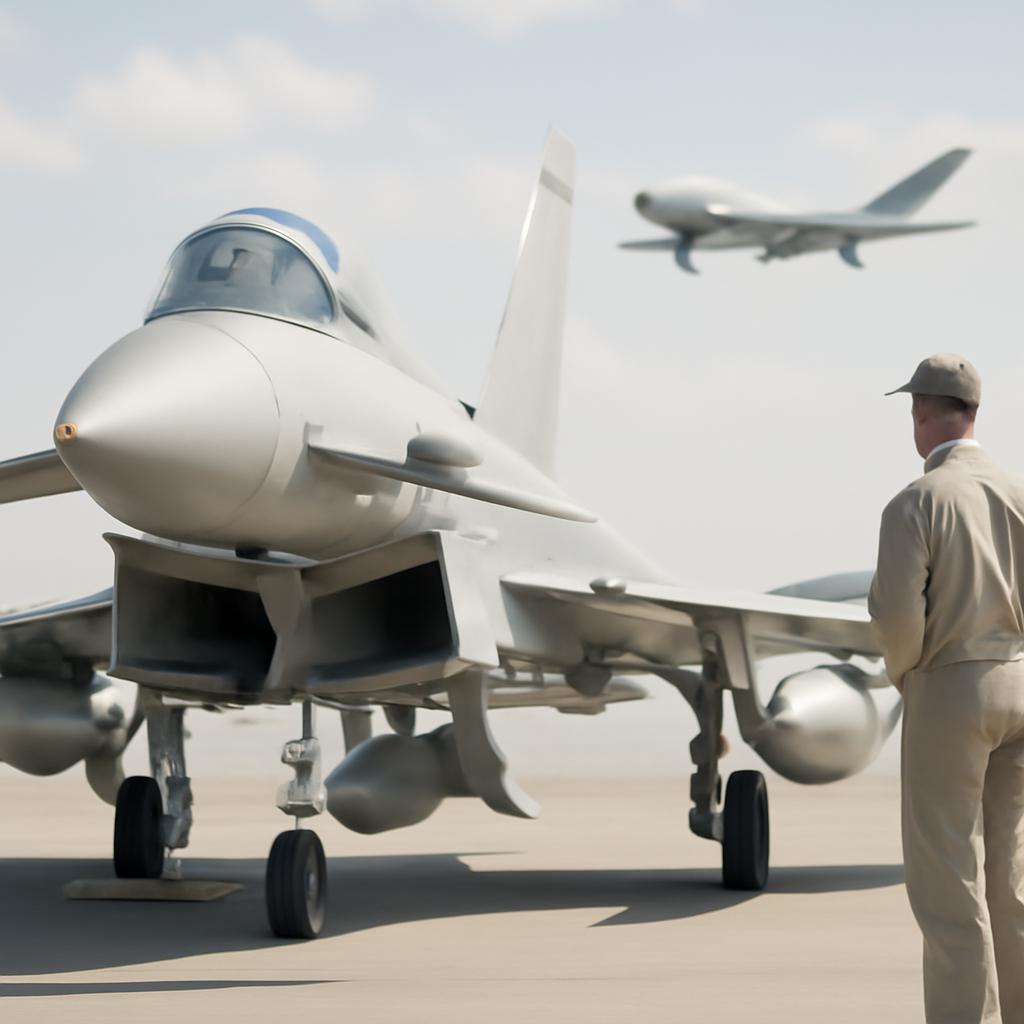
"Unsurprisingly, what we’re finding is that in the enlarged battlespace of the future, we’re able have a Typhoon — some people use the phrase ‘quarterback,’ choose what you will — with its extensive radar capabilities at range, and speed and agility, processing, to be able to work alongside collaborative combat aircraft and increase the combat mass that is needed from our air forces into the future, and the persistence and the range at which they’re able to reach, and bring more missiles into the fight," Chris Moon, Typhoon Future Capability Director at BAE Systems, told attendees at the Farnborough Air Show.
BAE Systems’ Typhoon/CCA concept and the LTE program
BAE Systems is actively concepting how the Eurofighter Typhoon could control uncrewed collaborative combat aircraft (CCA) to expand "combat mass" and extend reach and persistence. That work has accelerated over the previous 12 months and was presented at Farnborough just one week after the U.K. Royal Air Force launched a CCA program named Storm Fighter, which aims to produce a CCA able to fly into combat alongside the Typhoon, F-35, and Tempest.
These Typhoon/CCA capabilities are being pursued under a broader Long-Term Evolution (LTE) program that will bundle multiple enhancements — not only CCA integration but new cockpit and sensor suites meant to make teaming effective in operational settings. BAE says much of the experience from this Typhoon work will be ported to the future Tempest combat jet, which is being designed to work closely with drones from the outset.
ECRS Mk 2 radar, Large Area Display, and pilot workload
Three specific hardware and human‑machine elements anchor BAE’s concept: the European Common Radar System (ECRS) Mk 2, a new Large Area Display (LAD) cockpit, and the Striker II helmet‑mounted display. The ECRS Mk 2 uses an active electronically scanned array (AESA) on an articulated, swashplate repositioner that allows the antenna to swing to far greater angles off the centerline, widening the field of regard and boosting azimuth coverage. Eurofighter has claimed the repositionable array provides a field of regard "some 50 percent wider than traditional fixed‑plate systems."
The LAD replaces the Typhoon’s three‑multifunction displays with a single, top‑level screen where, according to Andrew ‘Blyty’ Mallery‑Blythe, Typhoon Operational Requirements Manager at BAE Systems, "everything is available" and the pilot can see friendly assets, CCAs, and stores at a glance. Reducing pilot workload is central: with the RAF having reduced two‑seat Typhoons and scrapped all Tranche 1 ‘T‑birds,’ BAE is prototyping simple HOTAS commands so a single pilot can send CCAs to carry out tasks without close‑control of each drone.

The cyber insurance questionnaire just landed. Now what?
SOC 2, HIPAA, insurance renewals - someone has to own security strategy. Nubivance provides fractional CISO leadership without the full-time salary.
Get a security leadWeapons, datalinks, and the aspiration to arm CCAs with Meteor
BAE’s concept demonstrations include CCAs employing air‑to‑air weapons — notably the ramjet‑powered Meteor missile that Typhoon also carries. The Meteor is described in the briefing as "among the longest‑ranged of any Western air‑to‑air missile" and is "generally considered to be able to engage certain types of targets out to around 130 miles." The missile uses a two‑way datalink that provides in‑flight updates and relays the missile’s fuel, energy, and tracking state back to the pilot in the launch aircraft.
BAE highlights how CCAs with their own sensors could pass data to the Typhoon and to an in‑flight Meteor regardless of which platform launched the missile, thereby increasing engagement range while allowing Typhoons to remain outside enemy engagement envelopes. The company also acknowledges that CCAs might ultimately carry different weapons, "including a successor to the Meteor that is now being developed."
Testing: simulation, synthetic trials, and datalink interoperability
BAE has tested many elements in a specially equipped Typhoon simulator. Moon and Blyty described scenarios — for example, a pair of Typhoons teamed with a four‑ship of CCAs off Scotland’s east coast — that extended range, coverage, and persistence; scenarios that could scale to include more Typhoons, CCAs, and F‑35Bs along the entire U.K. east coast.
In addition to internal simulation, BAE worked with QinetiQ on a synthetic trial that flew a Typhoon, a swarm of QinetiQ Banshee drones, and a Malloy Aeronautics T‑150 small heavy‑lift UAS using current operational military datalinks, including Link 16. These synthetic and simulated trials are being used to explore both tactical concepts and interoperability with extant datalink infrastructures.
What this means for the Royal Air Force, BAE Systems, and adversaries
- Royal Air Force: The RAF’s Storm Fighter program is the institutional pathway to field a CCA that can operate with Typhoon, F‑35, and Tempest; the RAF will need to integrate new operational concepts for kill boxes, delegated engagement authorities, and management of strategic versus tactical assets.
- BAE Systems: The company is investing in crewed‑uncrewed teaming capabilities now and plans to feed lessons into Tempest development — a strategic decision to carry prototype experience forward into a next‑generation platform.
- Potential adversaries: BAE frames CCAs as a forward, tactical extension of the fighter force that can be positioned "far closer to the threat" and take "a little bit more risk," while Typhoons act as more protected, strategic assets; that operational posture changes how engagements at extended ranges might be contested.
BAE’s presentations at Farnborough mapped a practical, incremental path from simulator demonstrations and synthetic trials to operational concepts where small, lower‑cost CCAs extend reach, pass sensor data, and potentially carry long‑range missiles like Meteor. The company is explicit that the work is still concepting — rapid prototyping to reduce pilot workload and mature autonomy will be necessary — but the direction is clear: crewed fighters acting as sensor‑rich quarterbacks that extend combat mass through uncrewed teammates, with lessons destined for the Tempest program.
Source: TWZ – Typhoons Paired With CCA Fighter Drones Armed With Meteor Missiles Eyed By UK